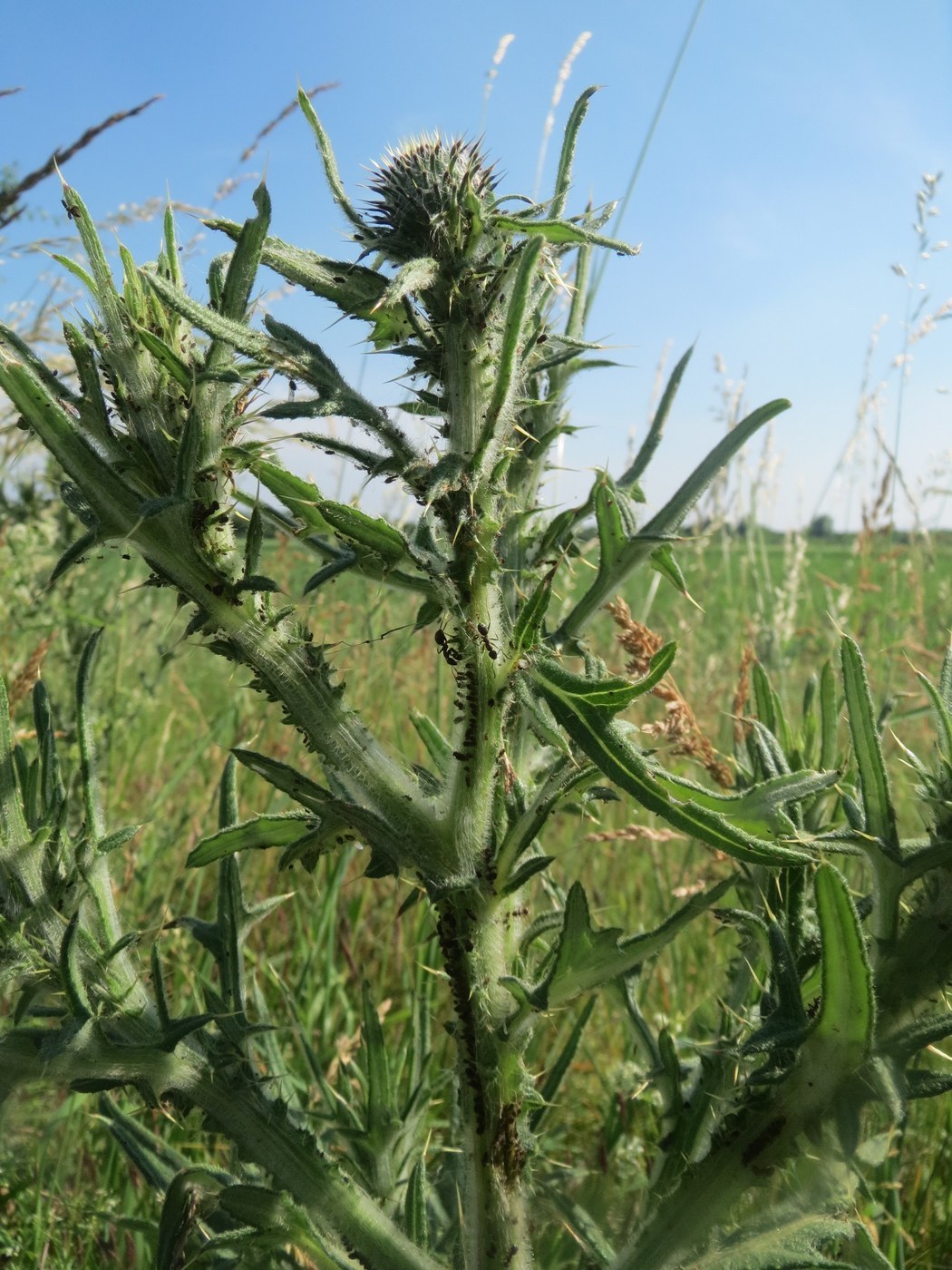
Bull Thistle
Cirsium vulgare
Bull thistle is a spiny biennial weed with sharp, prickly leaves and large rose-purple flower heads that is both a pasture nuisance and a pollinator magnet.
- Light
- Full sun
- Water
- Low to moderate; drought-tolerant
- Difficulty
- Easy
Got a plant like this?
Identify any plant from a photo, free.
Overview
Bull thistle (Cirsium vulgare) is a robust biennial weed recognized by its fiercely spiny foliage and showy purple flower heads. In its first year it forms a low rosette, and in its second year it bolts into a tall, branching flowering stalk before dying.
Native to Eurasia and North Africa, it has spread widely as a weed of pastures, roadsides, and disturbed land. While considered a noxious weed in many places, its flowers are highly attractive to bees and butterflies.
How to identify it
Unmistakable for its spines and large purple blooms.
- Leaves: Deeply lobed, coarse, with sharp spines on the margins and stiff, prickly hairs on the upper surface
- Stems: Erect, branched, with spiny wings running along them
- Flowers: Large, rose-purple flower heads (1-2 inches across) cupped by spiny, flask-shaped bracts
- Size: Up to 3-6 feet tall in its flowering year
- Seeds: Topped with feathery, off-white pappus for wind dispersal
Care & growing
Not cultivated; included for management.
- Light: Full sun
- Water: Drought-tolerant; thrives in dry, disturbed soils
- Soil: Adapts to most soils; common in overgrazed or disturbed ground
- Temperature: Hardy biennial across a broad climate range
- Control: Dig or cut the taproot below the crown before it flowers; mow or remove flower heads to prevent prolific wind-borne seed
- Life cycle: Biennial, flowering and dying in its second year
Habitat & origin
Bull thistle is native to Europe, western Asia, and North Africa but has naturalized across North America, Australia, and other temperate regions, where it is often listed as a noxious or invasive weed.
It colonizes pastures, roadsides, fields, clearcuts, and disturbed land, especially in sunny, open sites with bare soil.
Frequently asked questions
Is bull thistle native or invasive?
It is native to Europe, Asia, and North Africa, but in North America, Australia, and elsewhere it is an introduced, invasive weed and is legally noxious in some areas.
How do I get rid of bull thistle?
Because it is a biennial, cutting or digging the taproot below the crown before it flowers, and removing flower heads to stop seed production, is effective over a couple of seasons.
Is bull thistle good for pollinators?
Yes, its large purple flowers are rich in nectar and are very attractive to bees and butterflies, and its seeds feed finches.
Bull Thistle guides
In-depth guides for identifying, growing, and caring for Bull Thistle.
How to Care for Bull Thistle
A tough, sun-loving biennial thistle with spiny foliage and purple blooms; give it sun and lean soil and manage its vigorous self-seeding.
Bull Thistle Identification Guide
How to identify bull thistle (Cirsium vulgare) by its spiny winged stems, prickly deeply lobed leaves, and large purple flower heads with spine-tipped bracts.