
Butternut Squash Identification Guide
Identify butternut squash by its sprawling vine, large lobed leaves, yellow funnel flowers, and the unmistakable tan, bell- or pear-shaped fruit with a solid neck and orange flesh.
Read the full Butternut Squash encyclopedia entry →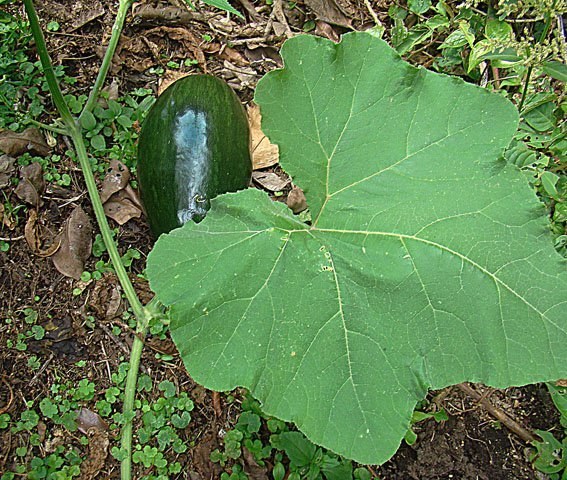
Key Identifying Features
Butternut squash (Cucurbita moschata) is a trailing warm-season annual vine in the gourd family (Cucurbitaceae). The standout feature is its fruit: a smooth, tan-to-buff, bell- or pear-shaped winter squash with a long solid neck and a bulbous seed-filled base, holding deep orange flesh. The vine itself is large and sprawling with big leaves and yellow flowers.
- Growth habit: long, sprawling/climbing vine, often 8–15 ft, running over the ground
- Signature: beige bottle/pear-shaped fruit with a solid neck
Leaves & Stems
Leaves are large (6–12 inches wide), broadly heart-shaped to shallowly 3–5 lobed, soft and slightly fuzzy-hairy, often with faint silvery-white mottling or flecks along the veins (a C. moschata trait). Stems are stout, ridged, hairy, and bear branched (forked) tendrils that grip supports. The vine roots can form where nodes touch soil.
Flowers & Fruit
Butternut is monoecious, with separate large golden-yellow to orange, funnel- or bell-shaped flowers about 3–4 inches across. Female flowers sit on a short stalk with a tiny squash-shaped ovary behind the petals; male flowers are on long slender stalks. The fruit is diagnostic: elongated, smooth-skinned, pale tan/buff, shaped like a bell, pear, or bottle — a long solid neck of flesh ending in a rounded bulb that contains the seed cavity. Flesh is dense and bright orange; the rind hardens at maturity to a matte tan. Unlike many squashes, the stem (peduncle) of C. moschata is hard, smoothly angled, and flares where it joins the fruit.
How to Tell It Apart from Look-Alikes
- Other winter squash (acorn, kabocha): acorn is ribbed and dark green; kabocha is squat, dark green and round — neck-and-bulb butternut shape is distinct.
- Pumpkins (C. pepo/maxima): round and orange/ribbed, with five-sided (pepo) or corky-round (maxima) stems; butternut is tan and bottle-shaped.
- Spaghetti squash: oval and yellow, but flesh shreds into strands and shape lacks the long neck.
- Gourds: hard and often warty; butternut is smooth and uniformly tan.
The tan bell/pear shape with solid neck + orange flesh + silvery-flecked lobed leaves confirms butternut.
Where You'll Find It
A popular winter squash grown in warm-season vegetable gardens and farms worldwide; it needs a long, warm season and full sun. Look for the sprawling vines in summer gardens and the stored tan fruits in fall and winter markets.
Quick ID Checklist
- Long sprawling vine with branched tendrils
- Large heart-shaped, softly lobed leaves, sometimes silvery-flecked
- Golden-yellow funnel/bell flowers, separate male and female
- Tan, smooth, bell/pear-shaped fruit with a solid neck and bulbous base
- Dense bright-orange flesh; hard, angled, flared stem
Frequently asked questions
What shape is a butternut squash?
Butternut squash is bell-, pear-, or bottle-shaped: a long, solid neck of orange flesh ending in a rounded, bulbous base that holds the seeds. The smooth skin is uniformly tan or buff when ripe.
How do I tell butternut from a pumpkin on the vine?
Pumpkins are round, ribbed, and usually orange with a hard five-sided or corky stem, while butternut is elongated, smooth, and tan with a flared, smoothly angled stem and a distinctive neck-and-bulb shape.
Why do butternut leaves have silvery spots?
Cucurbita moschata vines, including butternut, often show natural silvery-white mottling or flecks along the leaf veins. It's a normal feature, not a disease, and helps distinguish them.
How do I tell male from female butternut flowers?
Butternut is monoecious, bearing separate male and female flowers on the same vine. Female flowers have a tiny squash-shaped swelling (the ovary) behind the petals, while males sit on a plain long stalk with no swelling.