
Butternut Identification Guide
How to identify Butternut (Juglans cinerea), a native eastern walnut relative, by its compound leaves, sticky-hairy twigs, and football-shaped sticky nuts.
Read the full Butternut encyclopedia entry →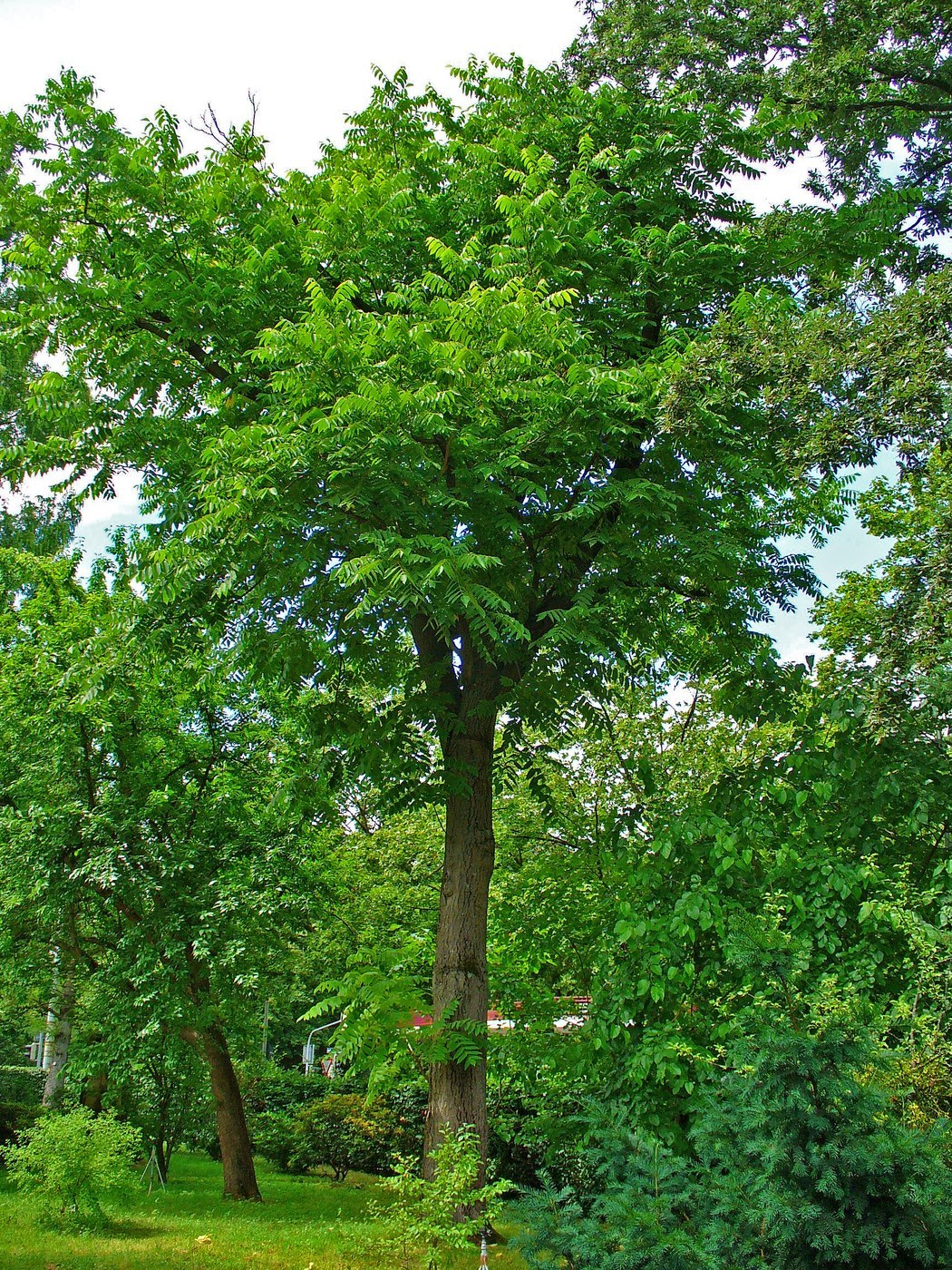
Key Identifying Features
Butternut (Juglans cinerea), also called white walnut, is a medium-sized tree of eastern North America reaching 40-60 feet. The most reliable diagnostic feature is the chambered pith inside the twigs: snap or cut a twig lengthwise and you'll see the central pith divided into chocolate-brown, ladder-like chambers separated by empty gaps. Combine this with a velvety, sticky-hairy pad of hairs along the upper edge of each leaf scar (the "mustache") and you have a near-certain ID.
- Light gray, smooth-then-ridged bark with flat-topped, silvery ridges
- Sticky-glandular hairs on twigs, leaf stalks, and the green husk
- Elongated, football- or lemon-shaped nuts (not round like black walnut)
Leaves & Stems
Leaves are pinnately compound, 15-30 inches long, with 11-17 leaflets arranged in pairs plus one terminal leaflet (note: a terminal leaflet is usually present, unlike black walnut where it is often absent or small). Each leaflet is 2-4 inches long, lance-shaped, finely toothed, and fuzzy underneath. Crushed foliage gives a spicy-resinous smell.
Twigs are stout, greenish-gray, and conspicuously sticky to the touch from glandular hairs. The leaf scars are large and three-lobed, topped by a downy fringe. Buds are pale and downy. The brown chambered pith is the clincher.
Flowers & Fruit
Butternut is wind-pollinated. In spring, drooping male catkins 2-5 inches long hang from last year's growth, while small greenish female flowers appear on new shoots. The fruit is the standout: a sticky, green, oblong husk covered in matted glandular hairs, enclosing a deeply ridged, sharply pointed nut. Nuts ripen in fall, often hanging in clusters of 2-5.
How to Tell It Apart from Look-Alikes
- Black walnut (Juglans nigra): has round nuts, dark furrowed bark, more leaflets (15-23) usually lacking a terminal leaflet, and a light tan to buff chambered pith. Butternut's pith is darker brown and its nuts are elongated.
- Hickories (Carya): have solid (not chambered) pith and fewer leaflets (5-9 typically); their husks split cleanly into segments.
- Tree-of-heaven / ash: lack chambered pith and lack the sticky leaf-scar fringe.
The sticky glandular hairs plus dark-chambered pith reliably separate butternut from all of these.
Where You'll Find It
Butternut grows in rich, moist, well-drained soils along streambanks, on slopes, and in mixed hardwood forests from New Brunswick and Quebec south through the Appalachians to Georgia and west to Minnesota. It tolerates more cold and prefers cooler sites than black walnut. Sadly, populations have crashed due to butternut canker (a fungal disease causing sunken, oozing black cankers on the trunk), so healthy trees are increasingly rare.
Quick ID Checklist
- Compound leaf with 11-17 fuzzy leaflets and a terminal leaflet
- Twigs sticky with glandular hairs; dark-brown chambered pith
- Downy fringe ("mustache") above each leaf scar
- Oblong, sticky, hairy husk; ridged, pointed nut
- Smooth gray bark with flat silvery ridges
- Moist, cool forest sites in eastern North America
Frequently asked questions
How can I tell butternut from black walnut?
Cut a twig: butternut has a dark chocolate-brown chambered pith, black walnut a pale tan one. Butternut nuts are oblong (football-shaped), black walnut nuts are round. Butternut also has lighter gray bark and a downy fringe above each leaf scar.
Why are butternut trees so hard to find now?
Butternut canker, an introduced fungal disease, has killed a large share of the population. Look for sunken black cankers with sooty margins on the trunk and branches of declining trees.
What does the chambered pith look like?
Split a twig lengthwise and you'll see the central core divided into small, dark-brown ladder-like compartments with hollow gaps between them, rather than a solid white center.