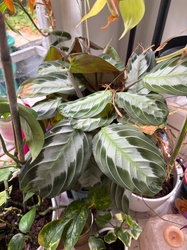
Calathea Medallion Identification Guide
Identify Calathea Medallion by its round, medallion-shaped leaves with feathered green patterning above and deep purple undersides, plus its nightly leaf-folding movement.
Read the full Calathea Medallion encyclopedia entry →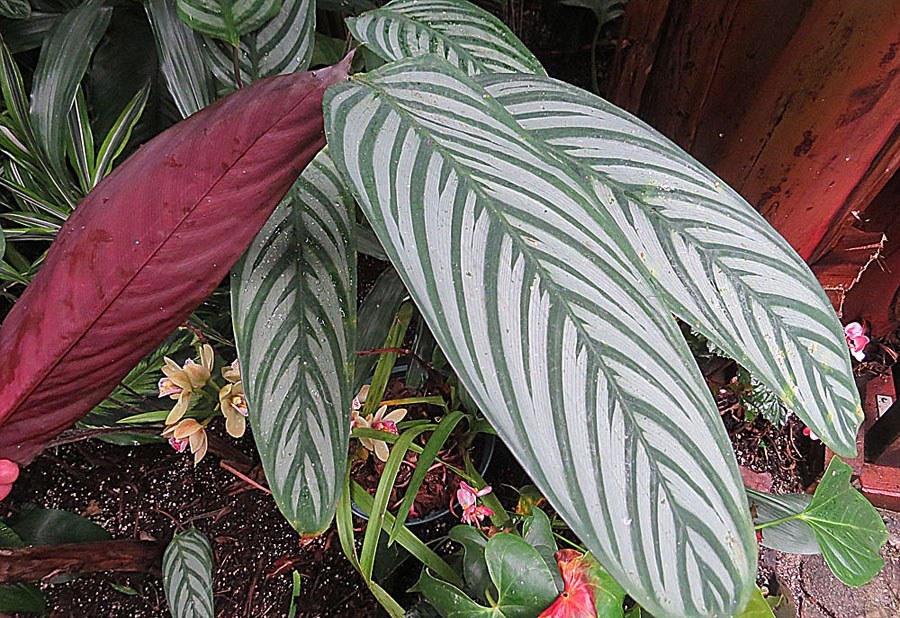
Key Identifying Features
Calathea Medallion (Goeppertia veitchiana 'Medallion', formerly Calathea veitchiana) is a compact prayer plant grown for its strikingly patterned, nearly circular leaves. The hallmark is a rounded, medallion-shaped blade with a feather/brushstroke pattern of dark and light green on top and a rich burgundy-purple underside.
- Leaves are broadly oval to almost round, like a medallion
- Upper surface shows a painted, feathered pattern in alternating light and dark green
- Undersides are a solid deep purple-maroon
- Leaves fold upward at night (nyctinasty) and reopen by day
Leaves & Stems
Each leaf can reach 6-10 inches long, held on a slender upright petiole that rises from the base of the plant. The top surface has a subtle velvety to satiny finish with concentric and feathered light-green markings radiating from the midrib, often outlined by a darker green band near the scalloped-looking margin. Turn the leaf over and the underside is uniformly wine-purple, a key separator from many other Calatheas.
The plant grows in a clumping rosette from underground rhizomes; there is no climbing or trailing stem. New leaves emerge tightly rolled, frequently showing purple before they unfurl.
Movement (Prayer Plant Behavior)
A living ID clue: in the evening the leaves raise and fold together like praying hands, then lower and flatten in the morning. You may even hear faint rustling as they move. This nyctinastic motion confirms it belongs to the Marantaceae (prayer plant) family.
Flowers & Fruit
Indoors it rarely flowers and is grown purely for foliage. Any blooms are small and insignificant compared to the leaves, so identification relies entirely on leaf shape, pattern, and underside color.
How to Tell It Apart from Look-Alikes
- Calathea roseopicta / 'Dottie' / 'Rosy': also round-leaved, but with a pink or rose central feathering and a more sharply defined inner ring; Medallion's pattern is greener and more brushstroke-like.
- Calathea orbifolia: much larger, silvery-and-green striped leaves with green undersides, not purple.
- Maranta (true prayer plant): smaller, low-spreading leaves with red herringbone veins, not the big rounded medallion shape.
- Stromanthe / Ctenanthe: more elongated, narrower leaves.
The pairing of a round leaf + feathered green top + purple underside is the reliable Medallion signature.
Where You'll Find It
Native to South American rainforest understory (Peru and surrounding regions), it thrives in warmth, high humidity, and bright indirect light. As a houseplant it is popular but fussy about dry air and tap-water minerals.
Quick ID Checklist
- Leaf shape is round/medallion, not elongated
- Top has a feathered light-and-dark green pattern
- Underside is solid deep purple-maroon
- Leaves fold up at night, open by day
- Grows as a clumping rosette, no vines
A round, painterly green leaf flashing purple as it moves through the day is almost certainly Calathea Medallion.
Frequently asked questions
Why do the leaves move up and down?
Calathea Medallion is a prayer plant. It exhibits nyctinasty, raising and folding its leaves at night and lowering them by day in response to light, driven by tiny swellings called pulvini at the base of each leaf.
How do I tell Medallion from Calathea roseopicta?
Both have round leaves, but roseopicta types usually show a pink or rosy central feathering and a crisp inner ring. Medallion's pattern is greener and more brushstroke-like, and its underside is solid purple.
Why are the leaf edges curling or browning?
This is usually an environmental stress sign rather than an ID trait. Calatheas are sensitive to low humidity, dry soil, and minerals or chlorine in tap water; filtered water and humidity help keep leaves flat and unblemished.
Calathea Medallion identified by the community
Recent Calathea Medallion specimens identified with Plant Identifier.