
Calathea Identification Guide
Identify Calathea (now largely Goeppertia) by its large, dramatically patterned leaves, colorful purple undersides, and gentle daily leaf movement.
Read the full Calathea encyclopedia entry →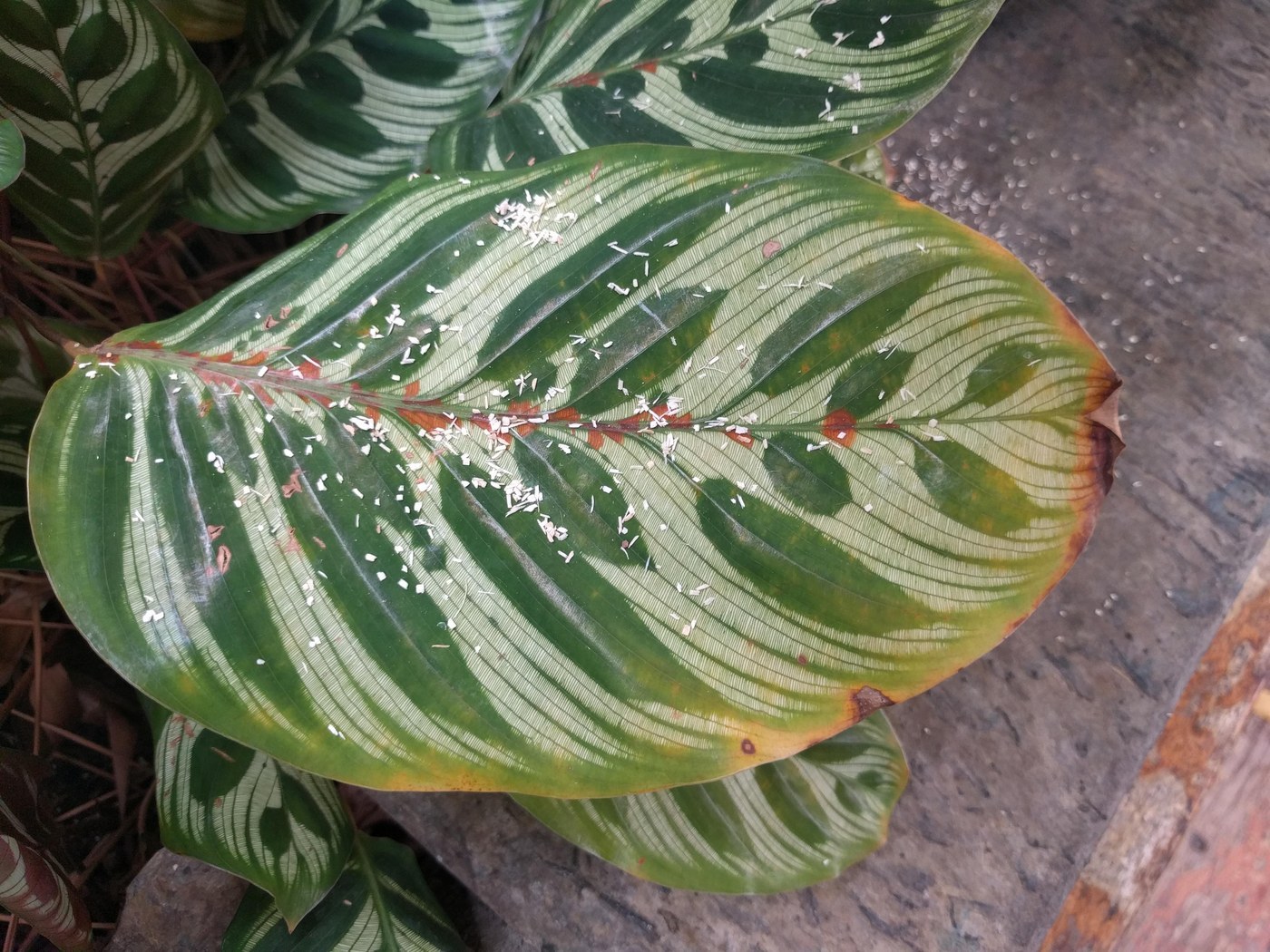
Key Identifying Features
Calathea (many species recently reclassified into the genus Goeppertia) is a group of tropical foliage plants grown for some of the most spectacular leaf patterning of any houseplant. Look for large, broadly oval leaves with intricate markings on top and often a rich purple-maroon underside.
- Big, upright-to-arching leaves on long stalks (petioles)
- Bold patterns: stripes, brushstrokes, fishbone, or "peacock" markings
- Purple or wine-red leaf undersides in many species
- Gentle nightly raising/lowering of leaves (prayer-plant movement)
Leaves & Stems
The leaves define the plant. Each grows on its own slender petiole rising from a clumping base. Patterns vary by species: Calathea orbifolia shows wide silver-green stripes on round leaves; C. makoyana (Peacock Plant) has translucent feather-like markings; C. lancifolia (Rattlesnake Plant) has wavy-edged lance leaves with alternating dark blotches; C. roseopicta has pink-to-cream haloed centers. Many have wavy or scalloped margins. A swollen joint (pulvinus) at the top of each petiole lets leaves move with the day cycle, often producing a soft rustling at dusk.
Flowers & Fruit
Most ornamental Calatheas rarely bloom indoors; their inflorescences are small and inconspicuous. One notable exception is Calathea crocata (Eternal Flame), grown for upright bright orange-yellow bracts. For most plants, treat flowering as rare and identify by foliage.
How to Tell It Apart from Look-Alikes
- Prayer Plant (Maranta): stays low and sprawling with small oval leaves; Calathea is taller and more upright with larger leaves.
- Stromanthe / Ctenanthe: close relatives; Stromanthe often has pink-and-cream variegation, Ctenanthe has long narrow leaves on branching stems. Calathea leaves tend to be broader with the strongest top-surface patterning.
- Aglaonema or Dieffenbachia: patterned but lack purple undersides and do not move at night.
- The combination of dramatic top patterning, purple undersides, and nightly movement points strongly to Calathea/Goeppertia.
Where You'll Find It
Native to the humid rainforests of South America, especially Brazil. As houseplants they demand high humidity, warmth, indirect light, and pure (distilled or rainwater) watering — crispy brown leaf edges are the classic sign of dry air or mineral-laden tap water.
Quick ID Checklist
- Large oval-to-lance leaves on long individual petioles
- Striking surface patterns (stripes, peacock, fishbone)
- Purple or maroon leaf undersides (most species)
- Leaves raise and lower with the day/night cycle
Frequently asked questions
Why are Calatheas now called Goeppertia?
Botanists reclassified most ornamental Calathea species into the genus Goeppertia based on DNA studies. The plants are unchanged, and 'Calathea' remains the common trade name.
How do I tell a Calathea from a Prayer Plant?
Calathea grows taller and more upright with larger leaves on long stalks, while the Prayer Plant (Maranta) stays low and sprawling with smaller oval leaves. Both move at night.
Why are the undersides of my Calathea purple?
Purple or maroon undersides are a natural pigment feature of many Calathea species, thought to help capture light in shady rainforest understories. It is a normal and useful ID trait.
Why do my Calathea leaf edges turn brown and crispy?
Crispy edges usually result from low humidity or minerals (fluoride, chlorine, salts) in tap water. Calatheas prefer high humidity and distilled or rainwater.