
Canary Creeper Identification Guide
Identify canary creeper (Tropaeolum peregrinum) by its lobed gray-green leaves and frilly, fringed canary-yellow flowers resembling tiny birds in flight.
Read the full Canary Creeper encyclopedia entry →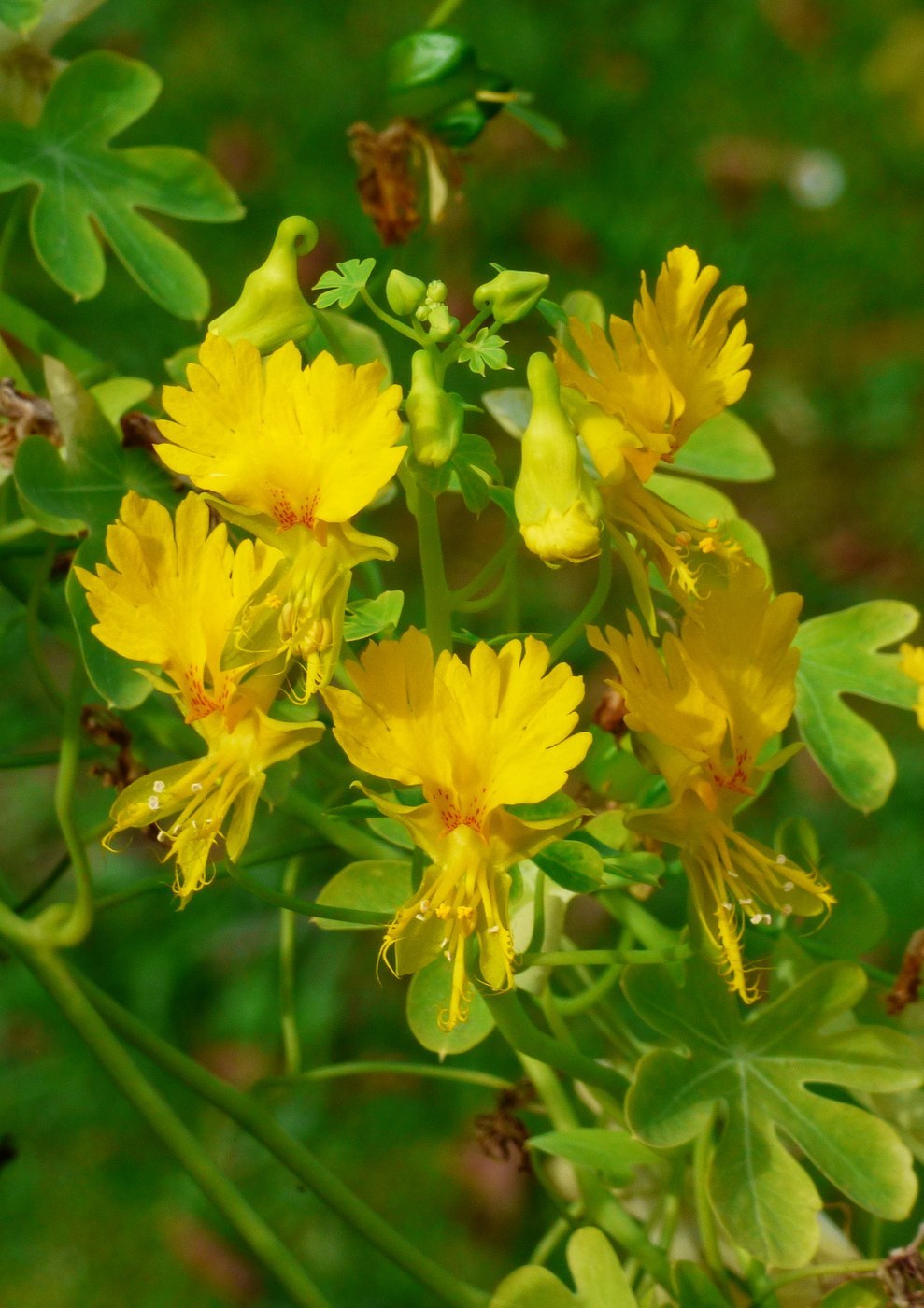
Key Identifying Features
Canary creeper (Tropaeolum peregrinum), also called canary-bird vine, is a delicate climbing annual related to nasturtium. Its charm lies in the bright canary-yellow flowers with deeply fringed upper petals that, with their spread 'wings' and tiny green spur, look like little birds in flight. The vine climbs daintily by twisting leaf stalks (petioles) to 6–12 feet, with airy gray-green, five-lobed leaves.
- Light, twining annual vine, 6–12 ft
- Frilly, fringed canary-yellow flowers like tiny birds
- Gray-green, five-lobed (hand-shaped) leaves
- Climbs by curling leaf stalks, not tendrils
Leaves & Stems
Leaves are alternate and palmately lobed into about five rounded lobes, giving a soft, bluish gray-green, almost ivy-like outline. They are smaller and more deeply cut than common nasturtium leaves. Stems are slender, smooth, and twining; the plant climbs by wrapping its leaf stalks around supports rather than using tendrils. The whole vine has a fine, lacy texture.
Flowers & Fruit
Flowers are small (about 1 inch), bright yellow, and irregular, with two large, deeply fringed (fanned) upper petals and three smaller lower petals, plus a short curved green spur behind. The fringed 'wings' and green spur create the bird-like silhouette. Bloom runs from summer to frost. Fruit is a small, ridged seed cluster typical of the nasturtium family.
How to Tell It Apart from Look-Alikes
- Common nasturtium (Tropaeolum majus) has round, shield-shaped leaves and larger, funnel-shaped orange/yellow/red flowers; canary creeper's leaves are lobed and its flowers small and fringed.
- Black-eyed Susan vine (Thunbergia) has flat five-petaled flowers with a dark eye, not fringed yellow 'wings.'
- The lobed gray-green leaves plus fringed bird-like yellow flowers are unmistakable.
Where You'll Find It
Native to western South America, canary creeper is grown as an ornamental annual on trellises, fences, and through shrubs in full sun to light shade with cool, moist roots. It is popular in cottage gardens for its airy habit and long bloom. It self-sows modestly where happy and is frost-tender.
Quick ID Checklist
- Slender twining vine, 6–12 ft
- Gray-green, five-lobed hand-shaped leaves
- Small fringed canary-yellow 'bird' flowers
- Climbs by curling leaf stalks
- Long summer-to-frost bloom, full sun to light shade
A dainty vine with bluish lobed leaves and fringed yellow flowers shaped like tiny birds is canary creeper.
Frequently asked questions
Why is it called canary creeper?
Its small, bright canary-yellow flowers have deeply fringed upper petals that look like the spread wings of a tiny bird in flight, hence the name canary-bird vine.
Is it related to nasturtium?
Yes, it is in the same genus (Tropaeolum), but it has lobed gray-green leaves and small fringed yellow flowers rather than the round leaves and large funnel flowers of common nasturtium.
How does canary creeper climb?
It climbs by twisting its leaf stalks around supports such as trellises and shrub branches, rather than using tendrils or twining stems.
What conditions does it like?
It prefers full sun to light shade with cool, moist roots and blooms from summer until frost, making it a favorite for cottage-garden trellises.