
Catmint Identification Guide
Identify catmint (Nepeta) by its soft gray-green aromatic foliage, square stems, and long, loose spikes of small lavender-blue flowers.
Read the full Catmint encyclopedia entry →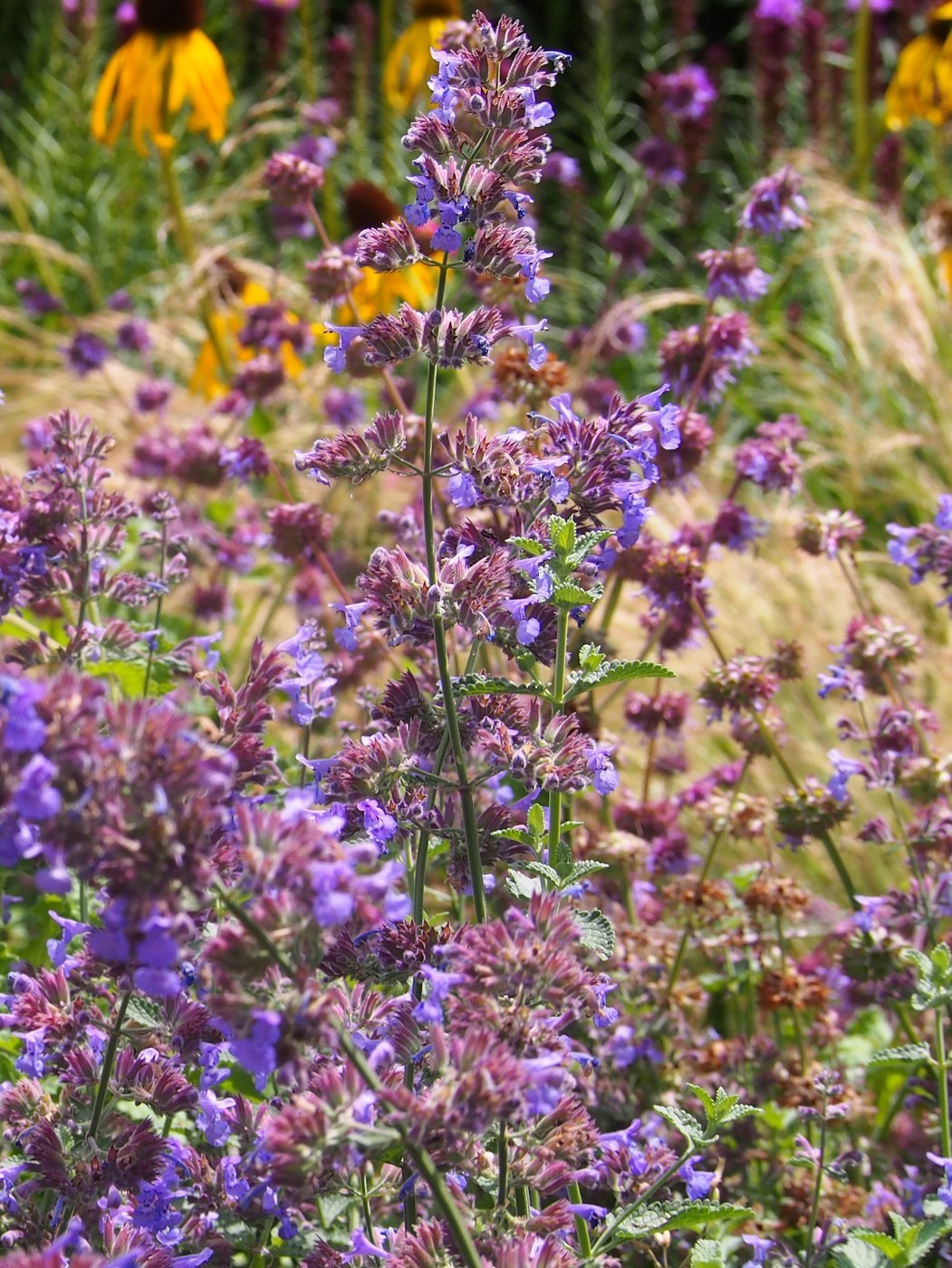
Key Identifying Features
Catmint (Nepeta) is a mint-family perennial that forms a soft, gray-green mound smothered in loose spikes of small lavender-blue flowers for much of the summer. It is a tidier, more refined relative of catnip.
- Foliage: small, gray-green, aromatic, soft-textured
- Stems: square, sprawling to upright
- Flowers: small two-lipped lavender-blue blooms in airy spikes
- Habit: rounded, billowing mound, 1-3 ft
Leaves & Stems
Leaves are opposite, small, gray-green to silvery, ovate to heart-shaped, with scalloped/toothed margins and a slightly fuzzy texture. The square stems mark the mint family. Crushed foliage is aromatic with a minty, slightly musky scent — true catnip (Nepeta cataria) is the form that excites cats, while ornamental catmints (like Nepeta × faassenii) are milder. Stems often sprawl outward to make a relaxed, billowing mound.
Flowers & Fruit
Flowers are small, tubular, two-lipped, in whorls forming long, interrupted spikes at the stem tips, in shades of lavender, violet-blue, and occasionally pink or white. Bloom is prolific and long; shearing after the first flush brings a rebloom. The flowers attract bees. Fruits are tiny nutlets in the persistent calyces.
How to Tell It Apart from Look-Alikes
- Russian sage: taller and airier with whiter stems and deeply cut leaves; catmint is lower, mounded, with toothed-but-not-dissected leaves.
- Lavender: narrow, untoothed leaves and dense flower spikes with a sweeter scent; catmint leaves are broader, toothed, and grayer.
- Salvia / true sages: stiffer upright flower spikes and broader leaves.
- Catnip (N. cataria): the wild, weedier cousin — taller, coarser, grayer-green with whiter flowers and stronger cat appeal.
The defining combo is soft gray-green aromatic mound + square stems + long loose spikes of small lavender-blue flowers.
Where You'll Find It
Catmint is a garden favorite for sunny borders, edging, and pollinator and xeric plantings, tolerating heat and drought. Catnip has naturalized along roadsides, fields, and waste ground across North America. Cats rolling on a plant is a memorable (if unscientific) ID hint.
Quick ID Checklist
- Soft gray-green, aromatic small leaves
- Square stems, sprawling mound
- Opposite, scalloped/toothed leaves
- Long, loose spikes of small lavender-blue two-lipped flowers
- Minty scent when crushed
- Sunny, dry-tolerant garden or roadside setting
Frequently asked questions
Is catmint the same as catnip?
They're close relatives in the genus Nepeta. Catnip (N. cataria) is the coarser, weedier species that strongly attracts cats, while ornamental catmints are tidier, more floriferous, and usually milder to cats.
How do I tell catmint from Russian sage?
Catmint is lower and mounded with small gray-green toothed leaves; Russian sage is taller and airier with whiter stems and deeply cut, dissected leaves. Both have square stems and blue flowers.
Why does my cat keep rolling in this plant?
It's likely catmint or catnip. The aromatic oils, especially in Nepeta cataria, trigger a playful response in many cats, which can itself help you identify the plant.
How is catmint different from lavender?
Lavender has narrow, smooth-edged leaves and dense, sweet-scented flower spikes, while catmint has broader, gray-green, scalloped leaves and looser, longer spikes of small lavender-blue flowers.