
Cauliflower Identification Guide
Identify cauliflower (Brassica oleracea var. botrytis) by its dense, smooth white curd of undeveloped flower tissue cradled in large blue-green leaves.
Read the full Cauliflower encyclopedia entry →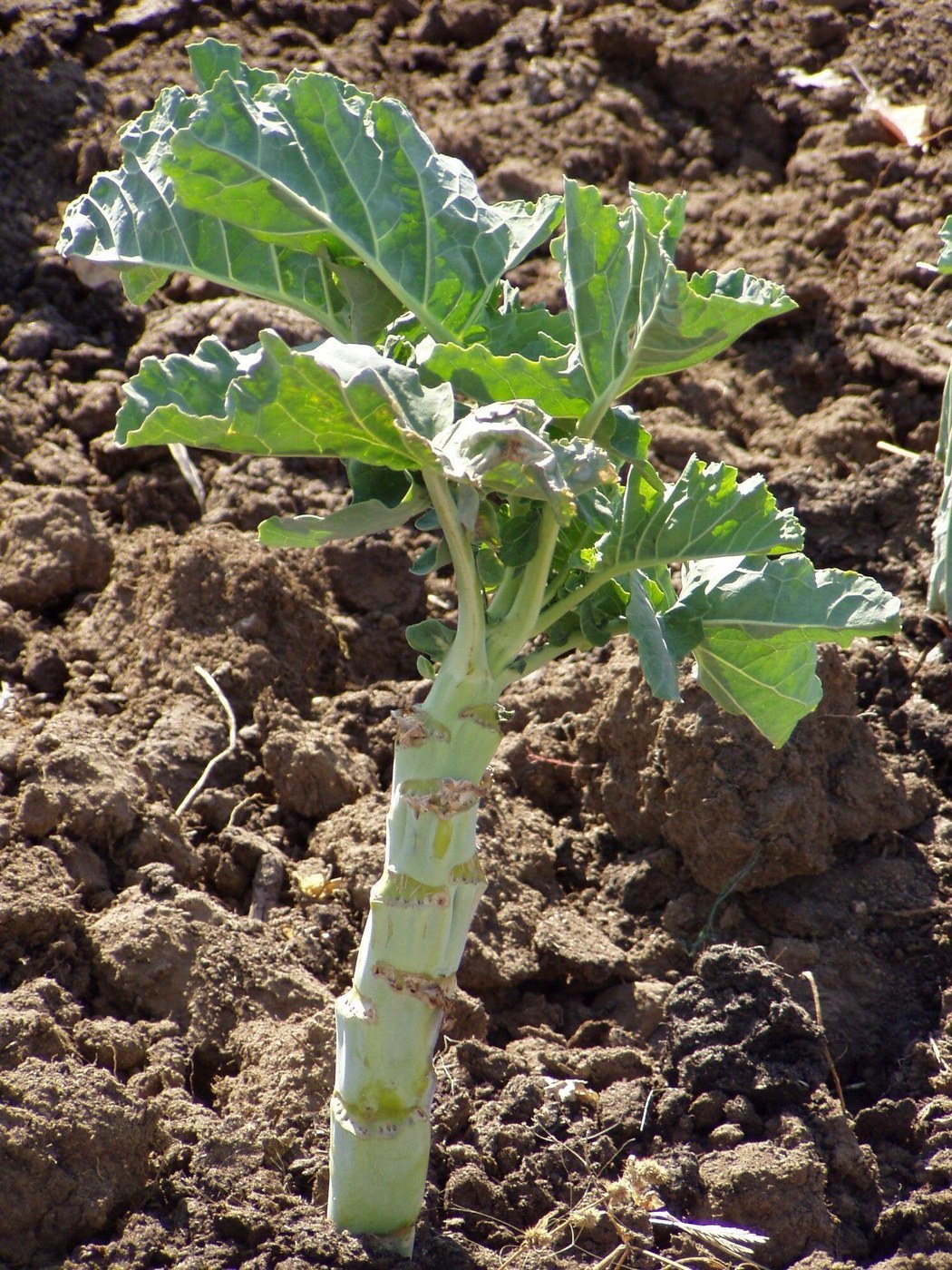
Key Identifying Features
Cauliflower (Brassica oleracea var. botrytis) is a cool-season member of the cabbage family (Brassicaceae). Its defining feature is the dense, compact "curd" — a tightly packed dome of undeveloped white flower tissue — sitting at the center of a rosette of large, waxy blue-green leaves on a thick stalk. Curds may also be orange, purple, or green in modern varieties.
Leaves & Stems
- A stout central stalk supports a rosette of large, oblong, blue-green leaves with a waxy bloom and pale midribs.
- Leaves typically wrap up and over the developing curd (self-blanching), which keeps white types pale.
- The plant resembles broccoli and cabbage in leaf and stalk.
Flowers & Fruit (the Curd)
- The curd is a mass of arrested flower buds on short, fleshy, crowded stalks — smooth, hard, and granular-surfaced rather than showing distinct buds.
- White is most common; orange, purple, and lime-green Romanesco (spiraled fractal cones) are variants.
- If left to mature, the curd "ricing" loosens and bolts into normal yellow four-petaled brassica flowers, then seed pods.
How to Tell It Apart from Look-Alikes
- Broccoli (B. oleracea var. italica): the closest look-alike, but broccoli's head is green with clearly visible individual flower buds, while cauliflower's curd is dense, smooth, and usually white with no distinct buds.
- Romanesco: technically a cauliflower/broccoli type with lime-green pointed spiral cones.
- Cabbage: forms a solid leafy head, not a flower-bud curd.
- Kale/collards: open leafy rosettes with no head or curd.
Where You'll Find It
Cauliflower is a cool-season garden and field crop that demands steady cool temperatures and rich, moist soil; heat or stress causes loose, riced, or buttoned curds. It's grown in spring and fall beds and rows. Look for a single firm, pale dome nested among broad blue-green leaves.
Quick ID Checklist
- Dense, smooth, compact curd (white, orange, purple, or green)
- No visible individual flower buds (unlike broccoli)
- Large waxy blue-green leaves wrapping the head
- Thick central stalk
- Cabbage-family smell when cut
- Yellow four-petaled flowers if it bolts
Frequently asked questions
How do I tell cauliflower from broccoli?
Look at the head: cauliflower forms a dense, smooth curd, usually white, with no visible buds, while broccoli is green with clearly distinct flower buds. Their leaves and stalks are otherwise very similar.
Why is my cauliflower head loose and grainy instead of tight?
Loose, riced, or fuzzy curds result from heat or stress causing the flower buds to begin developing. A truly maturing curd will eventually open into yellow four-petaled flowers.
Are orange and purple cauliflowers natural?
Yes. Orange cauliflower carries extra carotene pigment and purple gets its color from anthocyanins; both are the same species and variety as white cauliflower, just differently pigmented.
Is Romanesco a cauliflower or a broccoli?
Romanesco belongs to the same species and is closely related to both. It is recognized by its striking lime-green, pointed, spiraling fractal cones rather than a smooth white dome.