
Cedar of Lebanon Identification Guide
Identify the Cedar of Lebanon (Cedrus libani) by its majestic flat-topped crown, broad horizontal tiers of branches, dark green needles in spur rosettes, and upright barrel cones.
Read the full Cedar of Lebanon encyclopedia entry →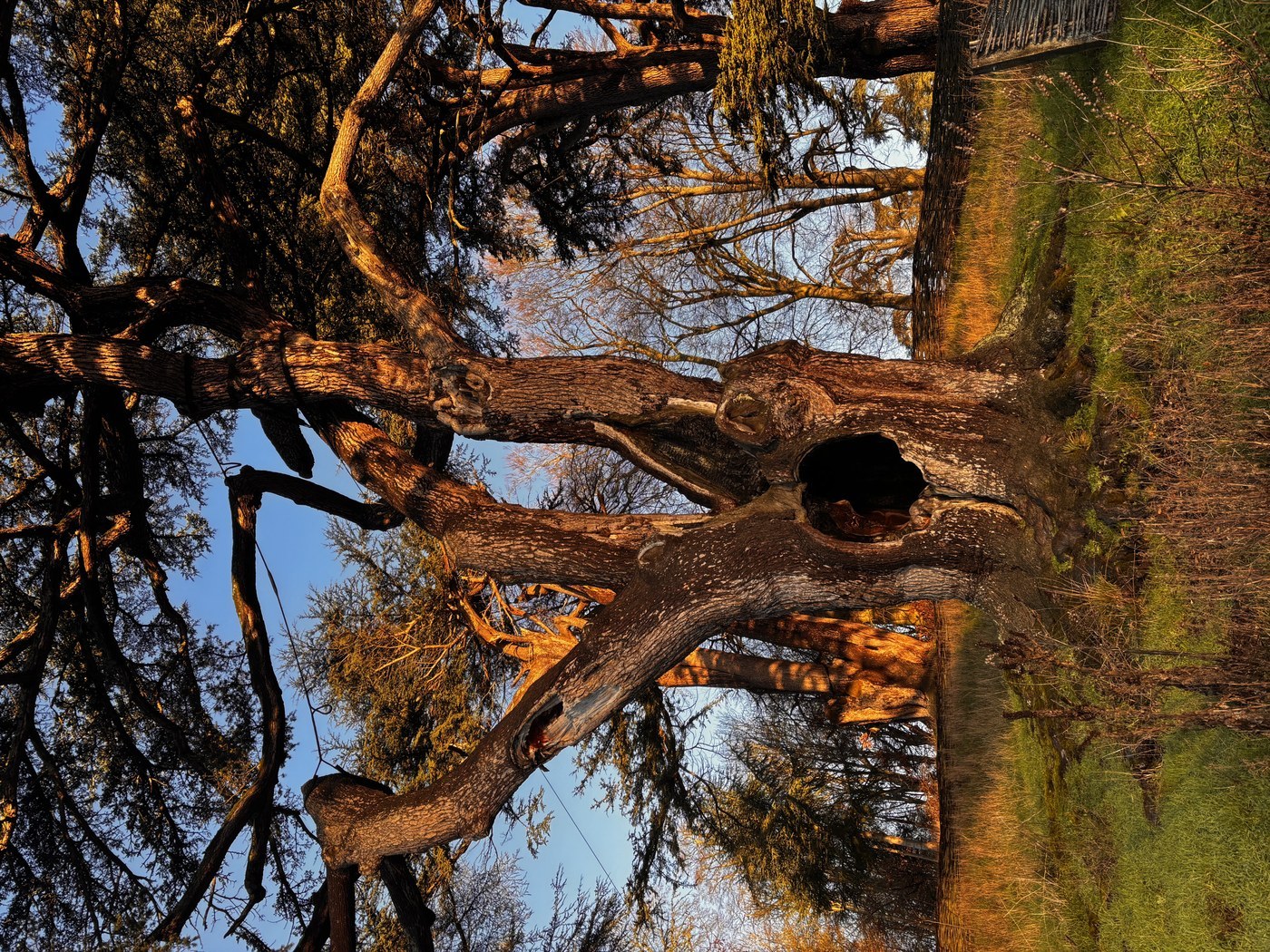
Key Identifying Features
The Cedar of Lebanon (Cedrus libani) is a massive, long-lived true cedar and the famous biblical tree of the Middle East. Mature specimens are unmistakable: a huge trunk dividing into several massive limbs that hold the foliage in broad, flat, horizontal tiers (layers), producing a distinctively flat-topped, table-like crown. It grows 40-80 ft tall and even wider, with a stately, architectural silhouette.
- Form: flat-topped, with broad horizontal tiered "plateaus" of foliage
- Trunk: massive, often dividing into several large ascending stems
- Color: dark green to gray-green
Leaves & Stems
Needles follow the cedar pattern: singly on long new shoots and in dense rosette clusters of 10-20 (up to 45) needles on short woody spurs along older branches. They are short, about 3/4 to 1 1/4 inch, stiff, and dark green to gray-green (typically darker/greener than the often-blue atlas cedar). The horizontal layering of the branches, combined with these rosettes, gives the foliage its characteristic flat, shelving appearance. Bark is dark gray-brown, fissured into ridges.
Flowers & Fruit
Seed cones are large, upright, barrel-shaped, 3 to 5 inches long, with a slightly flattened or dimpled top, sitting erect on the branches, ripening from purple-green to brown. As with all true cedars, the cones disintegrate on the tree, shedding scales and leaving a central spike, so whole cones are rarely found beneath the tree. Male cones are erect and finger-like, releasing pollen in autumn.
How to Tell It Apart from Look-Alikes
- Atlas cedar (Cedrus atlantica): more conical and stiffly ascending (especially the silver-blue 'Glauca'), with shorter needles; it does not develop the dramatic flat-topped tiered crown as readily.
- Deodar cedar (Cedrus deodara): longer, softer needles and drooping branch tips with a nodding leader - graceful and weeping rather than flat and horizontal.
- Pines/larches: pines have needles in bundles of 2-5; larches share rosettes but are deciduous.
The flat-topped horizontally tiered crown + short dark-green needles in spur rosettes + large upright barrel cones that disintegrate on the tree confirm cedar of Lebanon (especially in mature specimens).
Where You'll Find It
Native to the mountains of Lebanon, Syria and Turkey, it is planted as a grand specimen tree in large parks, estates and arboreta in temperate climates. Young trees are conical; the iconic flat-topped, layered form develops only with age, so mature trees are the easiest to recognize.
Quick ID Checklist
- Mature crown flat-topped with broad horizontal tiers of foliage
- Massive trunk often splitting into several big ascending limbs
- Short, stiff, dark green needles in rosette clusters on spurs
- Large upright barrel cones 3-5 in that fall apart on the tree
- Stately, architectural silhouette in parks and estates
Frequently asked questions
What's the most recognizable feature of cedar of Lebanon?
Its mature crown: a flat-topped, table-like silhouette with foliage held in broad, horizontal tiers on massive limbs. This layered, plateau-like form is distinctive among the true cedars.
How do I tell it from atlas cedar?
Cedar of Lebanon develops a flat-topped, horizontally tiered crown with dark green needles, while atlas cedar stays more conical with stiffly ascending branches and is often silver-blue ('Glauca').
Why don't whole cones drop from it?
Like all true cedars, its upright barrel-shaped cones disintegrate while still on the branch, scattering winged seeds and leaving a bare central spike behind.
Do young trees look the same?
No. Young cedar of Lebanon is narrowly conical and resembles other cedars; the famous flat-topped, tiered shape only develops as the tree matures over many decades.