
Cheatgrass Identification Guide
Identify cheatgrass (Bromus tectorum), a soft-hairy winter annual grass that turns reddish-purple as its drooping, awned seedheads ripen. Covers its hairy leaves, nodding panicle, and fire-prone dried stands.
Read the full Cheatgrass encyclopedia entry →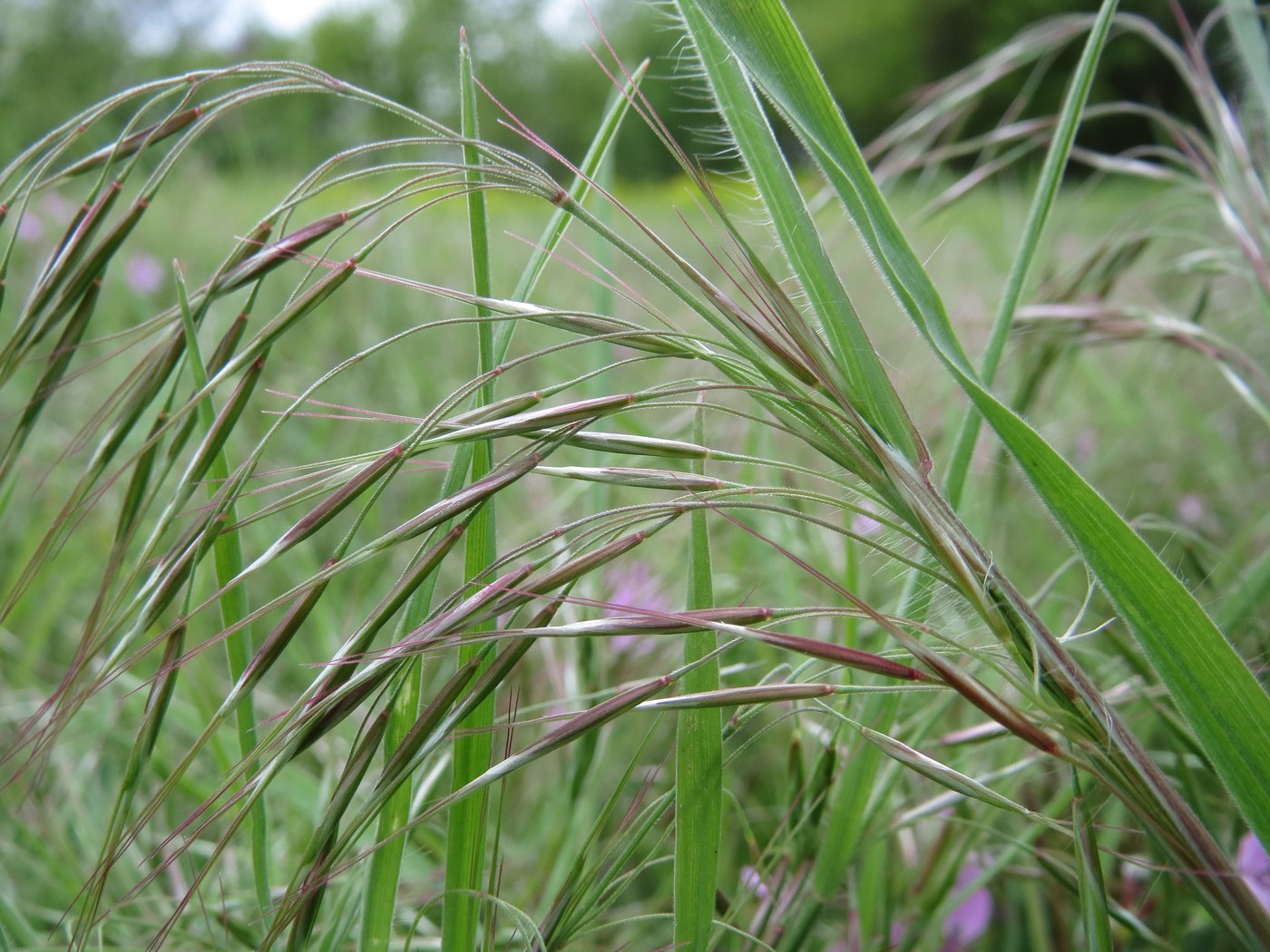
Key Identifying Features
Cheatgrass (Bromus tectorum), also called downy brome, is a winter annual grass that germinates in fall, stays green and low through winter, then bolts and matures by early summer. Its most memorable trait is the soft, drooping, one-sided seedhead that turns purple-red, then straw-tan as it dries, often coloring whole hillsides. The plant is softly hairy throughout.
- Soft-hairy (downy) leaves and sheaths
- Nodding, slender, often one-sided panicle with long awns
- Distinct reddish-purple to tan color at maturity
- Winter annual, only 6 to 24 inches tall
- Dries early, leaving flammable straw
Leaves & Stems
The leaf blades are narrow, flat, and covered with fine soft hairs, giving a velvety, downy feel, hence "downy brome." The leaf sheaths are likewise hairy, especially on young growth. There is a short membranous ligule. Stems are slender and weak. As a brome, it has closed leaf sheaths (fused most of their length), a useful technical clue if you split a sheath open. Early in the season plants are bright green and grassy; by late spring they begin reddening.
Flowers & Fruit
The inflorescence is a slender, soft, drooping panicle with branches that tend to hang to one side. Each spikelet is narrow and bears long, straight awns (roughly half an inch) that point outward, giving the head a feathery, bristly look. At maturity the whole seedhead and stem flush rosy purple to reddish brown, then bleach to a pale straw color. The sharp-pointed seeds detach readily and cling to socks, fur, and clothing. Flowering and seed set occur in late spring to early summer.
How to Tell It Apart from Look-Alikes
- Other bromes (Bromus spp.): Most are larger or perennial; cheatgrass is small, downy, and matures earliest, with strongly nodding, one-sided, purple-tinged heads.
- Foxtail barley: Has dense, bushy, silky spikes rather than an open drooping panicle.
- Rattlesnake brome / ripgut brome: Have much longer, stiffer awns and coarser seeds.
The trio of downy hairs, a nodding soft purple seedhead, and very early summer maturity reliably points to cheatgrass.
Where You'll Find It
Cheatgrass dominates dry, disturbed, sunny rangeland across the western United States and beyond: overgrazed pastures, roadsides, burned areas, croplands, and sagebrush steppe. It thrives on poor soils and exploits autumn moisture to outcompete native plants. Because it cures into fine, dry fuel by early summer, dense cheatgrass stands greatly increase wildfire frequency and spread.
Quick ID Checklist
- Small winter annual grass, 6 to 24 in
- Soft, downy hairs on leaves and sheaths
- Nodding, one-sided panicle with long awns
- Turns purple-red then straw-tan at maturity
- Closed (fused) leaf sheaths
- Dry, disturbed western rangeland; matures very early
Frequently asked questions
Why does cheatgrass turn purple-red?
As the winter annual matures and dries in late spring, its seedheads and stems naturally flush rosy purple to reddish brown before bleaching to straw color. This seasonal color shift is a strong field clue.
Why is cheatgrass a wildfire concern?
It cures into fine, dry, continuous fuel by early summer, far earlier than native plants, which lengthens the fire season and helps fires spread rapidly across rangeland.
How do I distinguish cheatgrass from other brome grasses?
Cheatgrass is small, softly downy, and matures earliest, with a distinctly nodding, often one-sided, purple-tinged seedhead and long straight awns. Most other bromes are larger or perennial.
Why do its seeds stick to my socks and pets?
The mature seeds have sharp points and long awns that readily detach and lodge in fabric and fur, which is how the plant spreads and can also injure animals.