
Cherimoya Tree Identification Guide
Identify the cherimoya (Annona cherimola) by its drooping velvety leaves, fragrant three-petaled flowers, and large heart-shaped fruit with scaly, thumbprint-marked green skin.
Read the full Cherimoya Tree encyclopedia entry →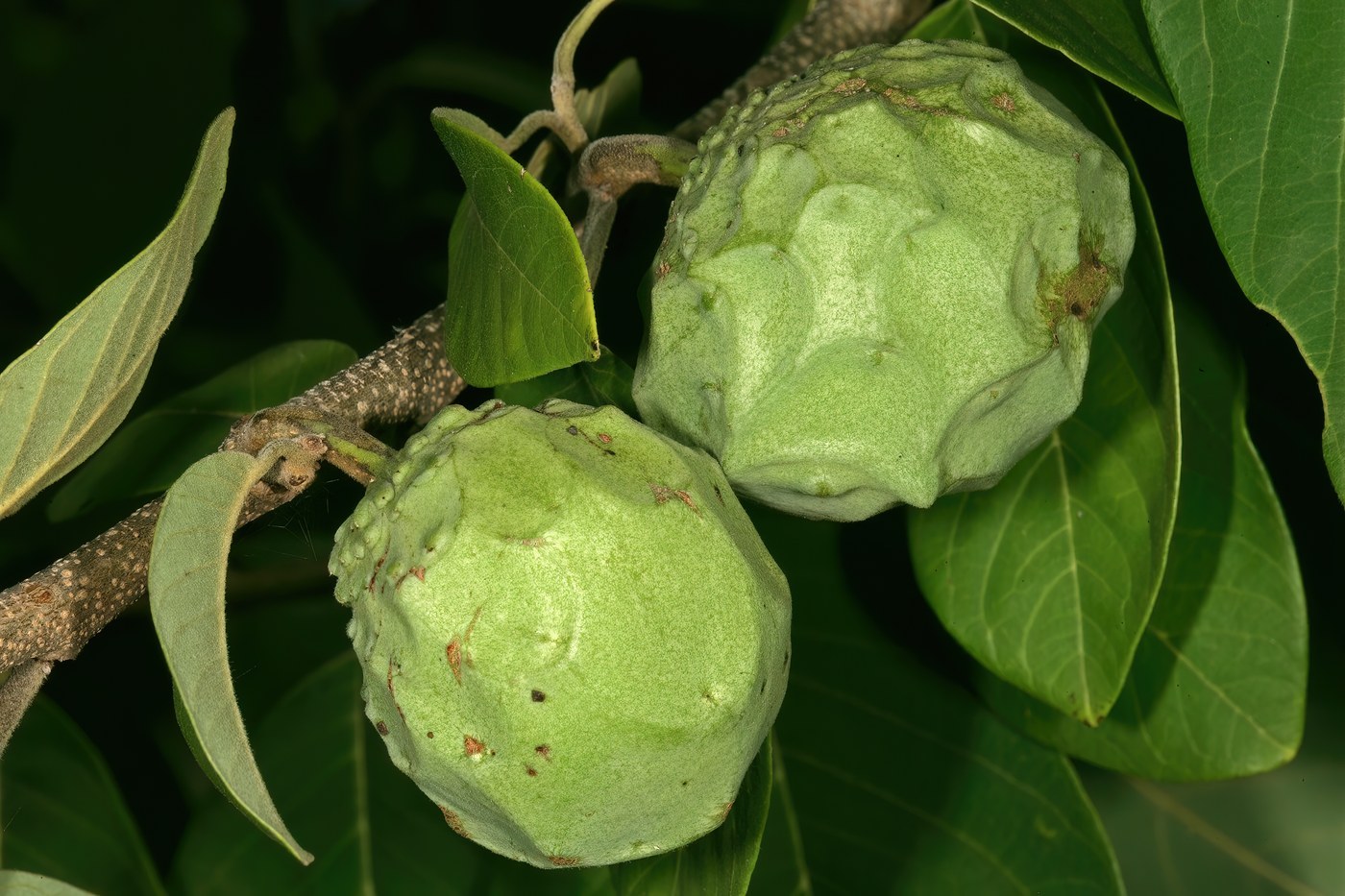
Key Identifying Features
The cherimoya (Annona cherimola) is a small, semi-deciduous subtropical tree, usually 15–30 feet tall, with a low, spreading, somewhat irregular crown. The standout traits are softly velvety-hairy young growth, large heart-shaped fruit with a green, scaly or thumbprint-dimpled skin, and unusual fleshy flowers with three thick outer petals.
- Dull green leaves that feel velvety underneath
- Conical to heart-shaped green fruit 4–8 inches long with raised polygonal areoles
- Faint sweet fragrance from the flowers, especially in evening
Leaves & Stems
Leaves are alternate, simple, and arranged in two ranks along the twig, measuring 2–6 inches long. They are dull medium-green and smooth above but distinctly soft and velvety (tomentose) on the underside, where fine hairs catch the light. The leaf shape is ovate to elliptical with a slightly drooping habit. In Mediterranean and subtropical climates the tree drops its leaves briefly before flowering. Young twigs are also hairy; bark on the trunk is grayish and smooth to slightly fissured.
Flowers & Fruit
Flowers are solitary or in small clusters, about 1 inch long, fleshy, and yellowish-green to brownish. Each has three long, thick, fingerlike outer petals and three tiny inner ones. They are protogynous (female-then-male), which is why hand-pollination is often used. The fruit is the diagnostic feature: a heart-shaped or conical compound fruit 4–8 inches long, weighing up to 1–2 pounds, with pale green skin marked by raised areoles that look like fingerprints, scales, or U-shaped lines depending on the variety. Inside is creamy white flesh studded with hard black-brown seeds.
How to Tell It Apart from Look-Alikes
- Sugar apple / sweetsop (Annona squamosa) has fruit that breaks into distinct rounded segments and a more shrubby form; cherimoya's skin is smoother and more continuous.
- Soursop (Annona muricata) has soft spines on the fruit and large glossy leaves, unlike cherimoya's smooth velvety leaves.
- Atemoya (a cherimoya × sugar apple hybrid) is intermediate; its skin areoles are more pronounced and pointed.
The combination of velvety leaf undersides, three-petaled fleshy flowers, and smooth scaly green heart-shaped fruit distinguishes true cherimoya.
Where You'll Find It
Cherimoya thrives in subtropical highlands and mild Mediterranean climates—it dislikes both hard frost and intense tropical heat. Native to the Andean valleys of Ecuador, Peru, and Colombia, it is now grown in Spain, Chile, California, and other cool-subtropical regions. Look for it in orchards and home gardens at moderate elevations, often where the climate suits citrus and avocado.
Quick ID Checklist
- Small spreading tree, briefly leafless before bloom
- Leaves velvety on the underside, two-ranked
- Fleshy flowers with three thick outer petals
- Heart-shaped green fruit with raised fingerprint-like areoles
- Creamy white flesh with black seeds
- Subtropical / mild upland climate
Frequently asked questions
How do I distinguish cherimoya from sugar apple?
Cherimoya fruit has smoother, more continuous green skin with shallow fingerprint-like markings, while sugar apple breaks into distinct knobby segments. Cherimoya leaves are also velvety beneath and the tree is a true tree rather than a shrub.
Why does my cherimoya tree drop its leaves?
Cherimoya is semi-deciduous and naturally sheds leaves for a short period before flowering in spring. This is normal and not a sign of disease.
What do cherimoya flowers look like?
They are small, fleshy, yellowish-green flowers with three long thick outer petals. They open female first then male, which is why growers often hand-pollinate.
How big does the cherimoya fruit get?
The heart-shaped or conical compound fruit is usually 4 to 8 inches long and can weigh up to 1 to 2 pounds, with pale green skin marked by raised fingerprint-like areoles.