
Cherry Tree Identification Guide
Identify cherry trees (Prunus species) by their glossy reddish-brown bark with horizontal lenticels, toothed oval leaves with nectar glands, clustered white-pink blossoms, and small round stone fruit.
Read the full Cherry Tree encyclopedia entry →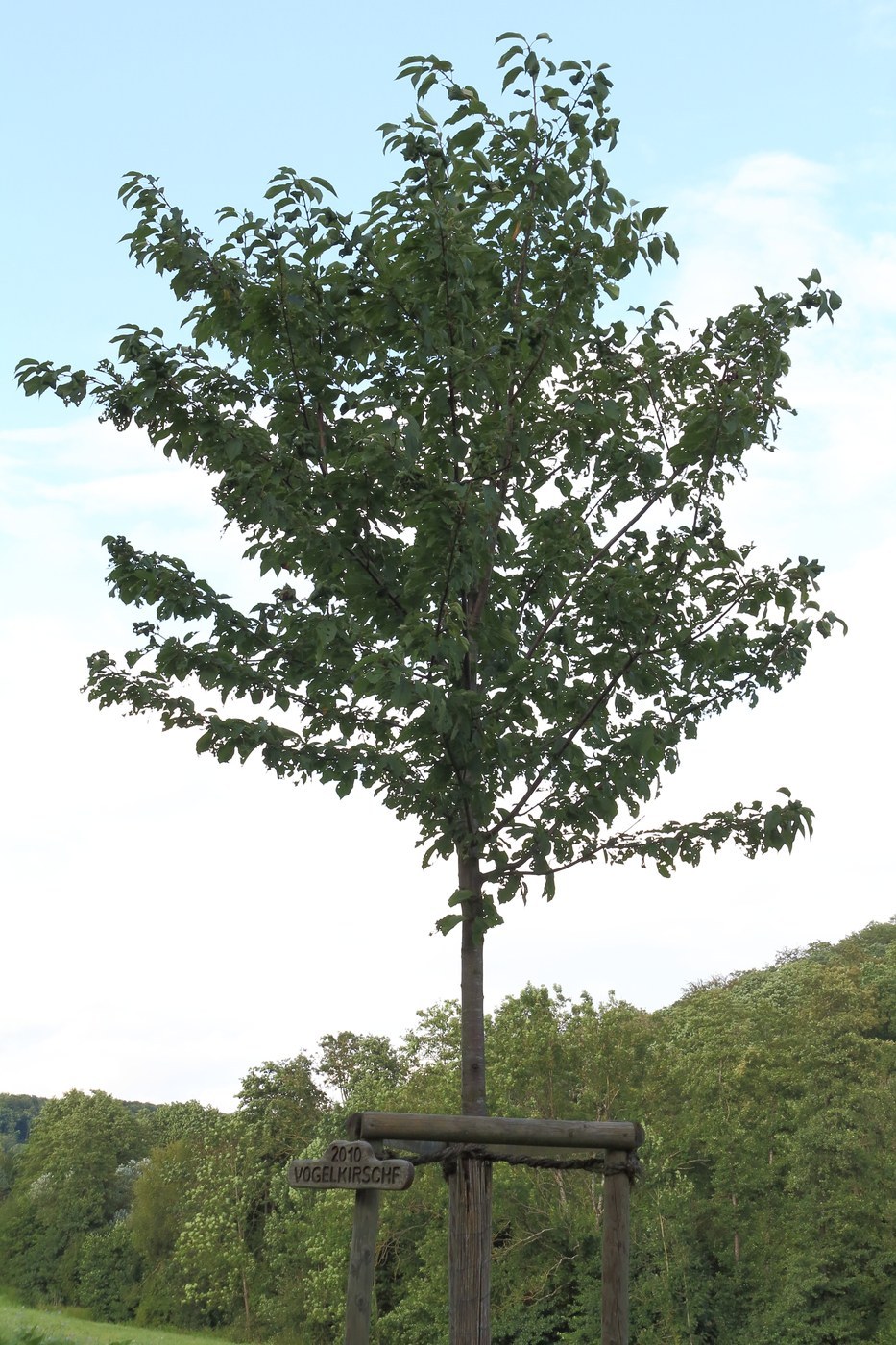
Key Identifying Features
Cherry trees (Prunus avium, P. cerasus, and ornamental cherries) are deciduous trees recognized by their smooth, glossy reddish-brown to gray bark marked with prominent horizontal lines (lenticels), often peeling in thin papery bands. In spring they burst into clusters of white-to-pink five-petaled blossoms, followed by small round stone fruits (drupes). A near-diagnostic detail: two tiny reddish glands sit at the top of the leaf stalk, where it meets the leaf base.
Leaves & Stems
- Leaves are simple, alternate, oval to elliptical, 6-12 cm, pointed at the tip, with finely toothed (serrate) margins.
- Look for one or two small bead-like glands (nectaries) on the petiole just below the leaf — characteristic of many Prunus.
- Leaves are dull to slightly glossy green, turning yellow, orange, or red in autumn.
- Bark is shiny reddish-brown to gray with conspicuous horizontal lenticels (breathing pores), a strong field mark.
Flowers & Fruit
- Flowers appear in spring, often before or with the leaves, in clusters or umbels of white to pink, five-petaled blooms about 2-3 cm across.
- Each has many stamens; ornamental varieties may be double-flowered.
- Fruit is a small round drupe (1-2.5 cm), red to dark purple-black (sweet/sour cherry) or tiny and black (wild/bird cherry), each with a single hard stone (pit).
How to Tell It Apart from Look-Alikes
- Plum trees (Prunus domestica): Larger oval fruit, less glossy bark, leaves often broader; lack the shiny horizontal-lenticel bark of cherries.
- Apple/pear: Leaves more rounded, bark not glossy reddish; fruit a pome with a core, not a single stone.
- Bird cherry (Prunus padus): Has flowers in long drooping spikes (racemes) rather than rounded clusters.
- Blackthorn (Prunus spinosa): Very thorny with flowers before leaves and blue-black sloes.
The glossy banded reddish bark + petiole glands + clustered five-petaled blossoms + single-stone fruit combination confirms a cherry.
Where You'll Find It
Cherries grow in gardens, orchards, parks, and streets (ornamental flowering cherries) and in woodlands and hedgerows (wild cherry, bird cherry) across temperate regions. They prefer full sun and well-drained soil. Spring blossom displays make them easiest to spot and identify.
Quick ID Checklist
- Glossy reddish-brown/gray bark with horizontal lenticel bands
- Oval, finely toothed, pointed leaves
- Tiny glands on the leaf stalk near the base
- Clusters of white-to-pink five-petaled spring blossoms
- Small round single-stone fruit (drupe)
- Deciduous, often with bright autumn color
Frequently asked questions
What is the easiest way to recognize a cherry tree?
Look at the bark: cherries have smooth, glossy reddish-brown to gray bark ringed with horizontal lines called lenticels, often peeling in papery bands. Add the toothed oval leaves with tiny glands on the stalk and clustered five-petaled spring blossoms to confirm.
What are the little bumps on a cherry leaf stalk?
Those are extrafloral nectaries, small glands typical of many Prunus species. Finding one or two reddish glands where the petiole meets the leaf base is a helpful clue that you have a cherry or related stone-fruit tree.
How do I tell a cherry from a plum tree?
Cherry fruit is small, round, and on long stalks, with a single stone, and the bark is glossy with horizontal lenticels. Plums have larger oval fruit, duller bark, and broader leaves. The bark and fruit shape are the quickest distinctions.
Are all cherry blossoms pink?
No. They range from pure white to deep pink, and ornamental cultivars can be single or fully double. All share the five-petaled base form (in singles) and appear in spring clusters.