
Chickweed Identification Guide
Identify common chickweed (Stellaria media) by its sprawling stems with a single line of hairs, small oval leaves, and tiny white star-shaped flowers.
Read the full Chickweed encyclopedia entry →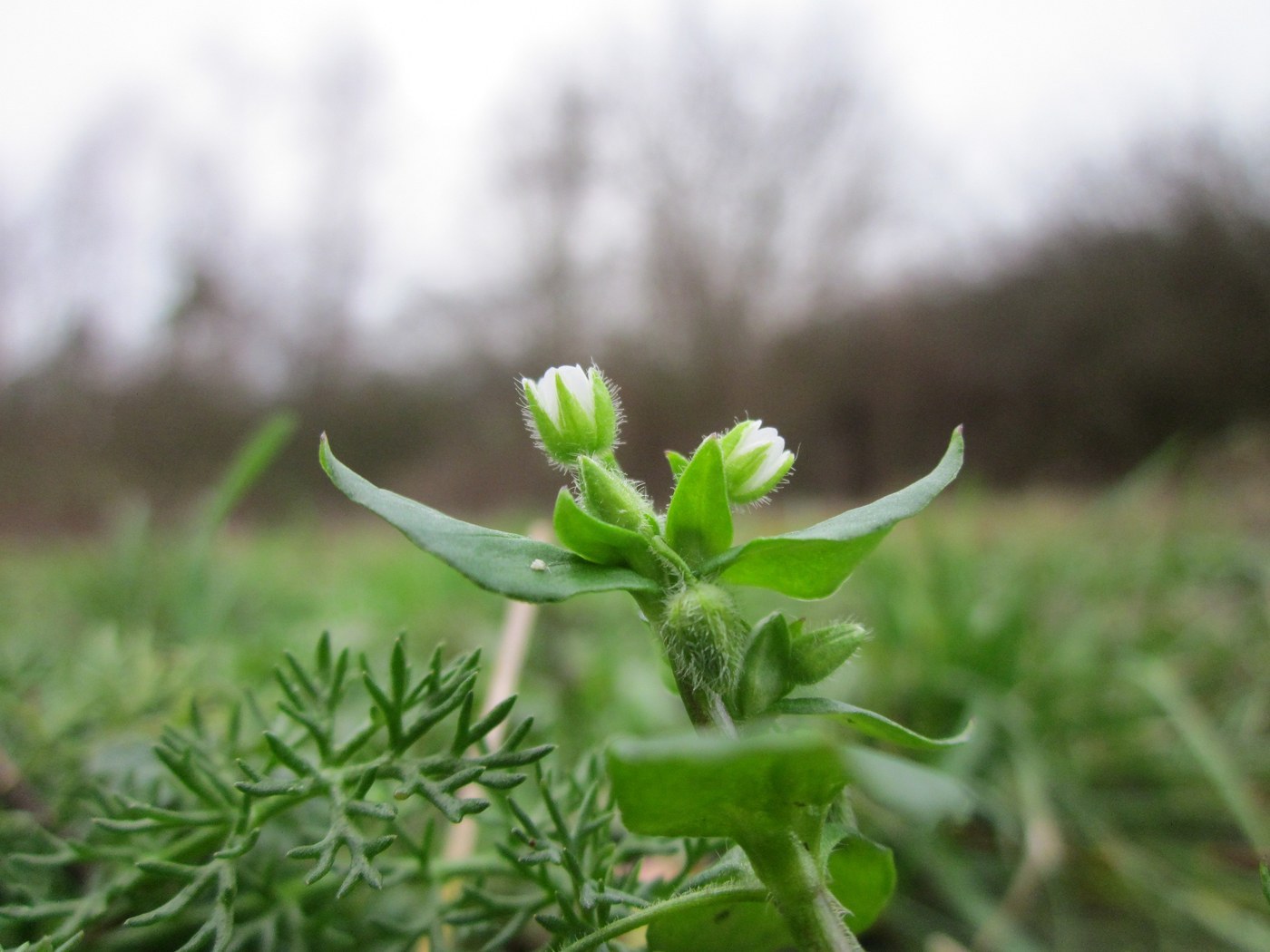
Key Identifying Features
Common chickweed (Stellaria media) is a low, sprawling annual of the pink family (Caryophyllaceae) and a near-universal garden weed. Three quick tests confirm it:
- A single line of fine hairs running along one side of the stem, switching sides at each pair of leaves.
- A stretchy inner core: gently pull a stem apart and an elastic central thread stays connected.
- Tiny white star flowers that appear to have 10 petals but actually have 5 deeply split petals.
These three features together reliably separate chickweed from look-alikes.
Leaves & Stems
Leaves are opposite, small (0.5-2 cm), oval with a pointed tip, smooth-edged, and bright green. Lower leaves have stalks; upper leaves are nearly stalkless. The weak, much-branched stems sprawl and root along the ground, forming soft mats. Apart from the single hairy line, the stems are otherwise smooth — a key contrast with hairier relatives.
Flowers & Fruit
Flowers are small, about 6 mm across, with 5 white petals so deeply cleft they look like 10. The green sepals behind them are usually as long as or longer than the petals. Chickweed can flower nearly year-round in mild climates. The fruit is a small capsule that opens by teeth at the top to release several reddish-brown seeds.
How to Tell It Apart from Look-Alikes
- Mouse-ear chickweed (Cerastium) is hairy all over (not just one stem line) and has a more greyish, fuzzy feel.
- Scarlet pimpernel (Anagallis/Lysimachia arvensis) has similar sprawling habit and opposite leaves but bears salmon-orange to red flowers and lacks the hairy stem line.
- Spurges (Euphorbia) exude milky sap when broken — chickweed sap is clear; never confuse the two.
The one-sided hairy line, the elastic inner stem thread, and deeply notched white petals confirm true chickweed.
Where You'll Find It
Chickweed thrives in cultivated and disturbed ground: vegetable beds, lawns, flower borders, field edges, and waste places, especially in cool, moist, fertile soil. It is a cool-season plant, often most abundant in spring and autumn, and grows nearly worldwide.
Quick ID Checklist
- Single line of hairs on one side of the stem
- Elastic inner thread when stem is pulled apart
- Opposite, oval, pointed small green leaves
- White flowers with 5 deeply split petals (look like 10)
- Clear (not milky) sap; sprawling, mat-forming habit
Frequently asked questions
What is the easiest way to confirm chickweed?
Look for the single line of fine hairs running along one side of the stem and switching sides at each leaf pair, then gently stretch a stem to see the elastic inner thread. Combined with the tiny white deeply notched flowers, these features are diagnostic.
Why do the flowers look like they have ten petals?
Chickweed actually has five white petals, but each is split so deeply down the middle that it appears to be two, giving a false impression of ten narrow petals.
How do I avoid confusing chickweed with a poisonous look-alike?
Scarlet pimpernel is sometimes mistaken for chickweed but has orange-red flowers and no hairy stem line. Also, break a stem to check the sap: chickweed has clear sap, while spurges have milky sap and should not be eaten.
When and where does chickweed grow?
It is a cool-season plant of disturbed, fertile ground such as gardens, lawns, and field edges, and can flower nearly year-round in mild climates, peaking in spring and autumn.