
Chokeberry Identification Guide
Identify Chokeberry (Aronia) by its white spring flower clusters, glossy toothed leaves with dark gland-dotted midribs, and red or black berries.
Read the full Chokeberry encyclopedia entry →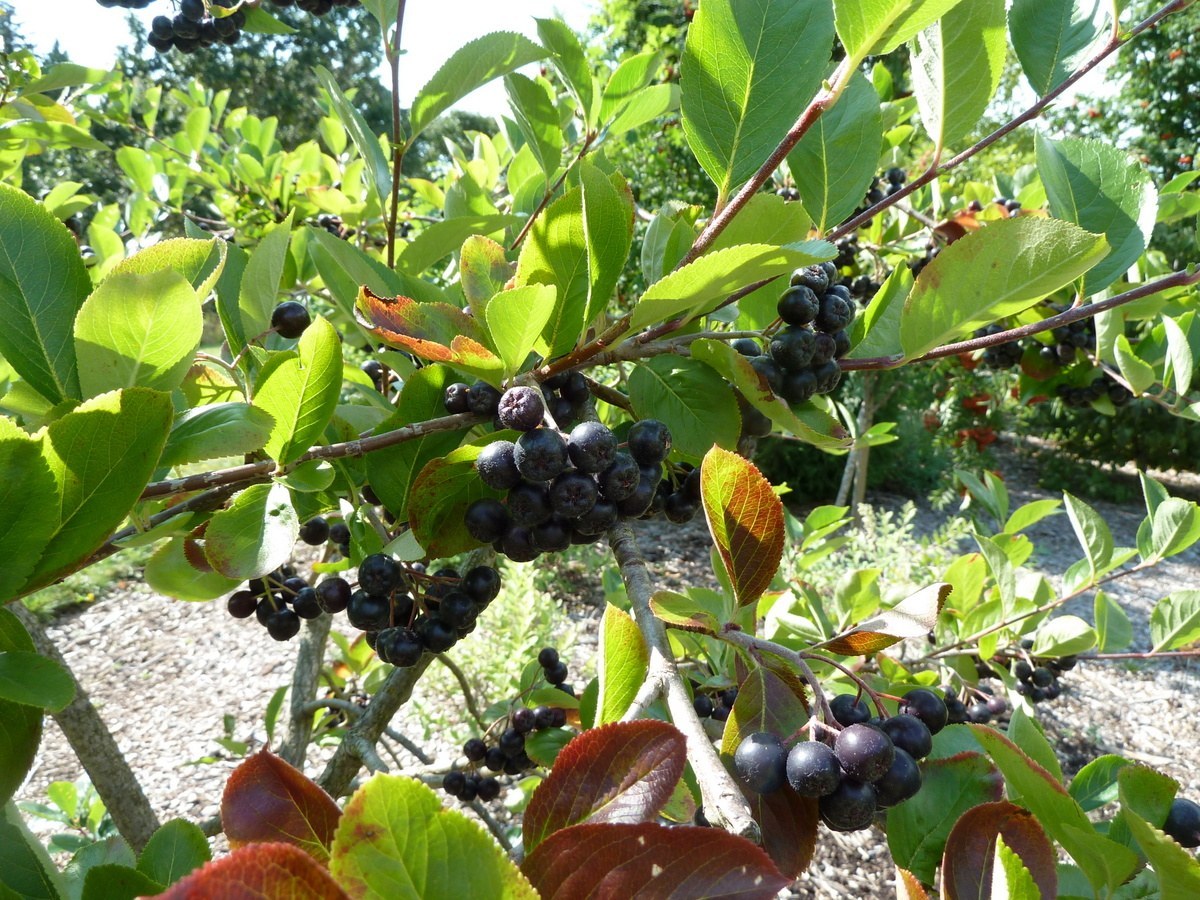
Key Identifying Features
Chokeberry (Aronia) is a deciduous shrub in the rose family (Rosaceae), native to eastern North America. The two main species are red chokeberry (Aronia arbutifolia) and black chokeberry (Aronia melanocarpa). Key features are flat-topped clusters of small white (sometimes pink-tinged) flowers, finely toothed glossy leaves with tiny dark glands along the midrib, and clusters of red or black berries that persist into fall and winter.
- Multi-stemmed, suckering deciduous shrub, 3–10 ft tall depending on species
- White spring flowers in flat clusters
- Distinctive dark glands dotting the upper leaf midrib
- Red or black pome berries persisting into fall and winter
Leaves & Stems
Leaves are alternate, simple, elliptic to obovate, 1–3 in long, with finely toothed margins and a glossy dark-green upper surface. A reliable ID trait is the row of small dark glandular dots along the top of the midrib — visible with a hand lens. Red chokeberry leaves are fuzzy/gray-hairy underneath; black chokeberry leaves are smooth beneath. Fall color is brilliant red to purple-red, especially in red chokeberry.
Flowers & Fruit
Flowers appear in mid-to-late spring in flat-topped clusters (corymbs) of small, 5-petaled white blooms with pink anthers, resembling small apple or hawthorn blossoms. The fruit is a small pome (like a tiny apple) about ¼–⅓ in across: bright red in red chokeberry (persisting into winter) or glossy black to purple-black in black chokeberry (ripening late summer).
How to Tell It Apart from Look-Alikes
- Serviceberry (Amelanchier): Has star-like flowers with narrow petals and lacks the dark midrib glands; fruit is purple.
- Hawthorn (Crataegus): Has thorns and lobed leaves; chokeberry is thornless with unlobed toothed leaves.
- Chokecherry (Prunus virginiana): Note the similar name but different plant — chokecherry has elongated flower/fruit clusters (racemes) and single-stone cherries, not flat-topped clusters of pomes.
The glandular midrib + flat-topped white flower clusters + small red/black pomes combination confirms Aronia.
Where You'll Find It
Native to wetlands, bogs, swamp edges, and moist-to-dry woodlands of eastern North America (USDA zones 3–9). Widely planted in native and rain-garden landscapes for its flowers, fruit, and fall color.
Quick ID Checklist
- Thornless, suckering deciduous shrub
- Flat-topped clusters of white 5-petaled flowers
- Alternate, finely toothed glossy leaves
- Dark glandular dots along the leaf midrib
- Red or black pome berries
- Strong red-purple fall color
Frequently asked questions
What's the difference between red and black chokeberry?
Red chokeberry (Aronia arbutifolia) has red fruit, hairy leaf undersides, and brilliant fall color; black chokeberry (Aronia melanocarpa) has black fruit and smooth leaf undersides.
Is chokeberry the same as chokecherry?
No. Chokeberry is Aronia with flat-topped flower clusters and small pomes; chokecherry is Prunus virginiana with elongated flower racemes and true cherry stones.
What's the best feature for confirming chokeberry?
Look for the tiny dark glands lined up along the top of the leaf midrib, combined with flat clusters of white flowers and red or black berries.