
Clarkia Identification Guide
Recognize clarkia by its slender wand-like stems, four-petaled pink to lavender flowers, and reddish ribbed buds. This guide details its key traits and look-alikes.
Read the full Clarkia encyclopedia entry →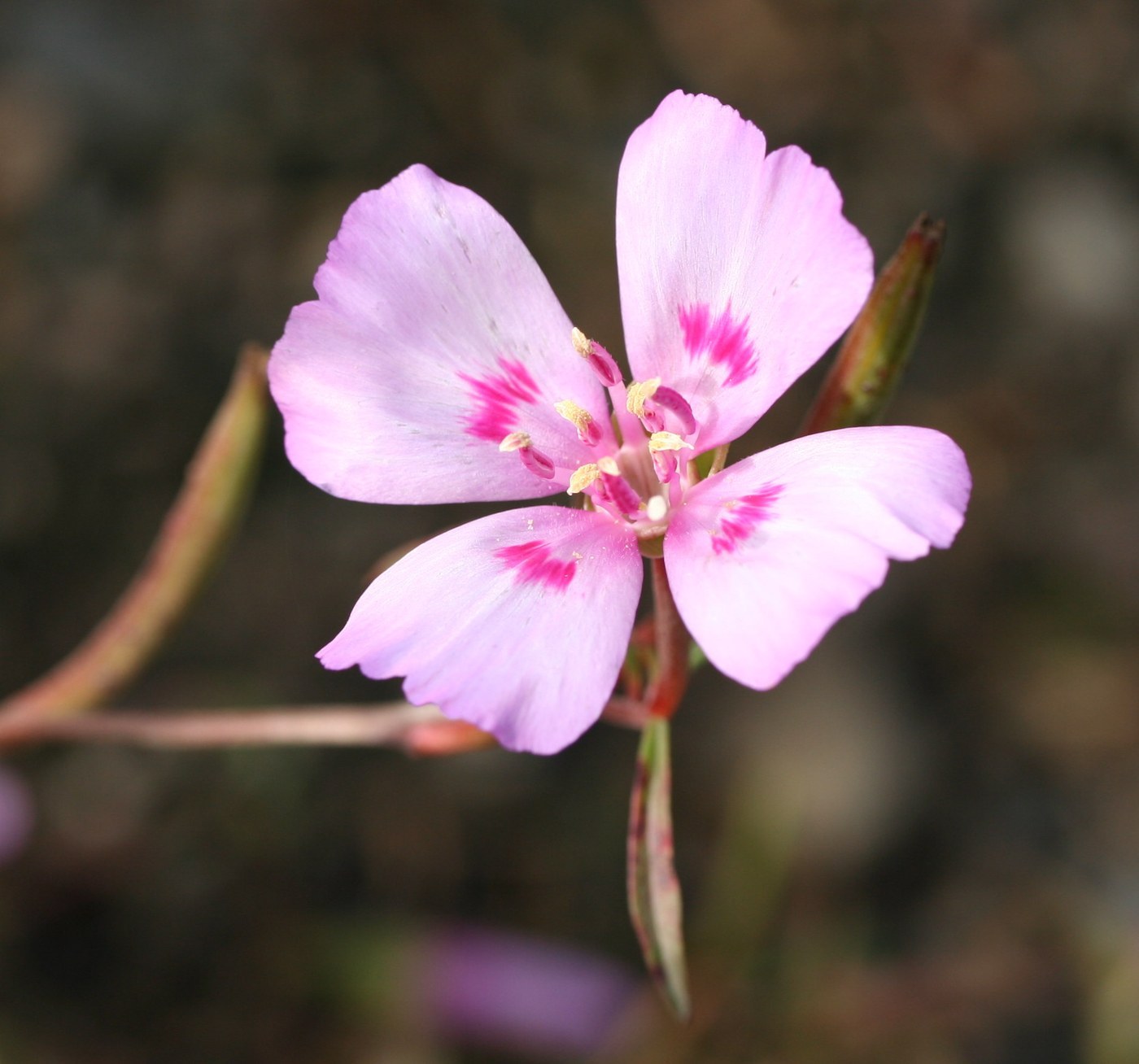
Key Identifying Features
Clarkia (genus Clarkia, including the popular Clarkia amoena godetia and Clarkia unguiculata mountain garland) is a group of western North American annuals in the evening primrose family.
- Flowers: four petals in pink, rose, lavender, salmon or white, often with a blotch or contrasting center
- Petal shape: fan-shaped, sometimes clawed (narrowed at the base) or fringed/lobed depending on species
- Stamens: typically 8, with a prominent four-lobed cross-shaped stigma
- Buds: often nodding and reddish, with ribbed sepals that flip back as the flower opens
- Height: 30-90 cm, with slender upright stems
Leaves & Stems
Leaves are alternate, narrow (lance-shaped to linear), untoothed or finely toothed, and usually short-stalked or stalkless. Stems are thin, wiry, often reddish-tinged, and may be smooth or slightly hairy. In Clarkia amoena (farewell-to-spring/godetia) the plant is bushier; in Clarkia unguiculata the stems are tall and wand-like with flowers spaced along the upper portion.
Flowers & Fruit
Flowers open along the stem from the lower buds upward. A reliable trait is the inferior ovary forming a long, narrow ribbed seed pod (capsule) below the flower typical of the evening primrose family. The four sepals are often fused and bent to one side as the bloom opens. Clarkia unguiculata has distinctively diamond- or paddle-shaped clawed petals; Clarkia amoena has broad satiny cup-shaped flowers often with a red splash. The four-lobed stigma is a giveaway for the family.
How to Tell It Apart from Look-Alikes
- Evening primrose (Oenothera): also four-petaled with a cross stigma, but flowers are usually yellow and the stigma sits well above the anthers
- Fuchsia: woody, with pendent tubular flowers, not flat four-petaled blooms
- Cosmos: has daisy-like flower heads (many ray florets), not four separate petals
- Rose campion / catchfly: five petals and an inflated calyx, not four
The four petals + four-lobed stigma + long ribbed inferior ovary + reddish nodding buds confirm clarkia.
Where You'll Find It
Clarkias are native to open slopes, woodland edges, chaparral and disturbed ground in western North America, especially California, blooming in late spring and early summer as the rains end (hence farewell-to-spring). They are also widely grown as cottage-garden annuals worldwide and prefer full sun and cool growing seasons.
Quick ID Checklist
- Four petals, pink/lavender/salmon/white, often blotched
- Four-lobed cross-shaped stigma, about 8 stamens
- Long ribbed seed pod beneath the flower
- Reddish, often nodding ribbed buds
- Narrow alternate leaves on slender stems
- Annual habit, western US origin
Frequently asked questions
How do I distinguish clarkia from evening primrose?
Both share four petals and a cross-shaped stigma, but clarkia flowers are typically pink to lavender while most evening primroses are yellow, and clarkia buds are often reddish and nodding.
What is the difference between godetia and clarkia?
Godetia is simply a common name for Clarkia amoena, a bushier species with broad satiny cup-shaped flowers; all godetias are clarkias.
What clue confirms the evening primrose family?
The long, narrow ribbed seed pod (inferior ovary) sitting below the flower plus the distinctive four-lobed stigma point to the Onagraceae family that clarkia belongs to.
When and where does clarkia bloom?
Wild clarkias flower in late spring to early summer on open slopes and disturbed ground in western North America, especially California, as the rainy season ends.