
Cleavers Identification Guide
Identify cleavers (Galium aparine) by its sprawling square stems, whorls of narrow leaves, and clingy Velcro-like hooked bristles that stick to clothing.
Read the full Cleavers encyclopedia entry →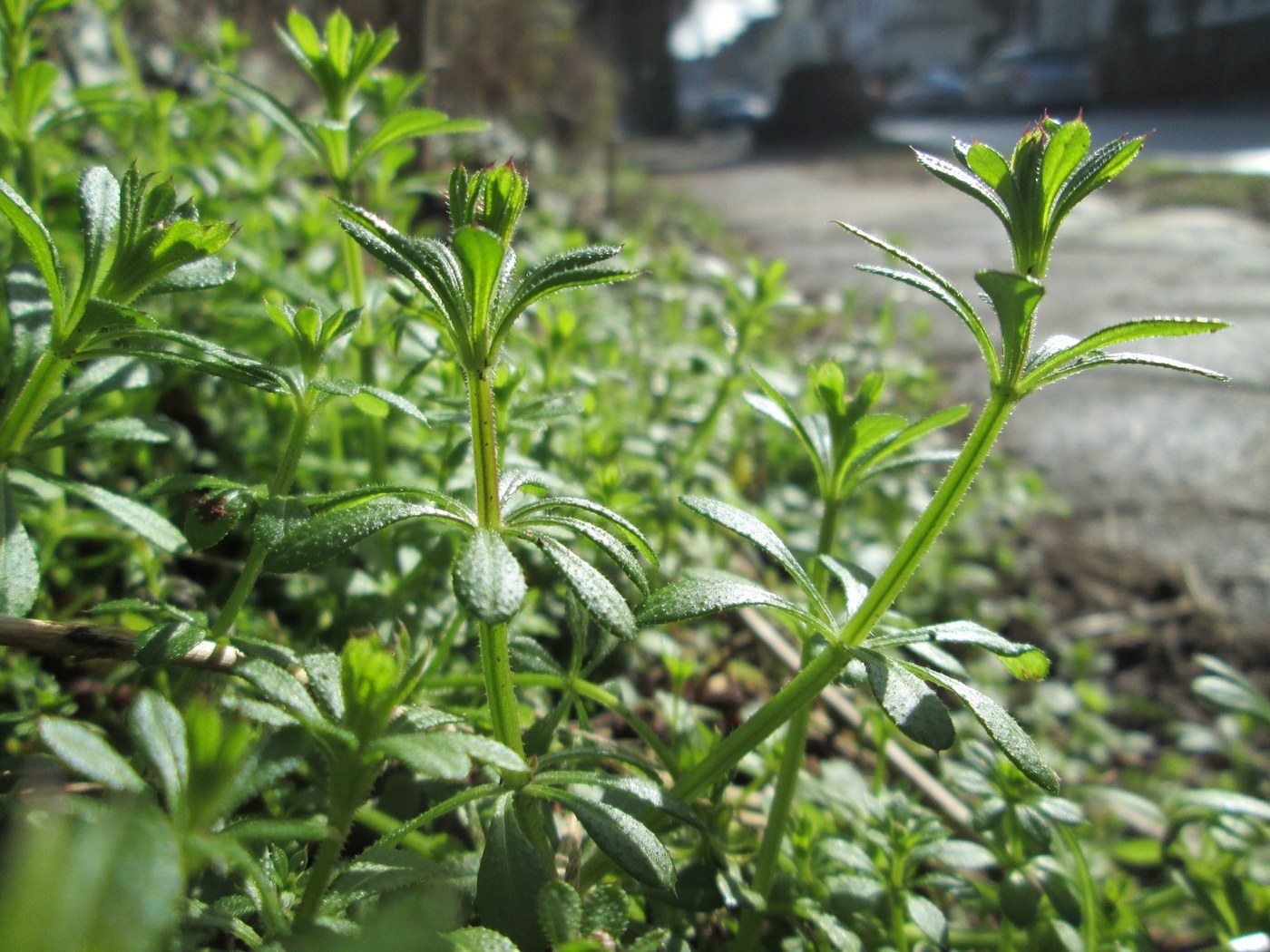
Key Identifying Features
Cleavers (Galium aparine) is an annual scrambling plant best known for its stickiness - the whole plant clings to clothing and fur thanks to tiny hooked bristles. If a weedy, straggling plant sticks to your sleeve like Velcro, you have almost certainly found cleavers.
- Weak, sprawling stems up to 3-6 ft (1-2 m) long, leaning on other plants
- Square (4-angled) stems with backward-pointing hooks
- Everything feels rough and clingy
Leaves & Stems
The leaves are arranged in distinctive whorls of 6-8 around the stem at each node, like the spokes of a wheel. Each leaf is narrow, lance-shaped to oblong, with a small bristle tip and rough, hooked hairs along the edges and midrib. The square stems also carry rows of downward-curving prickles, which is what lets the plant cling and climb. Stems are brittle and easily snap. The whole plant is light green and rough to the touch.
Flowers & Fruit
Flowers appear in late spring and summer and are tiny, white, and 4-petaled (star-shaped), only about 1/8 in (2 mm) across, borne in small stalked clusters from the leaf whorls. They are easy to overlook. The fruit is the clincher: paired, rounded, green-to-brown nutlets about 1/8 in across, densely covered in hooked bristles that cling to animals and clothing for dispersal. These burr-like seeds are unmistakable.
How to Tell It Apart from Look-Alikes
- Other bedstraws (Galium spp.): Hedge and lady's bedstraw have smoother stems and are not sticky; cleavers is uniquely clingy with hooked bristles everywhere.
- Sweet woodruff (Galium odoratum): Has similar leaf whorls but is smooth, not clinging, and smells of new-mown hay.
- Bedstraw vs. madder family relatives: The combination of 6-8 leaves per whorl, square hooked stems, and Velcro stickiness is diagnostic for cleavers.
Where You'll Find It
Cleavers thrives in hedgerows, woodland edges, waste ground, gardens, riverbanks, and disturbed soils across temperate regions. It is a common, fast-growing weed of moist, fertile ground, scrambling over fences, shrubs, and other plants in spring and early summer.
Quick ID Checklist
- Whole plant sticks to clothing via hooked bristles
- Square stems with backward-pointing prickles
- Leaves in whorls of 6-8, narrow and rough
- Tiny white 4-petaled flowers
- Round burr-like clinging seeds in pairs
- Sprawling annual of hedges and disturbed ground
Frequently asked questions
Why does cleavers stick to my clothes?
Its stems, leaf edges, and seeds are covered in tiny backward-hooked bristles that catch on fabric and fur, helping the plant climb and disperse its burr-like seeds.
What is the quickest way to confirm cleavers?
Run a stem lightly along your sleeve - if it clings like Velcro and has narrow leaves in whorls of 6-8 around a square stem, it is cleavers.
Are cleavers' flowers showy?
No, they are tiny white four-petaled stars only about 2 mm wide and easy to miss; the clinging round burr-seeds are far more noticeable.
What other names does cleavers go by?
It is also called goosegrass, sticky willy, catchweed, and bedstraw, all referring to its sticky, scrambling habit.