
Cloudberry Identification Guide
Recognizing cloudberry, a low arctic bog plant with single white flowers and amber raspberry-like fruit that ripens from red to gold.
Read the full Cloudberry encyclopedia entry →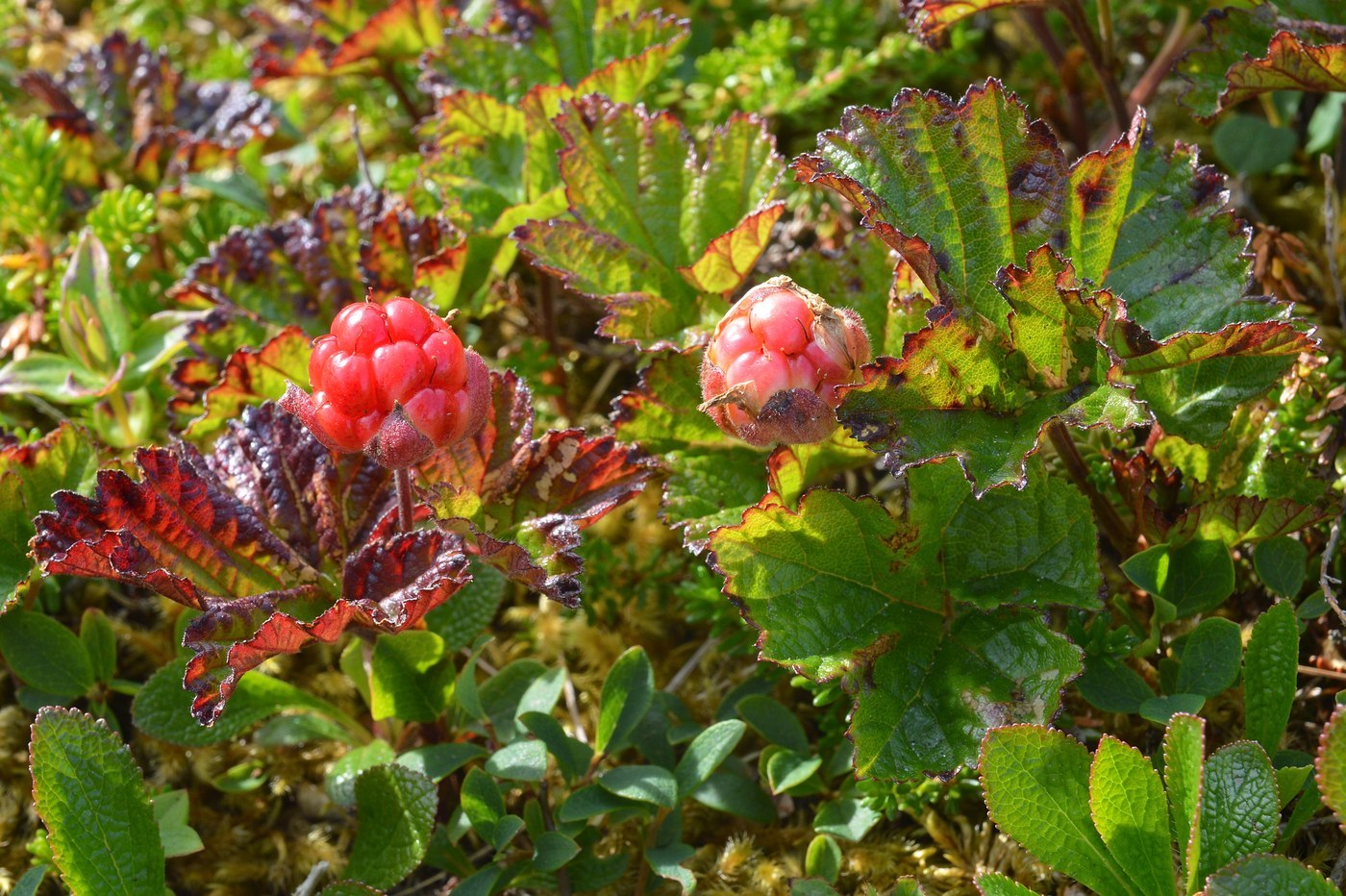
Key Identifying Features
Cloudberry (Rubus chamaemorus) is a low, creeping perennial of cold northern bogs — a most unusual Rubus because it is herbaceous, thornless, and bears a single fruit per stem. Identify it by its rounded, lobed wrinkly leaves, solitary white flowers, and the unmistakable amber-gold ripe fruit that turns paler as it ripens (opposite to most berries).
- Low herbaceous plant, only 5–25 cm tall, spreading by rhizomes
- No thorns or prickles — unique among brambles
- A single amber berry atop each short stem
Leaves & Stems
Leaves are rounded to kidney-shaped with 5–7 shallow lobes and crinkled, wrinkled surfaces with toothed margins, borne on upright stalks rising directly from a creeping underground rhizome. The whole plant is soft, low, and unarmed, lacking the woody canes and prickles of typical brambles. Each flowering stem bears just two or three leaves.
Flowers & Fruit
Cloudberry is usually dioecious (separate male and female plants). Flowers are solitary, white, five-petaled, about 2–3 cm across, held singly above the leaves — only female plants produce fruit. The fruit is an aggregate of a few large drupelets, starting hard and red, then ripening to a soft, translucent golden-amber color, like a pale raspberry. The reversed color change — red when unripe, golden when ripe — is a key trait. The flavor is tart and aromatic.
How to Tell It Apart from Look-Alikes
- Other Rubus (raspberries, salmonberry): all are woody and prickly with compound or maple-shaped leaves; cloudberry is low, soft, thornless, with lobed round leaves and a single fruit.
- Marsh cinquefoil / other bog plants: lack the raspberry-form amber fruit.
- Baked-apple berry is just another name for cloudberry itself.
- The single golden aggregate fruit on a low, thornless, round-lobed-leaved plant in a bog is unmistakable.
Where You'll Find It
Circumpolar in the Arctic and subarctic — across Scandinavia, Russia, northern Canada, Alaska, and the British Isles' uplands. It grows in acidic peat bogs, muskeg, tundra, and moorland, often among sphagnum moss. It is cold-demanding and does not grow in warm climates, making habitat itself a strong ID clue.
Quick ID Checklist
- Low (under 25 cm), thornless, herbaceous plant
- Round, lobed, wrinkled leaves
- Single white five-petaled flower per stem
- One amber-gold berry per stem (red when unripe)
- Grows in peat bogs and tundra of the far north
Frequently asked questions
Why is the ripe cloudberry pale instead of dark?
Unusually, cloudberry fruit is hard and red when unripe and becomes soft and golden-amber when ripe — the reverse of most berries — which is a reliable identification cue.
Does cloudberry have thorns?
No. Unlike its raspberry and blackberry relatives, cloudberry is a soft, low, herbaceous plant with no thorns or prickles at all.
Why do some plants never produce berries?
Cloudberry plants are usually either male or female (dioecious), so only female plants bear fruit, and only when male plants are nearby for pollination.
Where should I look for cloudberries?
Search acidic peat bogs, muskeg, and arctic tundra across the far north. The plant requires cold climates and won't be found in warm or lowland temperate regions.