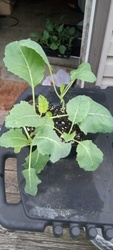
Collard Greens Identification Guide
Identify collard greens by their large, smooth, blue-green oval leaves with thick pale midribs, growing in an upright loose rosette atop a sturdy stem without forming a head.
Read the full Collard Greens encyclopedia entry →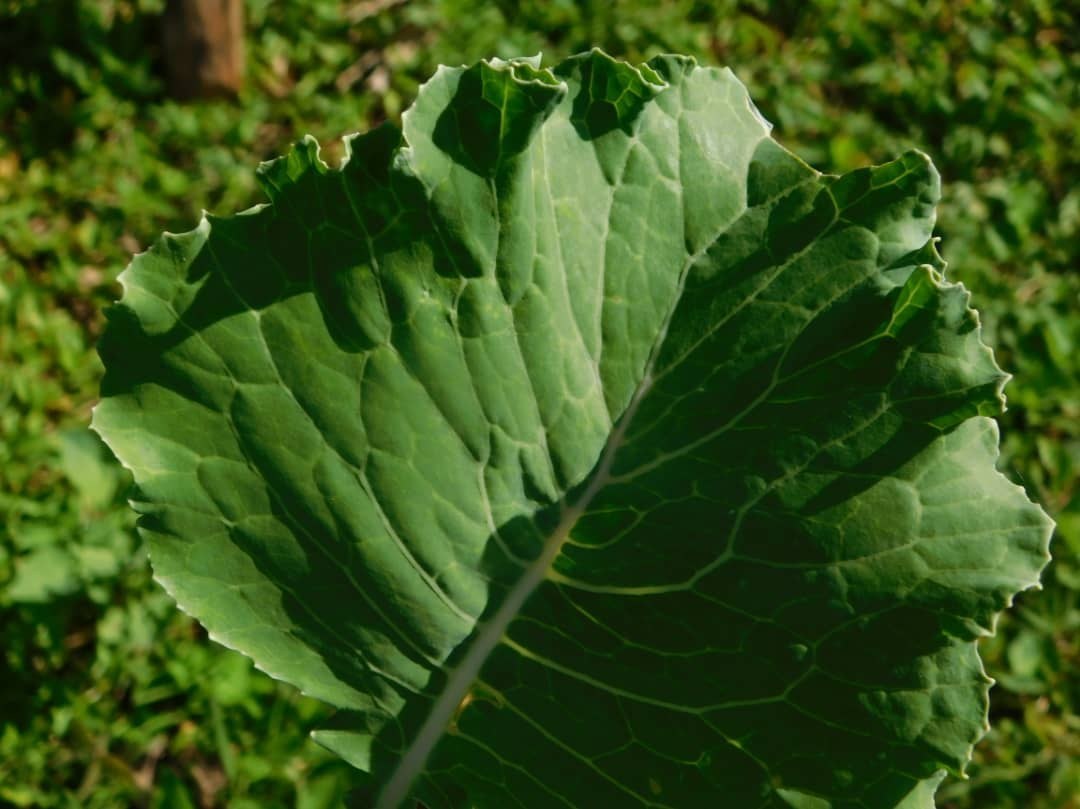
Key Identifying Features
Collard greens (Brassica oleracea var. viridis, the Acephala group) are a leafy form of cabbage in the mustard family (Brassicaceae). They are identified by their large, broad, smooth, flat oval to fan-shaped blue-green leaves with thick, pale central ribs, arranged in an open, upright rosette on a stout stem — and notably they do NOT form a head (acephala means "headless").
- Growth habit: upright, loose rosette 1–3 ft tall (taller as it ages, leaving a bare stalk below)
- Key trait: big paddle-shaped leaves, no cabbage head, waxy blue-green color
Leaves & Stems
Leaves are large (8–14+ inches long), broadly oval to rounded, smooth (not crinkled like kale), with slightly wavy or smooth margins and a thick, prominent whitish-green midrib. They are leathery and coated in a waxy bloom giving a dull blue-green color. New leaves emerge from the growing tip, and as the plant grows the lower leaves are harvested, leaving a thick, knobby stem with leaf scars below the leafy crown.
Flowers & Fruit
As a biennial, collards bolt in their second year (or in heat), sending up a branched stalk with clusters of small, pale-yellow four-petaled flowers — the classic crucifer cross — followed by slender seed pods (siliques) holding small round seeds. Harvest is normally well before flowering.
How to Tell It Apart from Look-Alikes
- Kale (B. oleracea): closely related, but kale leaves are usually crinkled/curly or bumpy (Lacinato) and narrower; collards are broad and smooth-bladed.
- Cabbage: same species, but forms a tight ball-head of overlapping leaves; collards stay open and headless.
- Mustard greens (Brassica juncea): brighter green, often ruffled or toothed, with a peppery bite; collards are smooth and milder.
- Spinach / chard: much smaller or different leaf shape and not waxy blue-green; chard has colorful stalks.
The large, smooth, waxy blue-green paddle leaves in a headless upright rosette identify collards.
Where You'll Find It
A staple of the American South and many global cuisines, collards are grown in vegetable gardens and farms as a hardy cool-season crop. They tolerate heat better than many brassicas and survive frost (which sweetens them). Look for them in home gardens, fall and winter plots, and market bunches of broad green leaves.
Quick ID Checklist
- Large, broad, smooth oval/fan-shaped leaves (not curly)
- Waxy blue-green color with thick pale midrib
- Open, upright, headless rosette on a sturdy stem
- Pale-yellow 4-petaled flowers and slim pods if bolting
- Smooth blades distinguish it from curly kale; headless habit from cabbage
Frequently asked questions
How do I tell collards from kale?
Collard leaves are large, broad, and smooth with a flat or slightly wavy surface, while most kale has crinkled, curly, or bumpy leaves. Both are the same species (Brassica oleracea) but differ in leaf texture and shape.
Why don't collard greens form a head like cabbage?
Collards belong to the acephala ('headless') group of Brassica oleracea, bred to keep producing loose, open leaves from an upright stem rather than tightening into a ball-head like cabbage.
What gives collard leaves their dull blue-green look?
A natural waxy coating (bloom) on the leaf surface gives collards their characteristic dull, blue-green color and helps the leathery leaves resist water loss.
Do collard greens flower?
Yes, in their second year or when stressed by heat they bolt, producing clusters of small pale-yellow four-petaled flowers typical of the mustard family, followed by slender seed pods.
Collard Greens identified by the community
Recent Collard Greens specimens identified with Plant Identifier.