
Columbine Identification Guide
How to recognize columbine (Aquilegia) by its distinctive spurred, nodding flowers and delicate, lobed blue-green foliage.
Read the full Columbine encyclopedia entry →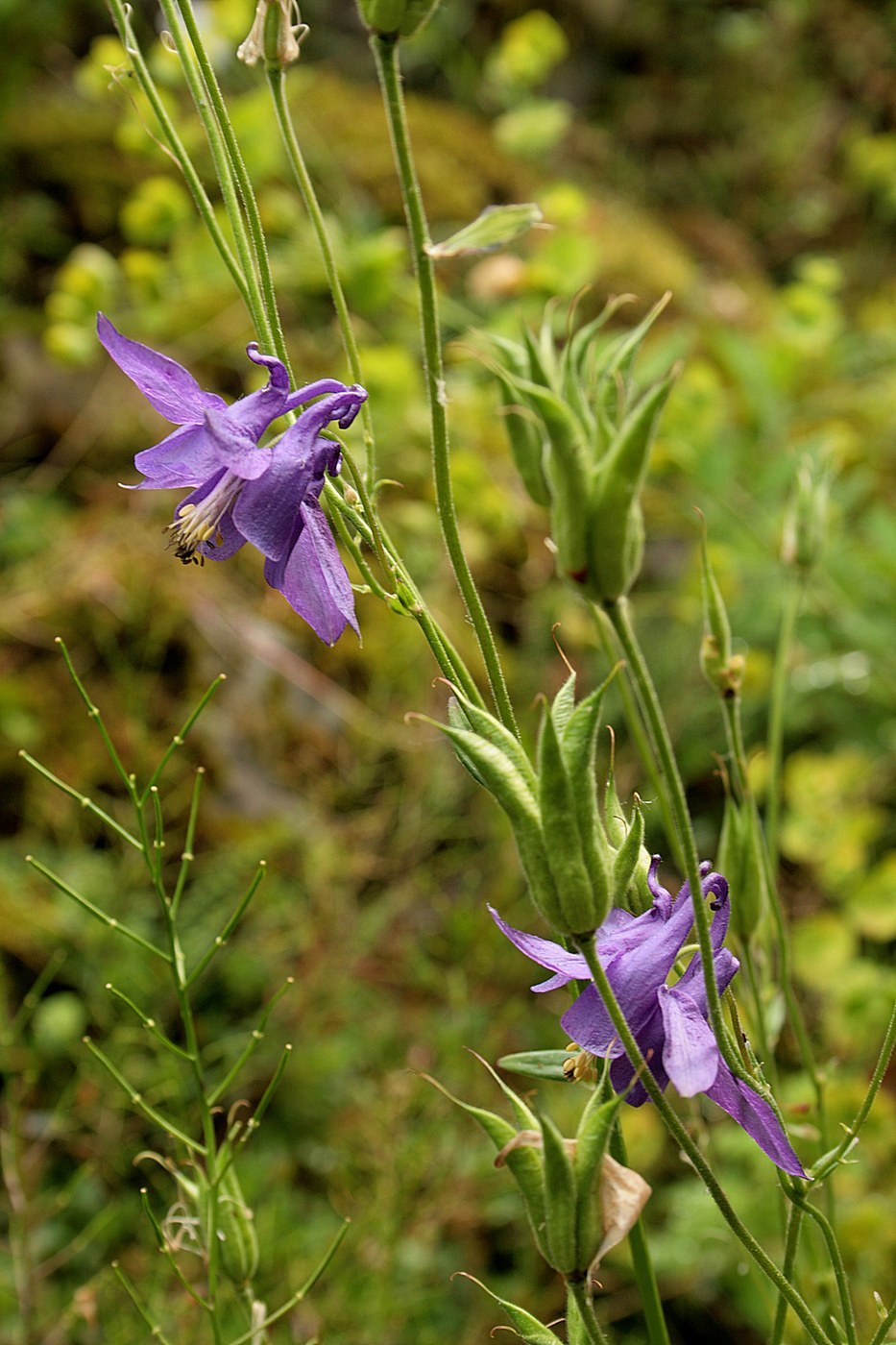
Key Identifying Features
Columbine (Aquilegia) is instantly recognizable by its uniquely spurred flowers. Each bloom has five petals that taper backward into long, hollow, nectar-filled spurs, giving the flower the look of a cluster of doves or a jester's cap. The flowers nod or face outward on slender, branching stems.
- Spurred, five-part flowers that hang or nod
- Fern-like, three-lobed compound leaves in soft blue-green
- Airy, branching flower stalks rising above a basal clump
- Height typically 30–90 cm (1–3 ft)
Leaves & Stems
The foliage is one of the best confirmations. Leaves are biternate — divided into threes and then into threes again — producing rounded, lobed leaflets with scalloped edges, similar in outline to a maidenhair fern or meadow-rue. The color is a distinctive dusty blue-green, often with a slightly waxy bloom. Most leaves form a basal rosette, with smaller, less-divided leaves up the flowering stems. Stems are thin, smooth to slightly hairy, and branch toward the top.
Flowers & Fruit
Flowers appear in late spring to early summer. The structure is the giveaway: five colored, petal-like sepals alternate with five true petals, each petal extended into a backward-pointing spur. A central tuft of yellow stamens projects forward. Colors range widely — blue, purple, red, yellow, pink, white, and bicolors. Wild A. canadensis (eastern North America) is red and yellow with downward-hanging flowers; A. vulgaris (European) is usually blue-purple with hooked spurs.
After bloom, flowers form clusters of five upright, beaked follicles (dry pods) that split open to release shiny black seeds.
How to Tell It Apart from Look-Alikes
- Meadow-rue (Thalictrum): Has nearly identical blue-green foliage but no spurred flowers — its blooms are fluffy and petal-less.
- Larkspur/Delphinium: Have a single spur per flower, not five; leaves are deeply palmate, not lobed-in-threes.
- Aquilegia hybrids vs. wild forms: Garden hybrids may have shorter or no spurs and upward-facing flowers, but retain the divided foliage.
The combination of multiple spurs per flower plus three-times-divided leaves is unique to columbine.
Where You'll Find It
Columbine grows in woodland edges, rocky slopes, meadows, and cottage gardens. Wild species favor partial shade and well-drained, even gravelly soil. It self-seeds readily, so you'll often find drifts of seedlings near established plants. It is a hardy perennial common across temperate North America, Europe, and Asia.
Quick ID Checklist
- Flowers with five backward-pointing spurs
- Nodding or outward-facing blooms
- Blue-green, fern-like leaves divided in threes
- Basal rosette with airy branching flower stems
- Upright clusters of beaked seed pods after bloom
- Blooming late spring to early summer
Frequently asked questions
What makes columbine flowers so distinctive?
The five backward-pointing nectar spurs on each flower. No other common garden flower has multiple spurs radiating from a single bloom, which gives columbine its unmistakable dove- or jester-cap silhouette.
How can I tell columbine from meadow-rue when it's not flowering?
You often can't from leaves alone — both have blue-green, three-times-divided foliage. Wait for flowers: columbine has showy spurred blooms, while meadow-rue produces fluffy, petal-less flower clusters.
Is the red-and-yellow columbine different from blue ones?
They're different species. Red-and-yellow nodding flowers are usually native Aquilegia canadensis (North America), while blue-purple hooked-spur flowers are typically European Aquilegia vulgaris. Both share the same characteristic divided leaves.
Are the seed pods useful for ID?
Yes. After bloom, columbine forms a cluster of five upright, beaked dry follicles that split open to drop shiny black seeds — a reliable confirmation once flowers fade.