Comfrey Identification Guide
Identify comfrey (Symphytum) by its large bristly hairy leaves, winged stems, and nodding coiled clusters of bell-shaped purple, pink, or cream flowers.
Read the full Comfrey encyclopedia entry →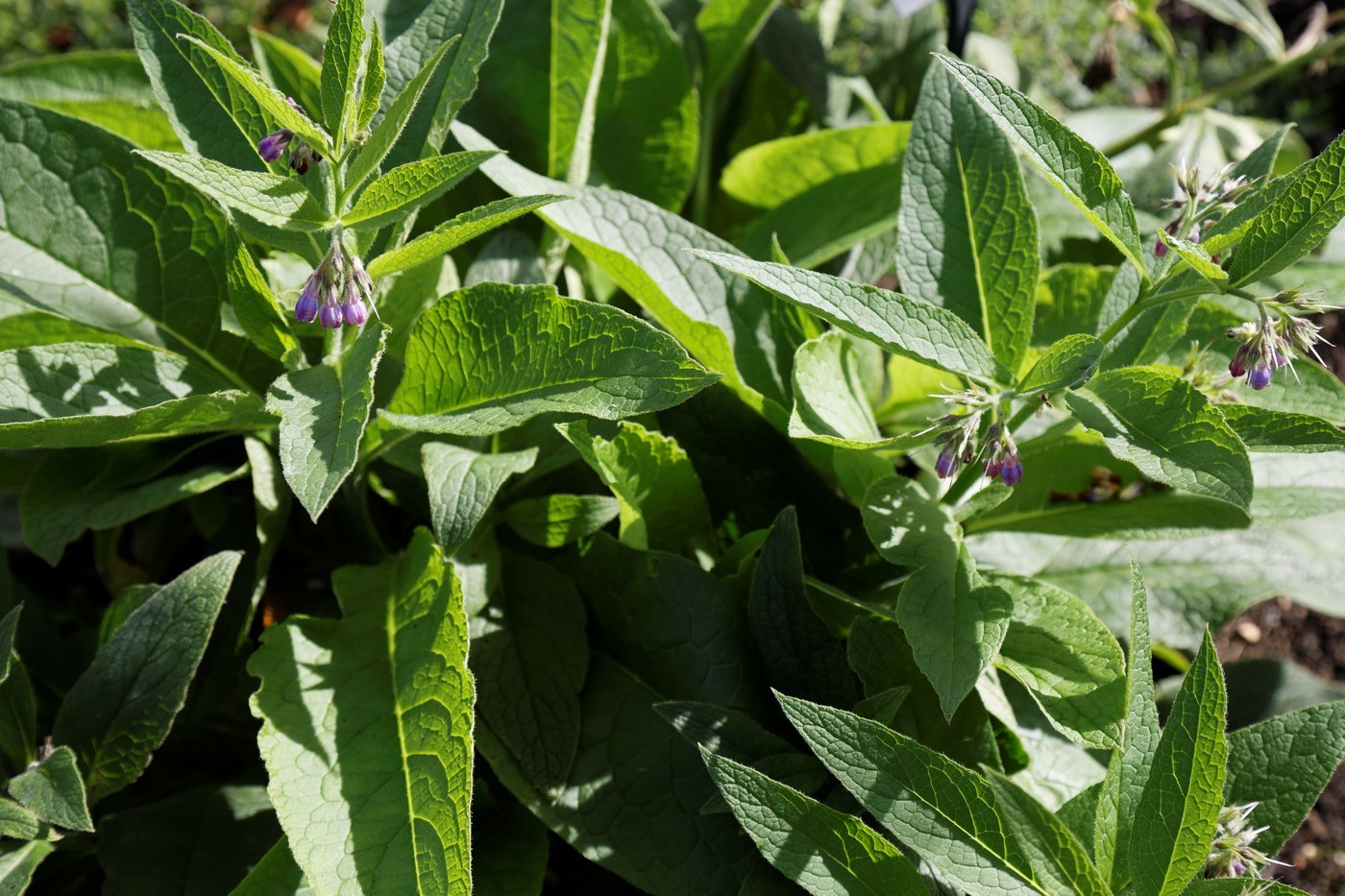
Key Identifying Features
Comfrey (genus Symphytum, especially S. officinale and the hybrid S. x uplandicum) is a coarse perennial in the borage family (Boraginaceae). Look for:
- Large, broad leaves covered in stiff bristly hairs that make the plant rough to the touch.
- Nodding, one-sided coiled clusters of bell- or tube-shaped flowers.
- Flowers in purple, violet, pink, or creamy-yellow, depending on species.
The rough hairiness plus the curled (scorpioid) flower cluster are classic borage-family signs.
Leaves & Stems
Leaves are alternate, large (the basal ones can reach 25 cm or more), broadly lance-shaped to oval, and taper at both ends. They feel distinctly rough and hairy on both surfaces. A key feature of S. officinale is that the leaf bases run down the stem as wings (decurrent), giving the stem a flanged, winged appearance. Stems are stout, branched, hollow, and also bristly. The plant grows 0.5-1.2 m tall from a thick, black-skinned, fleshy root.
Flowers & Fruit
Flowers hang in drooping, coiled one-sided sprays that unfurl as they bloom. Each flower is a 5-lobed bell or short tube, 1-2 cm long, with a small ring of scales in the throat. Colors range from pinkish-purple to violet-blue or pale cream. After flowering, each produces up to four small shiny nutlets. Bloom time is late spring through summer.
How to Tell It Apart from Look-Alikes
- Foxglove (Digitalis) has tall spikes of larger spotted tubular flowers and soft (not bristly-rough) downy leaves, with no winged stem.
- Borage (Borago officinalis) is also hairy but has bright blue star-shaped flowers with a black cone of stamens, not nodding bells.
- Green alkanet (Pentaglottis) has flat blue forget-me-not-type flowers, not bells.
- Foxglove and mullein rosettes can look similar before flowering, but mullein leaves are softly woolly-grey, not bristly-green.
The combination of rough bristly leaves, a winged stem, and nodding coiled bells of purple/cream flowers identifies comfrey.
Where You'll Find It
Comfrey is native to Europe and Asia and naturalized in North America. It favors damp, fertile ground: riverbanks, ditches, moist meadows, roadside verges, and the edges of gardens and allotments, where it is often grown as a compost and mulch plant.
Quick ID Checklist
- Rough, bristly-hairy large leaves
- Winged stem (leaf bases running down it) in common comfrey
- Nodding, coiled one-sided flower clusters
- Bell-shaped purple, pink, blue, or cream flowers
- Damp habitat; thick black-skinned root
Frequently asked questions
How do I tell comfrey from foxglove before they flower?
Comfrey leaves feel rough and bristly with stiff hairs, and in common comfrey the leaf bases run down the stem as wings. Foxglove rosette leaves are soft and downy, grey-green, and the stem is not winged. When in bloom, comfrey has nodding bells while foxglove has tall spikes of large spotted tubes.
What color are comfrey flowers?
It depends on the species and hybrid. Common comfrey ranges from creamy-yellow to pinkish-purple, while Russian comfrey (S. x uplandicum) is typically violet-blue to purple. All hang in drooping, coiled, one-sided clusters.
Why does comfrey feel so rough?
Both the leaves and stems are covered in stiff bristly hairs, a hallmark of the borage family. This roughness, combined with the coiled flower sprays, is a reliable field mark.
Where does comfrey usually grow?
It prefers damp, fertile ground such as riverbanks, ditches, moist meadows, and roadside verges, and is also widely cultivated in gardens and allotments as a mulch and compost plant.
Comfrey identified by the community
Recent Comfrey specimens identified with Plant Identifier.