
Coral Tree Identification Guide
How to identify Coral Trees (Erythrina) by their bright red claw-like flowers, three-part diamond leaves, thorny stems, and bead-like red seeds.
Read the full Coral Tree encyclopedia entry →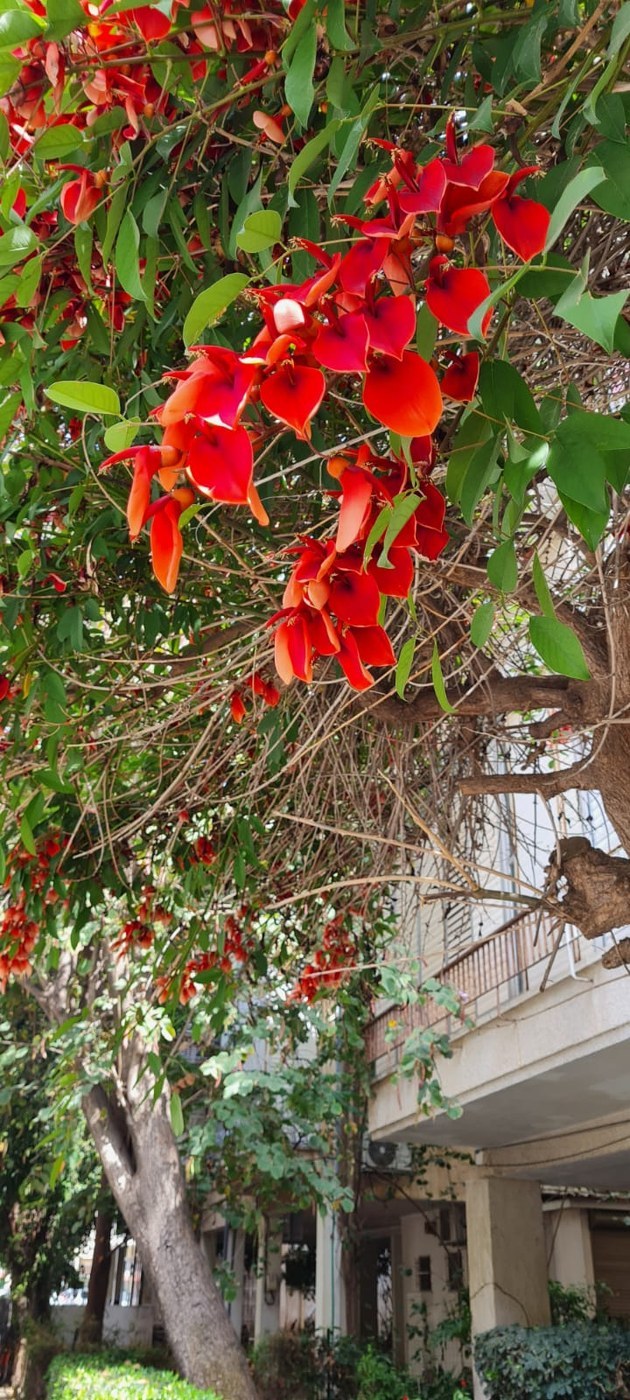
Key Identifying Features
Coral Trees (Erythrina species) are tropical and subtropical legumes celebrated for their brilliant red to orange-red flowers that often blaze on bare branches. Most species are also armed with thorns or prickles.
- Showy clusters of red/scarlet, claw- or beak-shaped flowers
- Compound leaves with three diamond-shaped leaflets (trifoliate)
- Thorns or prickles on stems, branches, and even leaf stalks
- Bean pods with bright red (and often black) seeds
- Shrub to large tree, 3-20 m depending on species
Leaves & Stems
Leaves are alternate and trifoliate — each leaf has three broad leaflets, the terminal one usually diamond- or broadly triangular (rhombic) shaped and the largest. Leaflets are smooth-margined, light to medium green, and can be large (10-20 cm). The leaf stalk and even the leaflet veins often bear small curved prickles.
Stems and trunks are typically armed with stout thorns or corky prickles (a key ID trait), and the wood is soft and lightweight. Most species are deciduous, dropping their leaves before the flowering flush. Bark is gray to greenish-brown, often warty or thorny.
Flowers & Fruit
- Flowers are vivid red, scarlet, or orange-red, borne in dense upright or spreading clusters (racemes) at branch tips, frequently when the tree is leafless. Each flower is a narrow, elongated, claw-, beak-, or tubular shape — a modified pea flower rich in nectar that attracts birds and, in the Americas, hummingbirds.
- Fruit is a constricted bean pod that looks beaded between the seeds. The seeds are typically bright red, or red-and-black, hard and shiny.
How to Tell It Apart from Look-Alikes
- Royal Poinciana / Flame Tree also has red flowers but bears fern-like bipinnate leaves and flat broad pods, unlike Erythrina's trifoliate leaves and beaded pods.
- Tigers claw and other coral trees are separated by species using thorniness, leaflet shape, and flower form, but the trifoliate diamond leaves + red claw flowers + thorns + red seeds combination identifies the genus.
Where You'll Find It
Erythrina species are pantropical, native to Africa, the Americas, Asia, and Australia. They are widely planted as ornamental, shade, and street trees, and as living fences and coffee-shade trees, in warm climates including California, Florida, Hawaii, Mexico, India, and South Africa. Several are national or regional floral emblems.
Quick ID Checklist
- Bright red/scarlet claw- or beak-shaped flowers in clusters
- Trifoliate leaves with a diamond-shaped end leaflet
- Thorns or prickles on stems and leaf stalks
- Beaded bean pods with red (or red-and-black) seeds
- Often flowers on bare branches; soft, lightweight wood
Frequently asked questions
What do coral tree leaves look like?
Coral trees have alternate compound leaves divided into three broad leaflets, with the terminal leaflet usually the largest and diamond- or broadly triangular-shaped. The leaf stalks and leaflet veins often carry small curved prickles.
Why do coral trees flower on bare branches?
Most species are deciduous and time their flowering for when the tree is leafless, usually after a dry or cool period, so the brilliant red blooms stand out and are easily reached by pollinating birds.
How do I distinguish a coral tree from a flame tree?
Coral trees (Erythrina) have trifoliate leaves with a diamond-shaped end leaflet, thorny stems, and narrow claw-shaped red flowers. The flame tree (Delonix regia) has fern-like bipinnate leaves and broad, flat, spreading flowers.
Do all coral trees have thorns?
Most do bear thorns or prickles on the stems, branches, or leaf stalks, which is a useful ID trait, though a few cultivated forms are nearly thornless. The trifoliate leaves and red flowers remain the surest features.