
Coreopsis Identification Guide
Identify coreopsis (tickseed) by its daisy-like yellow flowers with toothed ray tips and slender, often divided leaves.
Read the full Coreopsis encyclopedia entry →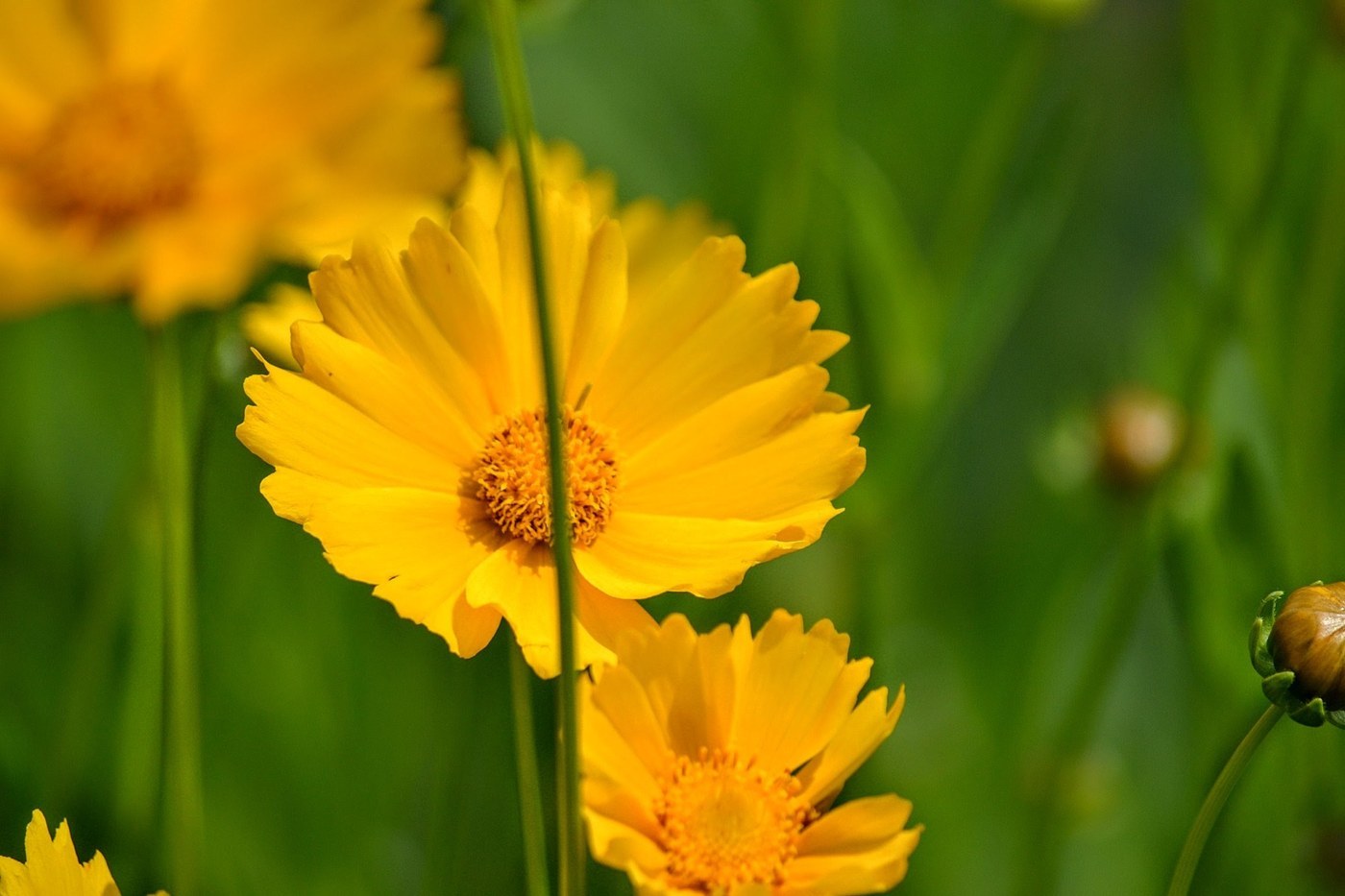
Key Identifying Features
Coreopsis, commonly called tickseed, is recognized by its bright daisy-like flower heads — typically golden-yellow — with ray petals whose outer tips are notched or several-toothed, surrounding a darker central disk. The name Coreopsis ("bug-like") and "tickseed" both refer to the flat, insect-like seeds.
- Daisy-form flower heads on slender stalks
- Ray petals toothed/lobed at the tips
- Mostly yellow or gold, some with red/maroon centers
- Flat, tick-shaped seeds
Leaves & Stems
Leaves are opposite and vary widely by species: some have simple, narrow, lance-shaped leaves (e.g. Coreopsis lanceolata), while threadleaf types (C. verticillata) have finely divided, almost thread-like foliage giving a soft, ferny look. Stems are slender, wiry, branching, and often nearly leafless toward the flowers, holding the blooms airily above the foliage. Plants form clumps from 30–90 cm tall; many spread by rhizome or self-seed.
Flowers & Fruit
Each head has typically eight ray florets (sometimes more) around a central button of disk florets. The rays are usually bright yellow or gold, frequently with a reddish-brown or maroon blotch at the base, and crucially their outer ends are squared off with several teeth or shallow lobes — a key ID detail. Some cultivated forms are pink, red, or bicolored. Bloom is early summer through autumn, prolific and long-lasting. The fruit is a small, flat, dark achene shaped like a tick or beetle, giving the common name.
How to Tell It Apart from Look-Alikes
- Black-eyed Susan (Rudbeckia): Has a raised dark brown-black cone center and untoothed, often hairy leaves; coreopsis rays are toothed at the tips and the center is flatter.
- Cosmos: Similar toothed-tip rays, but cosmos has very feathery leaves and larger pink/white/orange flowers, and seeds are long and spiky, not tick-flat.
- Bidens / beggarticks: Close relative; distinguished by barbed, clinging seeds versus coreopsis's flat tick-seeds.
The yellow daisy with toothed ray tips + flat tick-shaped seeds + opposite leaves confirm coreopsis.
Where You'll Find It
Native across the Americas, coreopsis grows in prairies, meadows, roadsides, and open woods, and is a top drought-tolerant garden perennial for borders and wildflower plantings. It thrives in full sun and well-drained, even poor soil, blooming heavily and attracting bees and butterflies.
Quick ID Checklist
- Daisy-like flower head, usually yellow/gold
- Ray petals notched or toothed at the tips
- Often a reddish blotch at ray bases
- Opposite leaves, simple or thread-like
- Slender, wiry, branching stems
- Flat, tick-shaped seeds
Frequently asked questions
What's the key detail separating coreopsis from other yellow daisies?
The ray petals of coreopsis are notched or several-toothed at their outer tips, rather than smooth and pointed. Combined with the flat, tick-shaped seeds, this reliably identifies tickseed.
How do I tell coreopsis from black-eyed Susan?
Black-eyed Susan has a raised dark brown-black dome center and untoothed hairy leaves, while coreopsis has a flatter center and ray petals that are toothed at the tips, often with a reddish blotch at the base.
Why is it called tickseed?
Because the small, flat, dark seeds resemble ticks or beetles. The botanical name Coreopsis likewise comes from Greek words meaning 'bug-like,' referring to the seed shape.
Do all coreopsis have thread-like leaves?
No. Threadleaf species like Coreopsis verticillata have finely divided ferny foliage, but others such as C. lanceolata have simple, lance-shaped leaves. All share opposite leaves and toothed-tip yellow rays.