
Cotoneaster Identification Guide
Recognize cotoneaster by its small simple leaves, arching herringbone branches, tiny white-to-pink flowers, and masses of bright red berries.
Read the full Cotoneaster encyclopedia entry →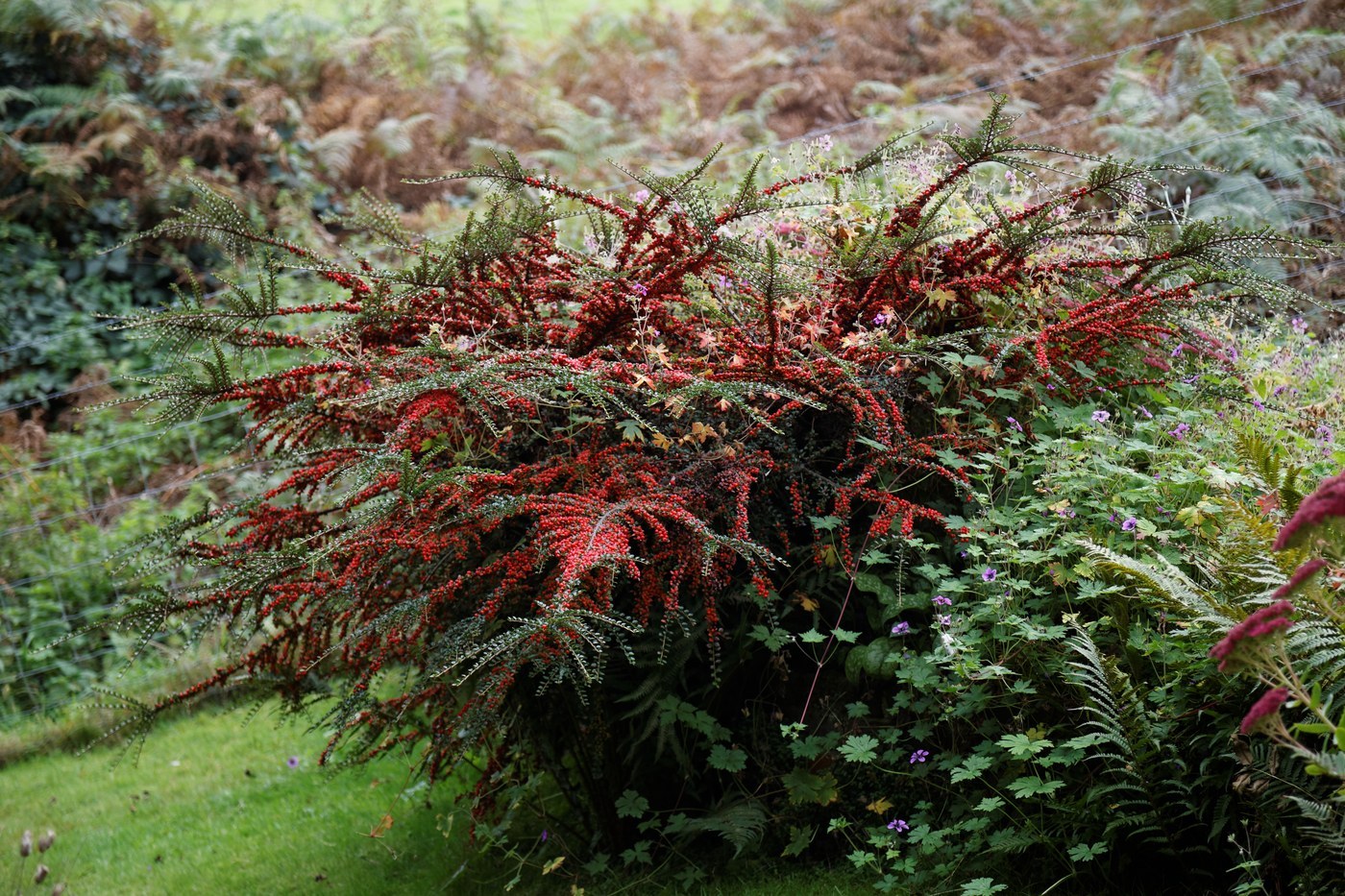
Key Identifying Features
Cotoneaster is a large genus of shrubs (and a few small trees), evergreen or deciduous, grown for bright red (sometimes orange) berries that smother the plant in fall and winter. The classic ground-cover species are recognized by their distinctive flat, fishbone (herringbone) branching pattern.
- Form ranges from flat ground-huggers to arching 6–10 ft shrubs
- Small, simple oval leaves, glossy dark green
- Tiny white or pink-tinged flowers in spring
- Abundant red-to-orange berry-like pomes in autumn
Leaves & Stems
Leaves are alternate, simple, and small (¼–1½ in), oval to round, with smooth (untoothed) margins — a key separator from the toothed leaves of look-alikes. The upper surface is usually glossy dark green while the underside is often paler and slightly downy. Deciduous types color orange-red in fall; evergreen types hold small leathery leaves year-round. Stems of the prostrate species spread in the famous flat herringbone array, branchlets alternating off a central stem like fish ribs.
Flowers & Fruit
Flowers are small, 5-petaled, and white or pink-flushed, either solitary or in small clusters, blooming in late spring — modest but attractive to bees. The real show is the fruit: small, round, ¼-in pomes (mini apples) in brilliant red, orange, or occasionally black, produced in such quantity they weigh down the branches and persist into winter for the birds. The fruit's tiny apple-like structure (it's in the rose family) is a useful cue.
How to Tell It Apart from Look-Alikes
- Pyracantha (firethorn): very similar red/orange berries, but pyracantha has sharp thorns and toothed leaves — cotoneaster is thornless with smooth-edged leaves.
- Hawthorn: toothed/lobed leaves and thorny; cotoneaster leaves are entire and stems unarmed.
- Holly: spiny leaves; cotoneaster leaves are soft-edged.
- Barberry: thorny stems and yellow flowers.
The thornless stems + smooth-margined small leaves + masses of red pomes (often on herringbone branches) combination identifies cotoneaster.
Where You'll Find It
Widely planted worldwide for ground cover, bank stabilization, hedging, and winter berry color. It tolerates poor soil, drought, and exposure, thriving in sun to part shade. Note that several species are invasive in parts of North America, Australia, and the UK, spread by birds eating the berries — you'll often find it naturalized on roadsides, walls, and waste ground.
Quick ID Checklist
- Thornless shrub or ground cover
- Small, simple, smooth-edged oval leaves
- Glossy green above, paler/downy below
- Tiny white or pink-flushed 5-petaled flowers
- Masses of small red/orange berry-like pomes in fall/winter
- Often flat herringbone branching (ground-cover types)
If you find a thornless, smooth-leaved shrub or carpeting plant drowning in tiny red berries each autumn, it's a cotoneaster — and if it has thorns instead, you've got its cousin pyracantha.
Frequently asked questions
How do I tell cotoneaster from pyracantha (firethorn)?
The quickest test is to feel for thorns: pyracantha has sharp spines along its stems and finely toothed leaves, while cotoneaster is completely thornless with smooth-edged leaves. Both produce similar red-orange berries, so the thorns and leaf margins are the deciding clues.
What shape are cotoneaster leaves?
They are small (about ¼ to 1½ inches), simple, and oval to round, with smooth untoothed margins. The upper surface is glossy dark green while the underside is paler and often slightly downy.
Why is cotoneaster considered invasive in some areas?
Birds eat the abundant berries and spread the seeds widely, allowing several species to naturalize aggressively on walls, roadsides, and wild land in parts of North America, Australia, and the UK. Check local guidance before planting.
What is the flat fishbone branching I see on some cotoneasters?
That herringbone pattern is characteristic of prostrate, ground-covering species like Cotoneaster horizontalis, where small branchlets alternate off a main stem like the ribs of a fish. It's a strong identification cue for those low-growing types.