
Creeping Charlie Identification Guide
How to identify creeping Charlie (Glechoma hederacea), a low mint-family lawn weed with scalloped leaves and square stems.
Read the full Creeping Charlie encyclopedia entry →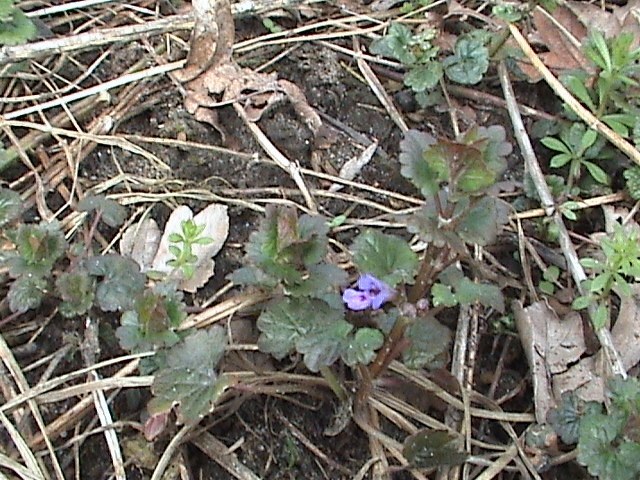
Key Identifying Features
Creeping Charlie (Glechoma hederacea), also called ground ivy, is a low-growing perennial in the mint family that spreads aggressively across shady lawns and gardens. The reliable clues are square stems, opposite scalloped (round-toothed) leaves, a minty aroma when crushed, and small blue-purple flowers in spring.
- Creeps flat along the ground, rooting at the nodes to form dense mats
- Square (four-sided) stems typical of mints
- Strong mint/menthol smell when mowed or crushed
Leaves & Stems
Leaves are opposite (paired), kidney- to round-shaped, with scalloped or round-toothed margins and a slightly crinkled, veined surface. They are bright to dark green, about 1/2-1 inch wide, on long stalks. Crushing them releases a distinctly minty odor. The square stems creep horizontally and root readily at each node, which is how a small patch quickly becomes a sprawling mat. This square-stemmed, opposite-leaved, aromatic combination separates it from most lawn weeds at a glance.
Flowers & Fruit
In spring to early summer creeping Charlie produces small, funnel-shaped blue to violet-purple flowers about 1/2 inch long, clustered in the leaf axils. Each flower has the typical two-lipped mint shape, often with darker purple spots on the lower lip. Fruit is an inconspicuous tiny nutlet. The low carpet of bluish flowers over scalloped leaves is a strong seasonal marker.
How to Tell It Apart from Look-Alikes
- Common mallow: rounder leaves but stems are not square and it lacks the mint smell.
- Henbit and purple deadnettle: also mints with square stems and purple flowers, but they grow upright and have more triangular or lobed leaves; creeping Charlie creeps flat with kidney-shaped scalloped leaves.
- Wild violet: heart-shaped leaves but no square stems and no mint odor.
- Dollarweed (pennywort): round leaves with the stem attached at the center; creeping Charlie's stalk attaches at the leaf edge notch.
Where You'll Find It
Creeping Charlie favors moist, shady, fertile ground: shaded lawns, garden beds, woodland edges, and under trees. It tolerates mowing and outcompetes thin turf. Native to Europe, it is now a widespread weed across North America and other temperate regions.
Quick ID Checklist
- Square stems that creep and root at nodes
- Opposite, kidney-shaped, scalloped leaves
- Strong minty smell when crushed
- Small blue-purple two-lipped flowers in spring
- Dense mats in shady, moist areas
Frequently asked questions
How do I know if it's creeping Charlie and not wild violet?
Creeping Charlie has square stems, a strong minty smell when crushed, and scalloped kidney-shaped leaves. Wild violet has rounded stems, heart-shaped leaves, and no mint odor.
Why does creeping Charlie smell minty?
It is a member of the mint family (Lamiaceae), so its leaves and square stems release a menthol-like aroma when bruised or mowed, which is a quick identification test.
What is the difference between creeping Charlie and henbit?
Both are square-stemmed mints with purple flowers, but creeping Charlie creeps flat along the ground with scalloped kidney-shaped leaves, while henbit grows upright with clasping, lobed leaves.
Where does creeping Charlie grow best?
It thrives in moist, shady, fertile spots like shaded lawns, garden beds, and woodland edges, where it forms dense mats by rooting at every stem node.