
Culver's Root Identification Guide
A field guide to identifying Veronicastrum virginicum by its whorled leaves and slender candelabra of white flower spikes.
Read the full Culver's Root encyclopedia entry →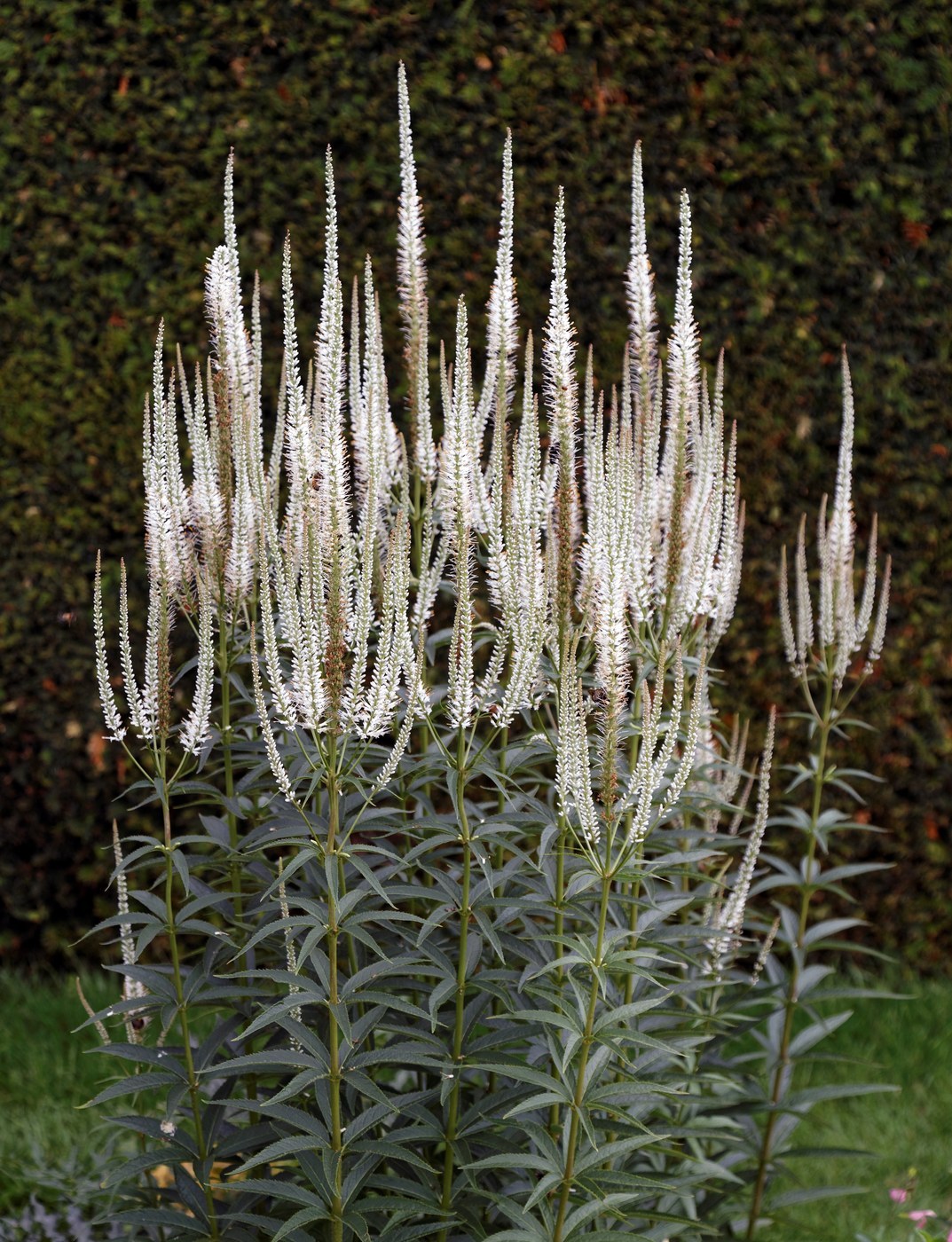
Key Identifying Features
Culver's root (Veronicastrum virginicum) is a tall, architectural native perennial of North American prairies and moist meadows. Its signature traits:
- Leaves arranged in whorls of 3-7 around the stem at each node — the single most diagnostic feature
- Slender, candelabra-like spikes of tiny white (occasionally pale lilac) flowers
- An erect, unbranched-to-few-branched habit reaching 3-6 ft tall
- A stately, vertical silhouette in summer
Leaves & Stems
The whorled leaves are the give-away. At each node, 3 to 7 (often 4-6) leaves radiate outward like spokes. Each leaf is lance-shaped (lanceolate), finely toothed, 3-6 in long, and tapers to a sharp tip, with short or no stalk. Stems are smooth, stiff, and upright, usually green and sometimes branching near the top into the flower spikes. The clean, layered tiers of foliage give the plant a tidy, almost formal look before it blooms.
Flowers & Fruit
Blooming mid- to late summer, the flowers form narrow, tapering spikes 3-9 in long at the stem tips, frequently several together producing a candelabra effect. Individual flowers are tiny, tubular, 4-lobed, and white (the wild form) with conspicuous protruding stamens that give the spike a fuzzy texture. After bloom, small dry capsules form, turning tan and persisting into winter as attractive seed spikes.
How to Tell It Apart from Look-Alikes
- Lysimachia / gooseneck loosestrife — white spikes but leaves are alternate or opposite, never in whorls of many.
- Liatris (blazing star) — also tall spikes but flowers are purple/pink and fuzzy, leaves grass-like and alternate.
- Speedwell (Veronica) — a close relative with similar little flowers, but it's low-growing with opposite leaves, not towering whorls.
- Mints — square stems and aromatic; Culver's root stems are round and not aromatic.
The combination of whorled leaves plus thin white flower wands separates Culver's root from nearly everything.
Where You'll Find It
Native to moist prairies, meadows, open woods, and stream edges in eastern and central North America. It thrives in full sun to part shade with consistent moisture, and is widely planted in pollinator and rain gardens. Look for it standing tall among grasses in July and August.
Quick ID Checklist
- Leaves in whorls of 3-7 at each node
- Lance-shaped, finely toothed leaves
- 3-6 ft tall, erect stems
- Narrow white flower spikes in a candelabra arrangement
- Tiny tubular flowers with sticking-out stamens
- Moist prairie/meadow habitat
If a tall prairie plant has tiers of whorled leaves topped by slender white spires, it is Culver's root.
Frequently asked questions
What's the easiest way to identify Culver's root?
Look at the leaves — they grow in whorls of 3 to 7 around the stem at each node. Combined with slender white flower spikes, that whorled arrangement is unmistakable.
Is Culver's root related to speedwell?
Yes. It was formerly placed in Veronica and is closely related, but it is much taller with whorled leaves and tall white spikes rather than low opposite-leaved mats.
What color are the flowers?
Wild plants are white, occasionally with a pale lilac or pinkish tint. Garden cultivars include pink and lavender forms.
When does it bloom?
Mid- to late summer, roughly July through August, with dry seed spikes persisting into winter.