
Cup Plant Identification Guide
Identify Cup Plant by its tall square stems, fused leaf-bases that form water-holding cups, and yellow sunflower-like blooms.
Read the full Cup Plant encyclopedia entry →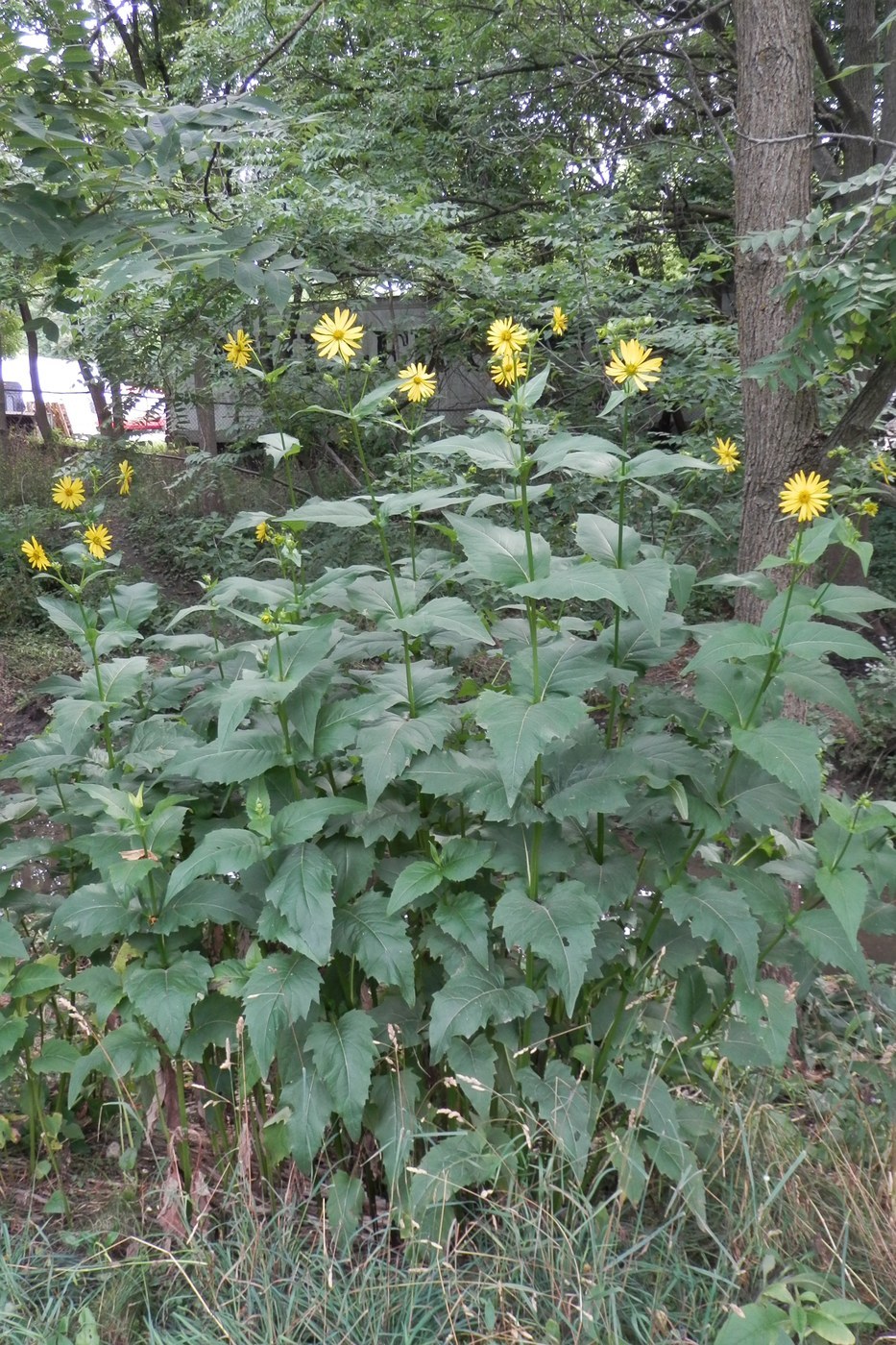
Key Identifying Features
Cup Plant (Silphium perfoliatum) is a towering prairie perennial in the aster family, instantly recognized by its leaf 'cups.' Key traits:
- Opposite leaves fused around the stem to form a water-holding cup at each node — the defining feature.
- Square (four-angled) stems — unusual for the daisy family.
- Yellow sunflower-like flower heads, 5–8 cm across, in branched clusters.
- Very tall, 1.5–3 m (5–10 ft) in height.
Leaves & Stems
The stout, smooth stems are distinctly square in cross-section. The large, coarse, triangular-to-ovate leaves are opposite and toothed; the upper leaf pairs join at their bases around the stem (perfoliate), forming a cup that catches and holds rainwater — birds and insects famously drink from these. Leaves are rough-textured (sandpapery) like other Silphium species.
Flowers & Fruit
Bloom time is mid to late summer (July–September). Flower heads sit atop the branched upper stems, each a yellow daisy with ~20–40 ray florets surrounding a paler yellow disc. Unlike true sunflowers, in Silphium the ray florets are the fertile, seed-producing ones. Fruits are flat, winged seeds (achenes) favored by goldfinches.
How to Tell It Apart from Look-Alikes
- True Sunflowers (Helianthus) have round stems, alternate upper leaves, and the disc florets (not rays) set seed; they never form leaf cups.
- Compass Plant (Silphium laciniatum) and Prairie Dock (S. terebinthinaceum) are relatives but have very different leaves (deeply cut or huge paddle-shaped) and don't form stem cups.
- Rosinweed (Silphium integrifolium) has unfused opposite leaves.
The single best confirmation is the perfoliate cup-forming opposite leaves on a square stem — no common look-alike shares it.
Where You'll Find It
Cup Plant grows in moist prairies, meadows, stream banks, ditches, and woodland edges across central and eastern North America. It favors full sun and moist, rich soil and forms tall, robust colonies. It is widely planted for wildlife, supporting bees, butterflies, and seed-eating birds.
Quick ID Checklist
- Fused opposite leaves forming water-holding cups at the stem
- Square stem
- Yellow sunflower-like heads, 5–8 cm
- Very tall, 1.5–3 m
- Rough, sandpapery, toothed leaves
- Moist sunny prairies, meadows, stream banks
Frequently asked questions
Do the leaf cups really hold water?
Yes. The opposite leaves fuse around the square stem to form a cup that collects rainwater and dew, and birds and insects are often seen drinking from them — hence the name Cup Plant.
How is Cup Plant different from a sunflower?
Cup Plant has a square stem and fused water-holding leaf cups, neither of which sunflowers have. Botanically, Silphium sets seed from its ray florets rather than its disc florets.
How tall does Cup Plant get?
It is a giant prairie plant, commonly 1.5–3 m (5–10 ft) tall, towering over most surrounding wildflowers.
Is Cup Plant good for wildlife?
Very — its flowers feed pollinators, its seeds attract goldfinches and other birds, and its leaf cups provide drinking water for many small creatures.