
Cypress Vine Identification Guide
Identify cypress vine (Ipomoea quamoclit) by its delicate, feathery, fern-like foliage and small star-shaped red trumpet flowers on a slender twining vine.
Read the full Cypress Vine encyclopedia entry →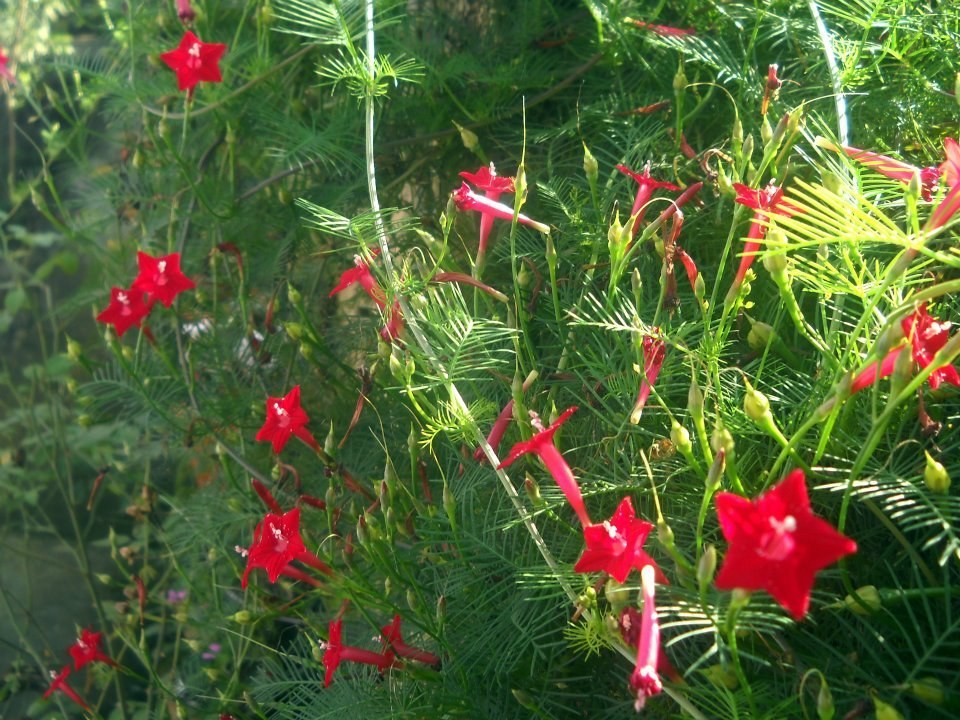
Key Identifying Features
Cypress vine (Ipomoea quamoclit), also called cypress creeper or hummingbird vine, is recognized by its finely cut, feathery, fern-like leaves and its small, star-shaped, scarlet-red flowers. It is a delicate, twining vine in the morning glory family.
- Lacy, thread-fine, fern-like foliage
- Small (~1 inch) five-pointed star flowers, usually bright red
- Slender twining vine, climbing 6–15 feet
- Hummingbird favorite
Leaves & Stems
The foliage is the most distinctive feature: leaves are deeply divided into many narrow, thread-like segments, giving a soft, feathery, almost pine-needle or fern appearance unlike any other morning glory. Leaves are bright green and alternate. Stems are very slender, smooth, and twining, climbing by wrapping around supports. The overall look is fine, airy, and lacy.
Flowers & Fruit
Flowers are small but vivid: a slender tube opening into a flat, five-pointed star about an inch wide, most commonly brilliant scarlet-red (white and pink forms exist). They appear singly or in small clusters along the stems and open during the day, attracting hummingbirds and butterflies. After bloom, small rounded capsules form containing a few black seeds. Blooms profusely from midsummer to frost.
How to Tell It Apart from Look-Alikes
- Cardinal climber (Ipomoea x multifida): A hybrid relative with slightly larger red flowers but lobed, less finely cut leaves — cypress vine's foliage is far more thread-like and ferny.
- Morning glory: Has heart-shaped leaves and larger flowers — completely different foliage.
- Cypress spurge or asparagus fern: May have feathery foliage but lack the red star flowers and twining habit.
- The fern-fine threadlike leaves + small red star flowers on a vine is unique to cypress vine.
Where You'll Find It
Cypress vine is grown as a fast annual ornamental vine on trellises, fences, strings, and arbors, prized for hummingbird appeal and delicate texture. Native to tropical America, it has naturalized in warm regions and can sometimes be found growing wild along fences and roadsides. It loves full sun, heat, and reseeds readily.
Quick ID Checklist
- Feathery, thread-fine, fern-like leaves
- Small scarlet-red star-shaped flowers (~1 in)
- Slender twining vine to 6–15 ft
- Attracts hummingbirds and butterflies
- Self-sows; blooms summer to frost
Frequently asked questions
What makes cypress vine easy to identify?
Its leaves are divided into many thread-fine, fern-like segments, unlike the heart-shaped leaves of most morning glories. This lacy foliage combined with small red star flowers makes it unmistakable.
What color are cypress vine flowers?
They are most often brilliant scarlet-red, though white and pink forms exist. The flowers are small, about an inch wide, and shaped like a five-pointed star.
How is cypress vine different from cardinal climber?
Both are red-flowered Ipomoea relatives, but cypress vine has extremely fine, thread-like fern foliage, while cardinal climber has broader, lobed leaves. The foliage texture is the quickest way to tell them apart.
Does cypress vine attract hummingbirds?
Yes. Its tubular red star flowers are highly attractive to hummingbirds and butterflies, which is why it is sometimes called hummingbird vine.