
Dallisgrass Identification Guide
How to identify dallisgrass (Paspalum dilatatum) by its coarse clumping habit, distinctive seedheads with black sticky spots, and short rhizomes in lawns and pastures.
Read the full Dallisgrass encyclopedia entry →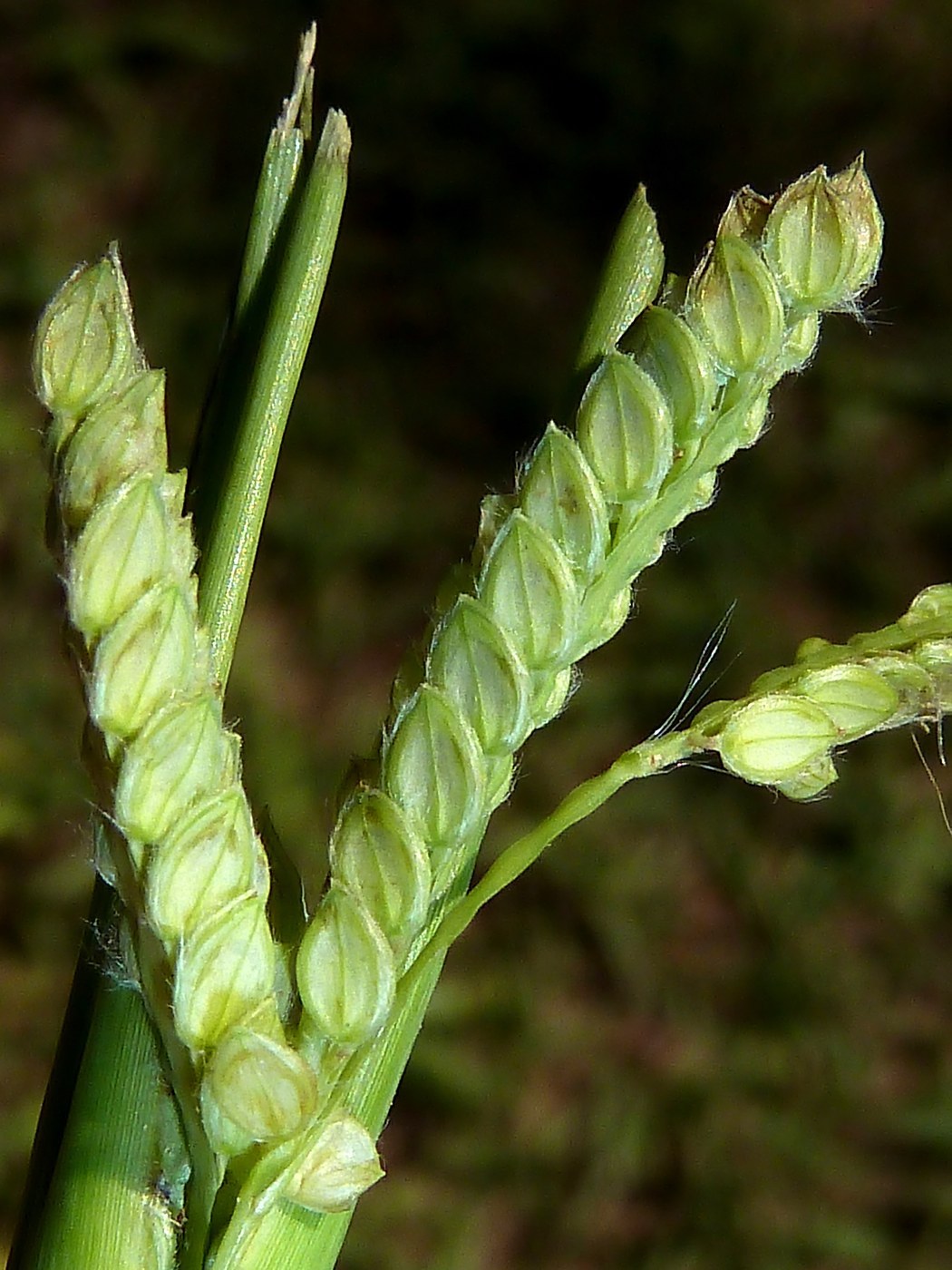
Key Identifying Features
Dallisgrass (Paspalum dilatatum) is a coarse, clump-forming perennial grass that is a notorious warm-season lawn and pasture weed. Identify it by:
- A dense, circular clump (bunch) growth that expands outward into rings
- Coarse, light green to grayish-green blades noticeably wider and rougher than turf grass
- A tall seedhead with finger-like branches lined with paired seeds
- Black sticky spots (ergot fungus) and fine silky hairs on the seeds
It grows faster than surrounding turf, producing seed stalks that shoot up days after mowing.
Leaves & Stems
Leaf blades are flat, 4-10 inches long, and up to about half an inch wide, with a prominent midrib and rough margins. The base of the plant is often tinged purple to reddish. A key vegetative clue is the membranous ligule (a papery collar) where the blade meets the sheath, and a few hairs near the collar. Dallisgrass spreads from short, knotty rhizomes, which produce the expanding clump and make it hard to pull out cleanly. Stems (culms) are stout and can reach 2-5 feet when allowed to flower.
Flowers & Fruit
The seedhead is the most reliable ID feature. It consists of a central stalk bearing 3-7 spreading branches (racemes) arranged like fingers. Along each branch, oval, flattened seeds (spikelets) are arranged in four rows and are fringed with fine silky white hairs. The seeds frequently carry black, sticky ergot fungus bodies, giving the head a speckled appearance — a near-diagnostic feature of dallisgrass. Seedheads appear from late spring through fall.
How to Tell It Apart from Look-Alikes
- Crabgrass: Lower-growing and lighter; its finger-like seedheads lack the silky-haired, black-spotted spikelets and crabgrass is an annual that dies at frost. Dallisgrass is a perennial clump.
- Bahiagrass (Paspalum notatum): A close relative, but bahiagrass usually has only two V-shaped seedhead branches versus dallisgrass's multiple spreading fingers.
- Tall fescue: Forms clumps but has narrower, darker, ribbed blades and a very different branched seedhead.
- Johnsongrass: Much taller with a large open reddish panicle and stout rhizomes, not the finger-like racemes.
Where You'll Find It
Dallisgrass favors warm climates, moist low spots, ditches, roadsides, pastures, sports fields, and over-watered lawns. It tolerates wet, compacted, and clay soils and is most aggressive in the southern and southeastern United States. It greens up in spring earlier than many warm-season turf grasses.
Quick ID Checklist
- Coarse clump expanding into a ring
- Wide, rough, light-green blades with prominent midrib
- Purple-tinged base and short knotty rhizomes
- Seedhead with 3-7 finger-like branches
- Spikelets in four rows, fringed with silky hairs
- Black sticky ergot spots on the seeds
- Perennial; regrows seed stalks quickly after mowing
The combination of a coarse perennial clump and a finger-branched seedhead dotted with black sticky spots reliably identifies dallisgrass.
Frequently asked questions
How is dallisgrass different from crabgrass?
Dallisgrass is a perennial that grows in expanding clumps from short rhizomes and survives winter, while crabgrass is a low-growing annual that dies at frost. Dallisgrass seedheads also have silky-haired spikelets with black sticky ergot spots, which crabgrass lacks.
What are the black spots on dallisgrass seedheads?
They are bodies of ergot fungus that commonly infect the seeds. This black, sticky speckling is a near-diagnostic identification feature for dallisgrass seedheads.
Why does dallisgrass grow taller than my lawn so fast?
It has a faster vertical growth rate than most turf grasses and rapidly sends up seed stalks, so within a few days of mowing you see coarse stalks rising above the surrounding lawn.
Is dallisgrass an annual or perennial?
It is a warm-season perennial. It survives winter through its crown and short knotty rhizomes and re-greens each spring, which is why simply removing the seedheads does not eliminate it.