
Daphne Identification Guide
Identify Daphne by its intensely fragrant clusters of small tubular flowers, neat oval (often variegated) leaves, and compact form.
Read the full Daphne encyclopedia entry →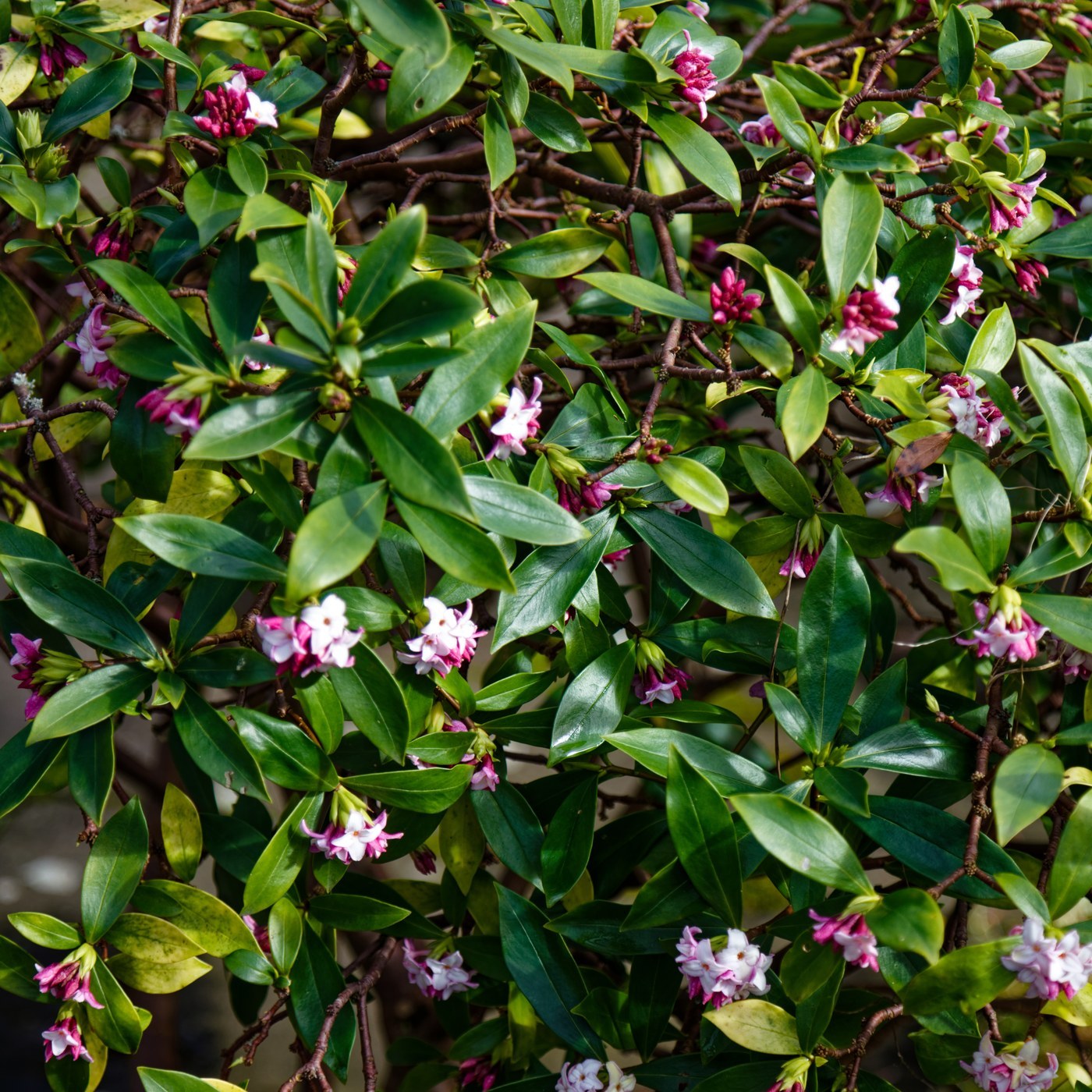
Key Identifying Features
Daphne is a genus of small, often evergreen shrubs (family Thymelaeaceae) prized for powerfully fragrant flowers. The most common garden type is Daphne odora (winter daphne). Identify Daphne by its dense terminal clusters of small, tubular, four-lobed flowers with an exceptionally sweet perfume, smooth-edged oval leaves (frequently variegated with a cream margin), and a tidy, slow-growing, mounded habit.
- Compact rounded shrub, often 2–4 ft tall and wide
- Intensely fragrant clusters of small flowers
- Smooth, untoothed, leathery leaves
- Tough, fibrous bark on smooth stems
Leaves & Stems
Leaves are alternate (sometimes nearly whorled at stem tips), simple, elliptic to oblong, 1.5–3.5 in long, thick and leathery with smooth (entire) margins and a glossy surface. Many popular forms — like Daphne odora 'Aureomarginata' — have a narrow cream or yellow leaf margin. Stems are smooth and the bark is tough and fibrous. Daphne is generally slow-growing and dislikes root disturbance.
Flowers & Fruit
Flowers are borne in tight, rounded clusters at the branch tips. Each flower is small, tubular, opening to four spreading lobes, typically pink to rosy-purple on the outside and paler/white inside (some species pure white or yellow). The defining feature is the strong, sweet fragrance that carries on the air — often in late winter to early spring for D. odora. Fruit is a small fleshy red (or sometimes yellow) berry-like drupe.
How to Tell It Apart from Look-Alikes
- Sarcococca (sweet box): Also winter-fragrant and evergreen, but has spidery white flowers and black berries, with narrower glossy leaves.
- Pieris/Andromeda: Has urn-shaped flowers in drooping chains, not tubular four-lobed clusters.
- Viburnum (fragrant types): Larger shrubs with bigger, often toothed leaves and broader flower clusters.
The small four-lobed tubular fragrant flower clusters + smooth leathery (often cream-edged) leaves + compact slow growth combination identifies Daphne.
Where You'll Find It
Grown in gardens across USDA zones 7–9 (some species hardier) in foundation beds, near entries and paths where the fragrance can be enjoyed, and in woodland borders. Daphne species are native to Europe, Asia, and North Africa. It prefers moist but very well-drained soil and part shade, and resents being moved.
Quick ID Checklist
- Compact, slow-growing, often evergreen shrub
- Powerfully fragrant clusters of small flowers
- Tubular, four-lobed pink/white/purple flowers
- Smooth-edged leathery leaves, often cream-margined
- Small red berry-like fruits
- Tough, fibrous bark and a tidy mounded habit
Frequently asked questions
Why is Daphne so famous for fragrance?
Daphne flowers, especially winter daphne (D. odora), emit an exceptionally strong, sweet perfume that carries on the air, often in late winter when little else blooms.
What do Daphne flowers look like up close?
They are small and tubular, opening into four spreading lobes, clustered tightly at the branch tips, usually pink to purple outside and paler inside.
Why is my Daphne struggling after transplanting?
Daphne is slow-growing and famously resents root disturbance; it does best left in place in well-drained soil and can decline if moved.