
Douglas Fir Identification Guide
A practical guide to identifying Douglas fir by its soft flat needles, three-pronged bracts on the cones, and pointed buds.
Read the full Douglas Fir encyclopedia entry →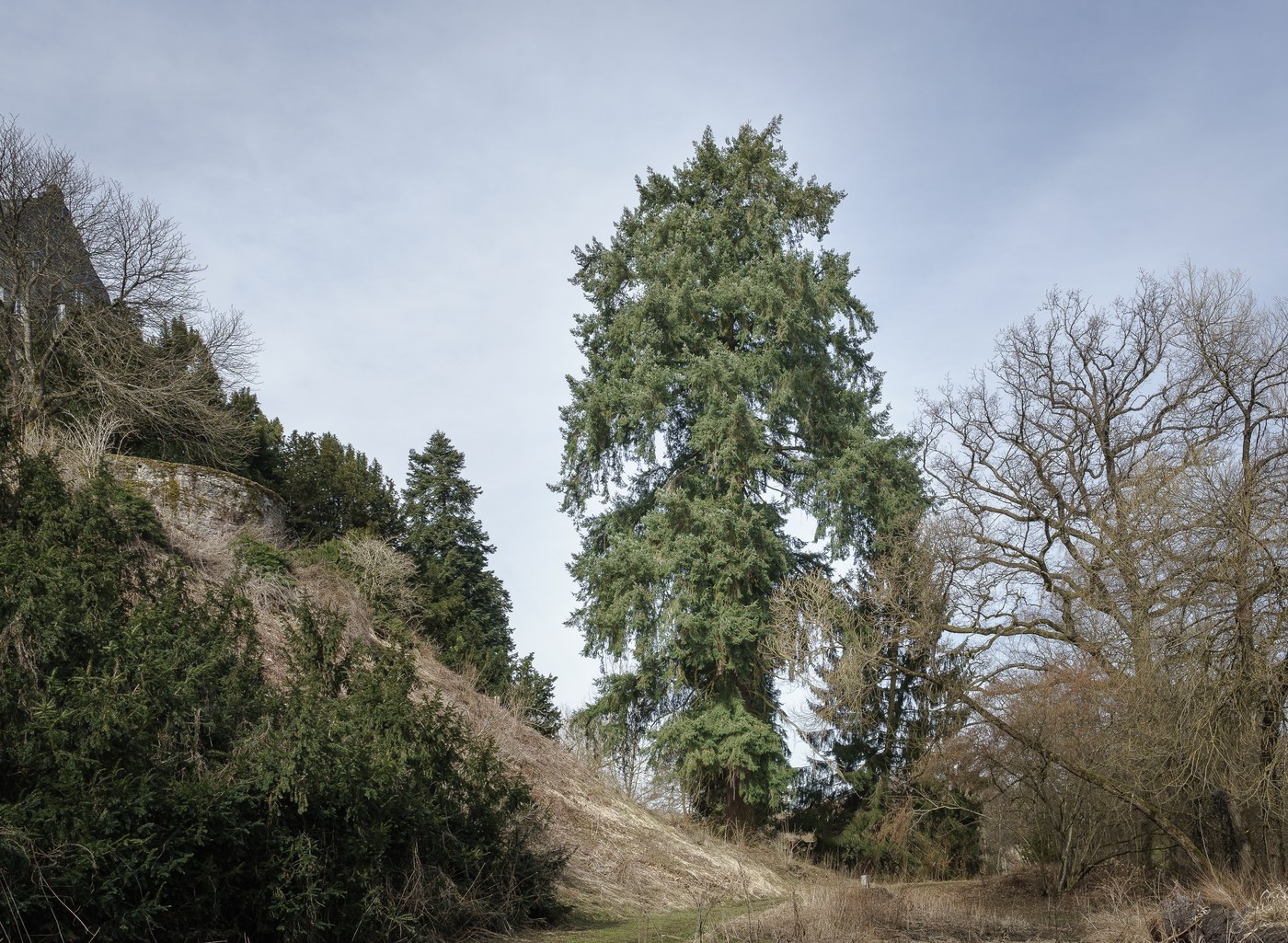
Key Identifying Features
Douglas fir (Pseudotsuga menziesii) is one of the tallest and most economically important conifers of western North America. Despite its name, it is not a true fir (Abies); its distinctive cone bracts give it away instantly.
- Soft, flat, single needles attached individually around the twig
- Cones that hang downward with three-pointed ("mouse tail") bracts sticking out between the scales
- Sharply pointed, reddish-brown buds at the twig tips
- Thick, deeply furrowed, corky gray-brown bark on mature trees
Leaves & Stems
The needles are flat, soft, and about 2-3 cm long, arranged spirally but often appearing to spread in all directions around the twig (bottlebrush-like). They are a deep yellow-green to blue-green, with two pale whitish bands of stomata on the underside. When crushed, they release a sweet, citrusy-resinous fragrance.
Unlike true firs, when a needle is plucked it leaves a small raised, woody peg-like projection on the twig. The terminal buds are a reliable feature: spindle-shaped, sharply pointed, shiny reddish-brown, and papery, unlike the rounded resinous buds of spruces and true firs.
Flowers & Fruit
As a conifer, Douglas fir produces cones rather than flowers. The seed cones are 5-10 cm long, oval, and hang down from the branches (true fir cones stand upright and disintegrate on the tree). The hallmark feature is the three-lobed papery bract protruding from beneath each cone scale, resembling the hind feet and tail of a mouse diving into the cone. Cones mature and fall intact in a single season.
How to Tell It Apart from Look-Alikes
- True firs (Abies): Cones stand upright and fall apart on the branch; needles leave flat round scars (no peg); buds are rounded and resinous.
- Spruces (Picea): Needles are stiff, four-sided, and sharp, and sit on woody pegs; no three-pronged bracts.
- Hemlocks (Tsuga): Needles are much shorter and flat with a fine-toothed margin; cones are tiny and lack bracts.
The protruding mouse-tail bracts are diagnostic and found on no other common conifer.
Where You'll Find It
Native to the Pacific Northwest, the Rocky Mountains, and the mountains of the western U.S. and Mexico. Coastal Douglas fir thrives in moist, well-drained mountain and valley forests, while the Rocky Mountain variety occupies drier slopes. It is also widely planted as a timber tree, ornamental, and Christmas tree across temperate regions worldwide.
Quick ID Checklist
- Soft, flat needles spreading around the twig, citrus-resin scent
- Sharp, pointed, reddish-brown papery buds
- Hanging cones with three-pronged "mouse tail" bracts
- Twigs with small raised pegs where needles detach
- Thick, deeply furrowed corky bark on old trees
Frequently asked questions
Is Douglas fir a true fir?
No. Despite the name, it belongs to the genus Pseudotsuga, not Abies. Its hanging cones with three-pronged bracts and pointed buds distinguish it from true firs.
What is the easiest way to identify Douglas fir?
Look at a fallen cone for the distinctive three-lobed papery bracts that stick out between the scales, often described as a mouse's tail and hind feet.
How do the buds help with identification?
Douglas fir has sharply pointed, spindle-shaped, shiny reddish-brown papery buds, unlike the rounded, resinous buds of true firs and spruces.
Do the needles smell like anything?
Yes, crushed needles give off a sweet citrusy-resinous fragrance, which is why the foliage is popular for Christmas trees and wreaths.