
Dragon Blood Tree Identification Guide
Identify the dragon blood tree (Dracaena cinnabari) by its umbrella-shaped crown, sword-like blue-green leaves, and the red resin that bleeds from its bark.
Read the full Dragon Blood Tree encyclopedia entry →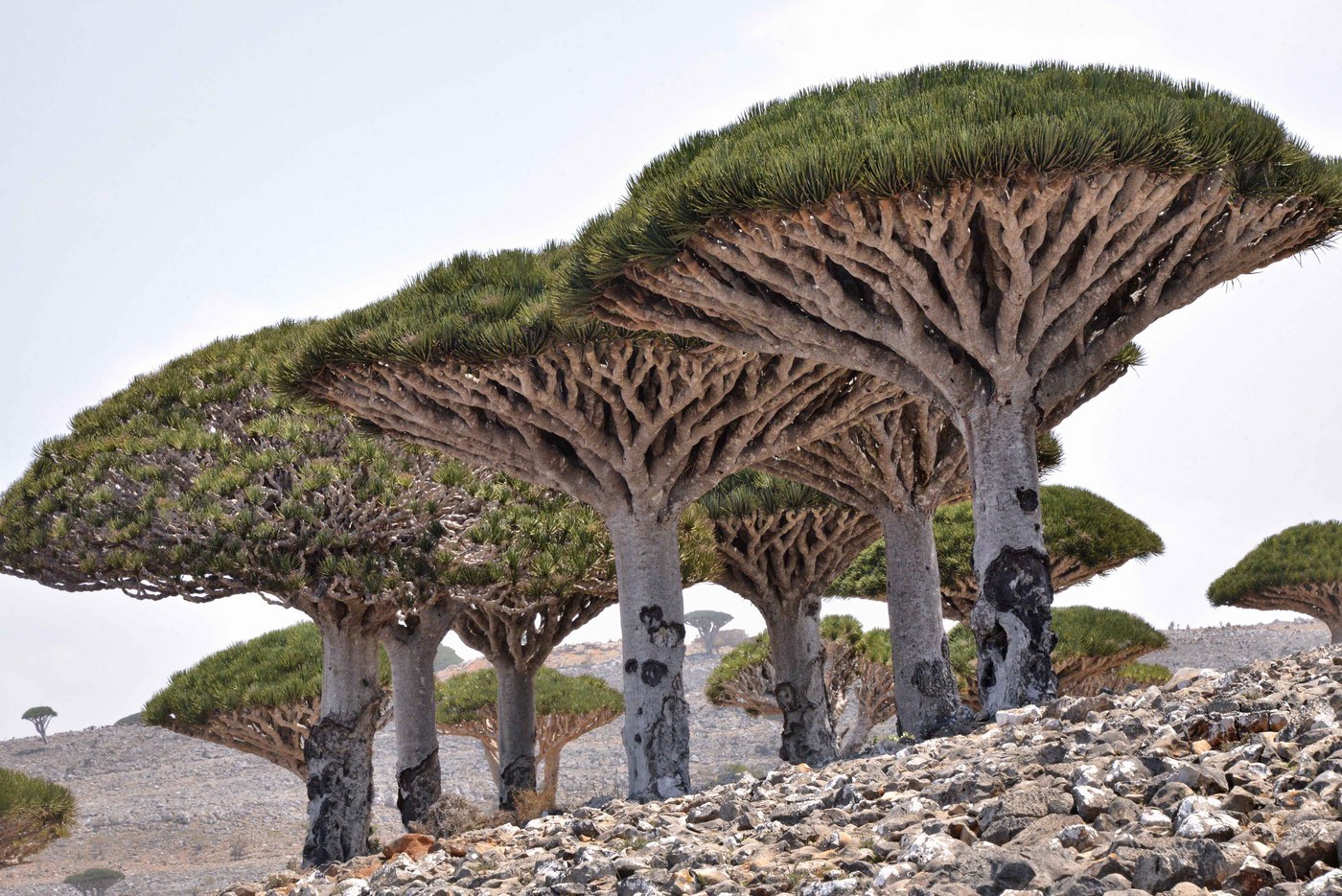
Key Identifying Features
The dragon blood tree (Dracaena cinnabari) of Socotra is one of the most distinctive trees alive, recognized by its dense, upturned, umbrella- or mushroom-shaped crown held on a thick trunk that branches repeatedly into a tightly packed canopy. Cut or wounded bark exudes a dark red sap - the legendary "dragon's blood."
- Umbrella / inverted-mushroom crown of densely packed branches
- Stiff, sword-shaped blue-green leaves clustered at branch tips
- Red resin ("dragon's blood") that oozes from the bark
- Thick, smooth, gray trunk dividing into many equal branches
Leaves & Stems
Leaves are long, narrow, stiff, and sword-like (lanceolate), 1-2 ft long and about 1-1.5 in wide, gray-green to blue-green, with parallel veins typical of a monocot. They are crowded into dense rosettes only at the very ends of the branches, leaving the interior of the crown bare. Branches fork dichotomously (each tip splits into two), and this repeated even forking is what builds the characteristic flat-topped umbrella. The trunk is stout, smooth, and silvery-gray.
Flowers & Fruit
Flowering occurs at the branch tips with panicles of small, fragrant, greenish-white flowers. These develop into small fleshy berries that ripen from green through black to orange-red when mature, each containing a few seeds and dispersed by birds. Flowering and fruiting are seasonal and not always present. The plant's most famous "product" is not the fruit but the bright crimson resin that seeps from cuts in the bark and is harvested for dye and varnish.
How to Tell It Apart from Look-Alikes
- Other Dracaena (e.g. D. draco, Canary Island dragon tree): very similar umbrella crown and red sap; D. cinnabari is endemic to Socotra and tends to have a more perfectly flattened, tightly packed umbrella, while D. draco is bulkier with a stouter trunk.
- Joshua tree / yuccas: also have sword leaves in tip clusters, but produce large white flower spikes and have a shaggier, irregular form, and no red resin.
- Aloe trees (Aloidendron): succulent rosettes and tubular flowers, but leaves are fleshy and toothed, not stiff and flat, and sap is yellowish.
The flat umbrella crown + tip-clustered sword leaves + red bleeding resin confirm a dragon blood tree.
Where You'll Find It
It is endemic to the Socotra archipelago of Yemen, growing on arid limestone plateaus and mist-catching mountain slopes, where its crown harvests fog moisture. It is rare in cultivation and grown only in specialist collections and botanical gardens in dry, frost-free climates. It is considered vulnerable/endangered due to climate change and grazing.
Quick ID Checklist
- Dense umbrella or upturned-mushroom crown
- Sword-shaped blue-green leaves clustered only at branch tips
- Dark red resin bleeding from cut bark
- Branches fork evenly (dichotomously) into two
- Small berries ripening green to orange-red
- Arid setting; native to Socotra
Frequently asked questions
Why is it called the dragon blood tree?
When the bark or branches are cut, the tree exudes a deep red resin that looks like blood, long called 'dragon's blood.' This crimson sap has been harvested for dyes and varnish for centuries.
Why does it have that umbrella shape?
Its branches fork evenly into two again and again, building a dense, flat-topped umbrella crown. This shape helps the tree collect moisture from fog and shade its own roots in its arid Socotra habitat.
Is the dragon blood tree the same as the Canary Island dragon tree?
They are close relatives in the genus Dracaena and look similar, both bleeding red sap. The true dragon blood tree, Dracaena cinnabari, is endemic to Socotra, while Dracaena draco is from the Canary Islands and nearby.
Where does the dragon blood tree grow naturally?
Only on the Socotra archipelago of Yemen, on dry limestone plateaus and misty mountain slopes. It is rare and considered threatened, so it is uncommon outside specialist collections.