Dragon Blood Tree
Dracaena cinnabari
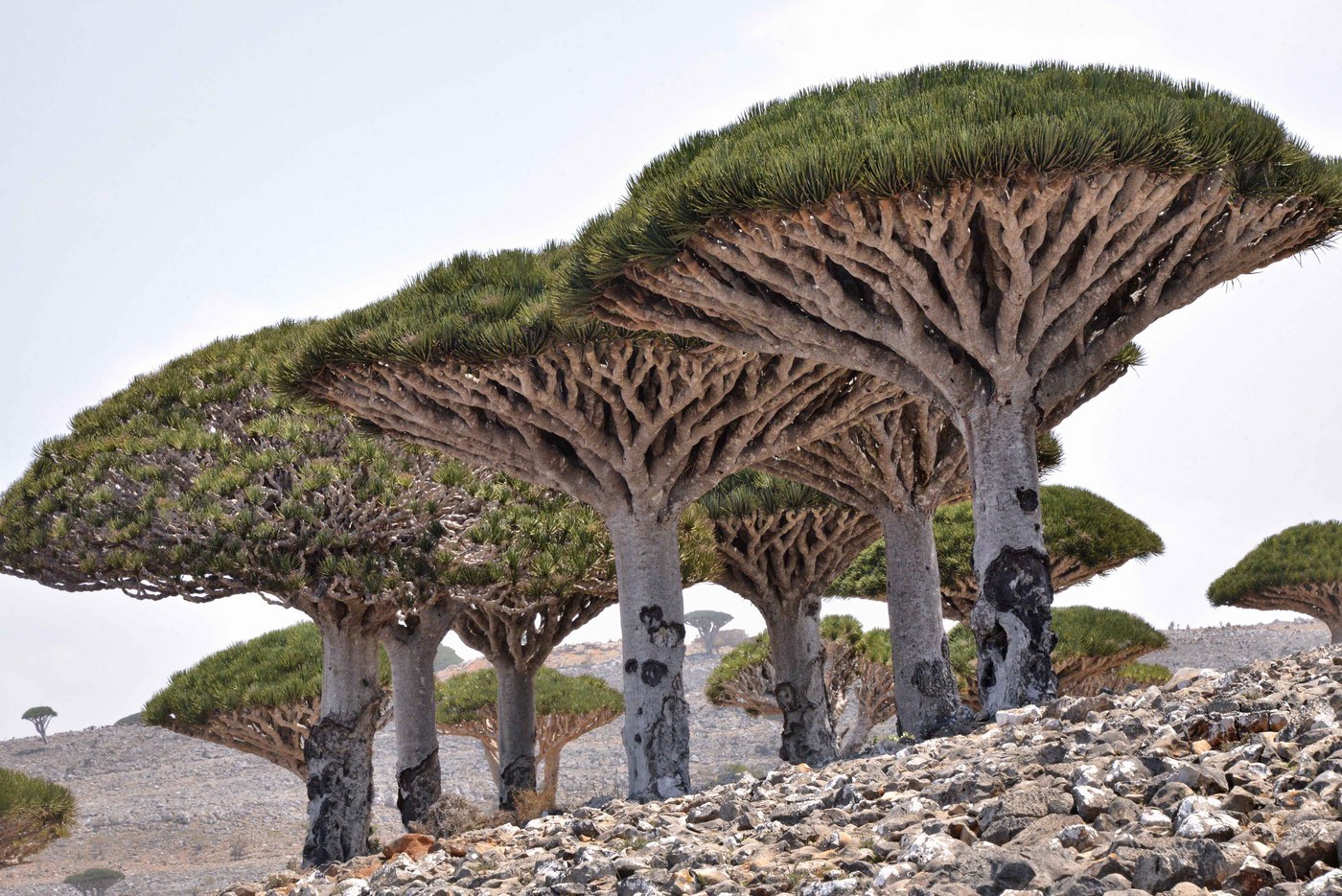
The dragon blood tree is a strange, umbrella-shaped tree endemic to Yemen's Socotra Island, named for the deep-red resin it exudes. Its dense canopy of upturned branches resembles an inside-out umbrella.
- Light
- Full sun to bright light
- Water
- Low; very drought-tolerant
- Difficulty
- Moderate
Got a plant like this?
Identify any plant from a photo, free.
Overview
The dragon blood tree, Dracaena cinnabari, is one of the most distinctive trees in the world, with a thick trunk that branches into a dense, tightly packed, upward-curving crown shaped like an upturned umbrella or mushroom.
It is named for the dark red sap, "dragon's blood," that bleeds from cuts in the bark and has been traded since antiquity as a dye and varnish.
The species is endemic to Socotra Island, Yemen, where its unique umbrella shape is an adaptation to capture moisture from mist and shade its own roots. It is slow-growing, long-lived and now threatened by a drying climate and lack of regeneration.
How to identify it
- Canopy: dense, umbrella- or mushroom-shaped crown of upward-pointing branches packed tightly together
- Leaves: stiff, sword-shaped, blue-green leaves clustered at the branch tips, renewed every few years
- Trunk: stout, with smooth grey bark; branches dichotomously (splitting in twos) after flowering
- Resin: dark red sap ("dragon's blood") oozes from wounds in the bark
- Fruit: small fleshy berries that ripen from green through black to orange-red
Care & growing
Light: full sun to bright light.
Water: very drought-tolerant; water sparingly and let the soil dry well between waterings, as it is adapted to arid, misty conditions.
Soil: sharply drained, gritty or rocky soil; avoid wet feet.
Temperature: warm, frost-free conditions; protect from freezing.
Feeding: minimal.
Propagation: from seed (slow) or sometimes cuttings; growth is extremely slow, a few centimeters of trunk per year.
Note: grown as a rare collector's specimen and container plant outside its homeland.
Habitat & origin
Dracaena cinnabari is endemic to the Socotra archipelago of Yemen in the Arabian Sea, where it grows on limestone plateaus and mountains, drawing moisture from sea mists and monsoon cloud.
It is classed as Vulnerable, threatened by a drying climate, overgrazing that prevents seedlings from surviving, and habitat loss. Outside Socotra it is grown only as a rare ornamental and botanical curiosity in arid-climate gardens and collections.
Frequently asked questions
Why is it called the dragon blood tree?
Cuts in the bark exude a deep blood-red resin known as 'dragon's blood,' historically prized as a dye, varnish and incense.
Where does the dragon blood tree grow?
It is endemic to the Socotra archipelago of Yemen, growing on the island's misty limestone highlands and nowhere else in the wild.
Why is the tree shaped like an umbrella?
The dense, upturned canopy helps capture moisture from mist and funnels it to the roots while shading the ground beneath, an adaptation to its arid, misty home.
Is the dragon blood tree endangered?
It is listed as Vulnerable. A drying climate and grazing animals prevent new seedlings from establishing, so the existing trees are aging without replacement.
Dragon Blood Tree guides
In-depth guides for identifying, growing, and caring for Dragon Blood Tree.
How to Care for Dragon Blood Tree
Grow the sculptural Dragon Blood Tree in full sun with gritty, fast-draining soil and very sparing watering for a slow, dramatic form.
Dragon Blood Tree Identification Guide
Identify the dragon blood tree (Dracaena cinnabari) by its umbrella-shaped crown, sword-like blue-green leaves, and the red resin that bleeds from its bark.