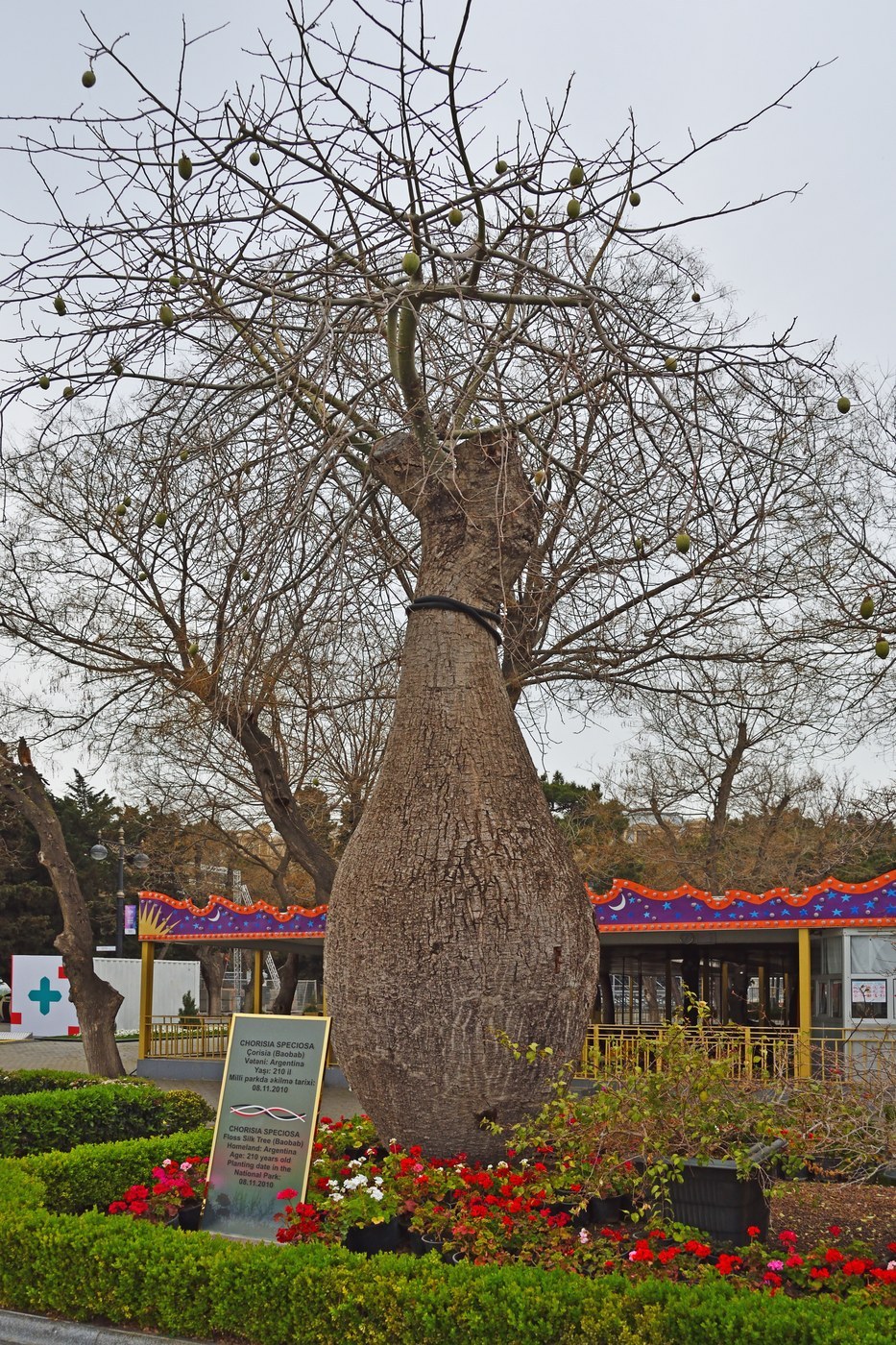
Silk Floss Tree
Ceiba speciosa
The silk floss tree is a striking subtropical tree with a bulging, thorn-studded green trunk and large pink-and-cream hibiscus-like flowers in autumn. Its seed pods burst to release silky white fibers, giving the tree its name.
- Light
- Full sun
- Water
- Moderate; drought-tolerant
- Difficulty
- Moderate
Got a plant like this?
Identify any plant from a photo, free.
Overview
Ceiba speciosa (formerly Chorisia speciosa) is a fast-growing deciduous tree native to the subtropical forests of South America, grown worldwide for its dramatic trunk and showy blooms.
The swollen, often bottle-shaped trunk is covered in stout conical spines and stores water, an adaptation to seasonal drought. In autumn the bare or partly leafed branches erupt with large pink, rose, and creamy-white flowers.
Later, woody pods split open to reveal masses of silky kapok-like floss surrounding the seeds, a fiber historically used for stuffing.
How to identify it
A medium to large deciduous tree reaching 10-18 m with a distinctive swollen, spiny trunk.
- Trunk: green when young (photosynthetic), often bulging or bottle-shaped, studded with thick conical thorns
- Leaves: palmately compound with 5-7 lance-shaped, finely toothed leaflets
- Flowers: large, five-petalled, pink to rose with creamy-white and brown-streaked centers, hibiscus-like, in autumn
- Fruit: woody, pear-shaped capsules that split to release seeds embedded in silky white floss
- Habit: fast-growing with a spreading crown
Care & growing
Suited to warm, frost-free Mediterranean and subtropical climates.
- Light: full sun
- Water: moderate; very drought-tolerant once established thanks to its water-storing trunk
- Soil: well-drained soil is essential; tolerates sandy and rocky ground
- Temperature: tolerates light frost when mature; best in zones 9-11
- Feeding: minimal; occasional feeding aids young trees
- Propagation: easily from seed; cuttings also root
Habitat & origin
Native to the subtropical and tropical forests of Brazil, Argentina, Paraguay, and Bolivia, where it grows in seasonally dry woodland.
Widely planted as an ornamental street and park tree in warm regions including California, the Mediterranean, Australia, and South Asia, valued for its tolerance of heat and drought.
Frequently asked questions
Why is the trunk covered in spines?
The conical thorns are thought to deter browsing animals and reduce climbing predation; they are most prominent on young trunks and branches.
What is the silky floss used for?
The kapok-like fiber from its pods has traditionally been used as stuffing for pillows, mattresses, and flotation devices.
Why is it called the drunken tree?
The Spanish name palo borracho, or drunken stick, refers to the swollen, bottle-shaped trunk that bulges as it stores water.
Does it lose its leaves?
Yes, it is deciduous and typically drops its leaves before or during its autumn flowering display.
Silk Floss Tree guides
In-depth guides for identifying, growing, and caring for Silk Floss Tree.
How to Care for Silk Floss Tree
Grow the dramatic Ceiba speciosa: a fast, thorny-trunked ornamental tree that loves full sun and rewards patience with pink autumn blooms.
Silk Floss Tree Identification Guide
How to identify the Silk Floss Tree by its thorn-studded green bottle-shaped trunk, pink hibiscus-like flowers, and pods stuffed with silky floss.
Silk Floss Tree identified by the community
Real specimens identified with Plant Identifier.