Silk Floss Tree Identification Guide
How to identify the Silk Floss Tree by its thorn-studded green bottle-shaped trunk, pink hibiscus-like flowers, and pods stuffed with silky floss.
Read the full Silk Floss Tree encyclopedia entry →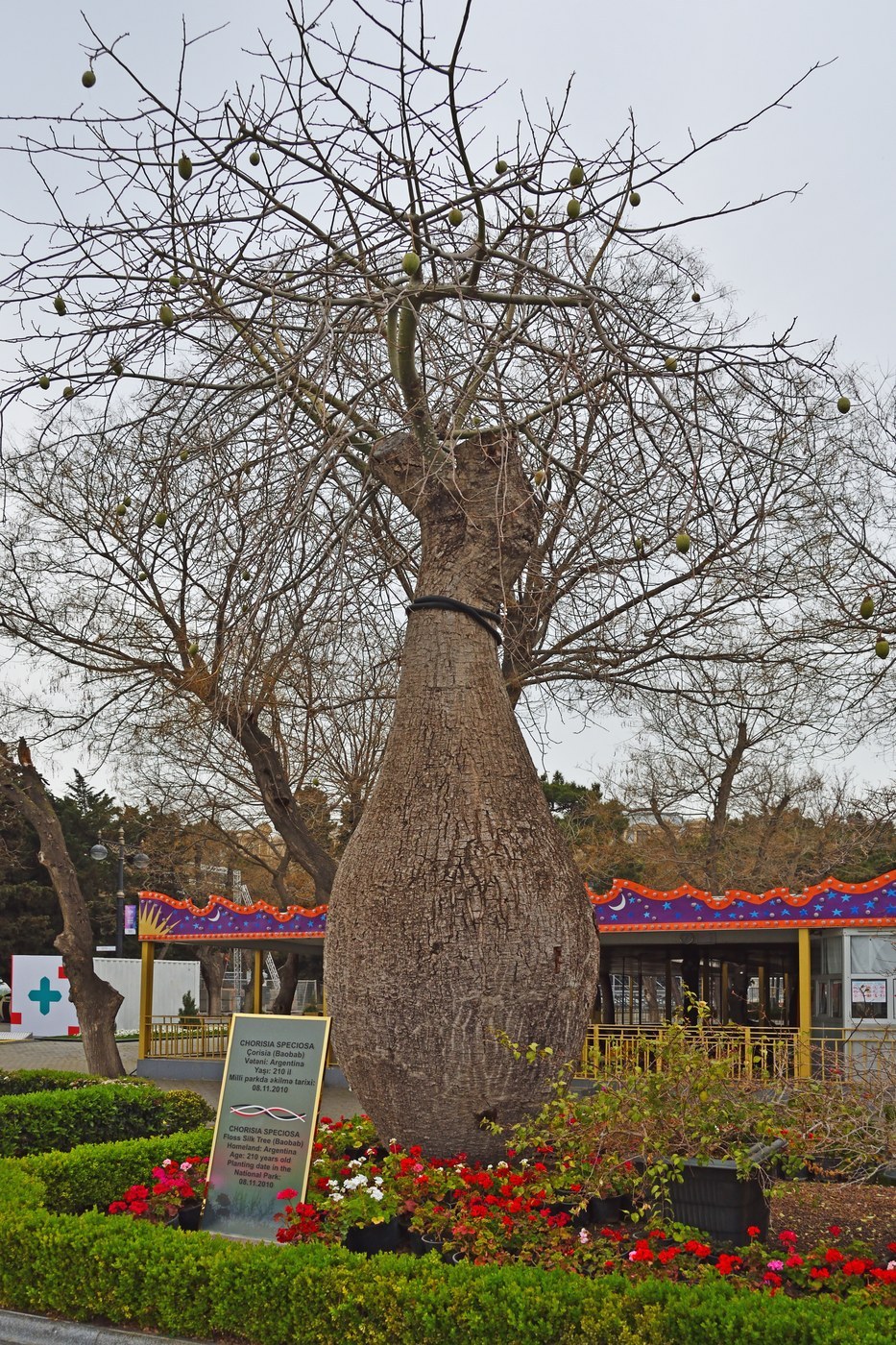
Key Identifying Features
The Silk Floss Tree (Ceiba speciosa, formerly Chorisia speciosa) is one of the most distinctive trees in cultivation, recognized at a glance by its thick, green, thorn-covered, bottle-shaped trunk.
- Swollen green trunk studded with stout conical thorns
- Large pink to rose flowers with a creamy/yellow throat
- Pear-shaped pods bursting with white silky floss
- Medium tree, 10-18 m tall, with a spreading crown
Leaves & Stems
Leaves are palmately compound (hand-shaped) with 5-7 finger-like leaflets radiating from a central stalk. Each leaflet is lance-shaped to elliptical, 8-12 cm long, with finely toothed margins and a pointed tip. The tree is deciduous, usually dropping its leaves before or during flowering.
The trunk is the signature feature: smooth, green (from chlorophyll in the bark), often bulging or bottle-shaped, and armored with broad-based, sharp conical thorns that can be 1-2 cm long. Younger trunks are greenest; older bark grays and the thorns may become less dense.
Flowers & Fruit
- Flowers appear in autumn (often on bare branches), each a showy 10-15 cm wide, five-petaled bloom. Petals are pink to rose at the tips, fading to creamy white or yellow streaked with brown toward the center — resembling a hibiscus or orchid. They attract bees, butterflies, and hummingbirds.
- Fruit is a woody, pear- or avocado-shaped capsule that splits to reveal masses of fluffy white silk (kapok-like floss) surrounding the seeds. This floss was historically used for stuffing pillows and life jackets and is the source of the common name.
How to Tell It Apart from Look-Alikes
- Kapok / Ceiba pentandra is a giant relative with buttressed trunks and white/pink flowers, but its trunk is far larger and its flowers smaller and dingier.
- Floss Silk relatives (Ceiba insignis) have yellow or white flowers rather than pink — a key color distinction.
- Silk Cotton and Bombax species can have thorny trunks, but the bright green photosynthetic bottle-trunk plus large pink-and-cream flowers identifies Ceiba speciosa specifically.
Where You'll Find It
Native to the subtropical forests of Brazil, Argentina, Paraguay, and Bolivia, it is widely planted as an ornamental street and park tree in warm climates including California, Florida, the Mediterranean, Australia, and South Africa. It tolerates drought once established and prefers full sun.
Quick ID Checklist
- Green, swollen, bottle-shaped trunk covered in stout thorns
- Palmate leaves with 5-7 toothed finger-like leaflets
- Large pink-and-cream five-petaled flowers in autumn
- Woody pods filled with white silky floss
- Often flowers on bare branches; deciduous
Frequently asked questions
Why is the trunk green and covered in thorns?
The bark contains chlorophyll, allowing the trunk to photosynthesize, which is why it stays green. The conical thorns are thought to deter climbing animals and browsers and help the young tree store and protect water.
What is the 'silk floss' the tree is named for?
It refers to the fluffy white fibers packed inside the seed pods. This kapok-like floss surrounds the seeds and was historically harvested to stuff pillows, mattresses, and flotation devices.
How do I tell it from a yellow-flowered floss tree?
The closely related Ceiba insignis has white to yellow flowers, while the true Silk Floss Tree (Ceiba speciosa) has distinctly pink to rose flowers with a creamy center. Flower color is the quickest separator.
When does the Silk Floss Tree flower?
It typically blooms in autumn, often spectacularly on bare or nearly leafless branches, covering the canopy in large pink flowers before or as the new foliage emerges.
Silk Floss Tree identified by the community
Recent Silk Floss Tree specimens identified with Plant Identifier.