
Dragon Fruit Identification Guide
Identify dragon fruit (pitaya, Hylocereus/Selenicereus) by its three-ribbed climbing cactus stems, huge night-blooming white flowers, and scaly pink fruit.
Read the full Dragon Fruit encyclopedia entry →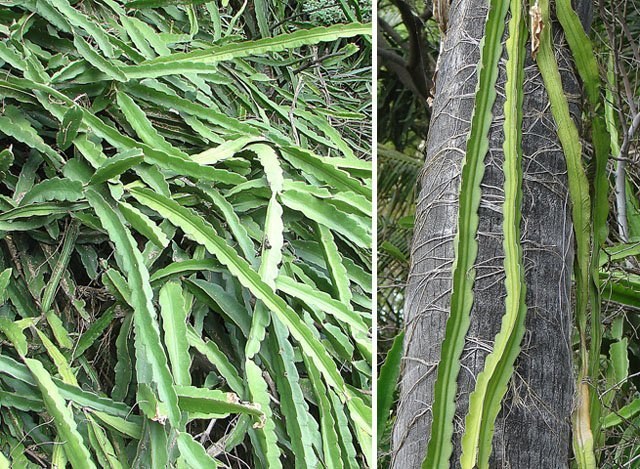
Key Identifying Features
Dragon fruit, or pitaya (Selenicereus undatus, formerly Hylocereus undatus, and related species), is a climbing/sprawling epiphytic cactus. Its diagnostic traits are fleshy, three-sided (triangular) green stems with wavy ribs and small spines, enormous fragrant white night-blooming flowers, and a striking oval fruit covered in leafy scales (bracts), usually bright pink or yellow.
Leaves & Stems
- It has no true leaves; photosynthesis occurs in the succulent green stems.
- Stems are three-angled (occasionally 4-5 ribbed), 4-7 cm thick, with scalloped/wavy margins bearing clusters of 1-3 short spines (areoles) along the ridges.
- Stems climb and clamber using aerial roots, draping over supports and trees, reaching several meters.
Flowers & Fruit
- Flowers are spectacular, 25-30 cm long, white with greenish-yellow outer segments, opening only at night and lasting a single night (hence "Queen of the Night" for relatives).
- Each bloom is heavily fragrant and pollinated by moths or bats (often hand-pollinated in cultivation).
- Fruit is oval, 10-15 cm, with bright magenta-pink, red, or yellow skin covered in green-tipped fleshy scales.
- Flesh is white, red, or magenta, juicy, dotted with tiny black seeds like a kiwi.
How to Tell It Apart from Look-Alikes
- Other columnar cacti (Cereus, Stenocereus): these are often upright, rigid, and more heavily spined; dragon fruit stems are floppy, climbing, and three-ribbed.
- Epiphyllum / orchid cactus: has flat leaf-like stems, not triangular ones.
- Cereus night-bloomers: flowers look similar, but dragon fruit's scaly pink fruit is unmistakable.
- The leafy-scaled bright fruit plus triangular climbing stems together rule out all common cacti.
Where You'll Find It
Native to Mexico and Central America, dragon fruit is now grown across tropical and subtropical regions worldwide. In cultivation it is trained on posts, trellises, and concrete frames; in the wild and in gardens it scrambles over trees, walls, and rocks. It needs warmth, bright light, and excellent drainage and is intolerant of hard frost.
Quick ID Checklist
- Climbing/sprawling cactus with aerial roots
- Three-ribbed, fleshy green stems with wavy margins and small spine clusters
- No leaves
- Giant white night-blooming fragrant flowers
- Oval pink/yellow fruit with leafy scales and seed-flecked flesh
Frequently asked questions
Is dragon fruit a cactus?
Yes. Dragon fruit is the fruit of a climbing epiphytic cactus with fleshy three-sided green stems, aerial roots, and spine clusters along the ribs, rather than true leaves.
How do I recognize the dragon fruit plant without fruit?
Look for long, floppy, climbing green stems that are distinctly three-angled with wavy scalloped edges and small clusters of short spines, attaching to surfaces with aerial roots.
What do dragon fruit flowers look like?
They are very large (about 25-30 cm), white with greenish outer petals, intensely fragrant, and open only at night for a single night before closing.
What gives dragon fruit its name?
The oval fruit is covered in overlapping fleshy, often green-tipped scales or bracts that resemble dragon scales, set against bright pink, red, or yellow skin.