Dragon Tree Identification Guide
Identify the Dragon Tree (Dracaena marginata) by its slender woody canes topped with spiky fountains of thin red-edged leaves.
Read the full Dragon Tree encyclopedia entry →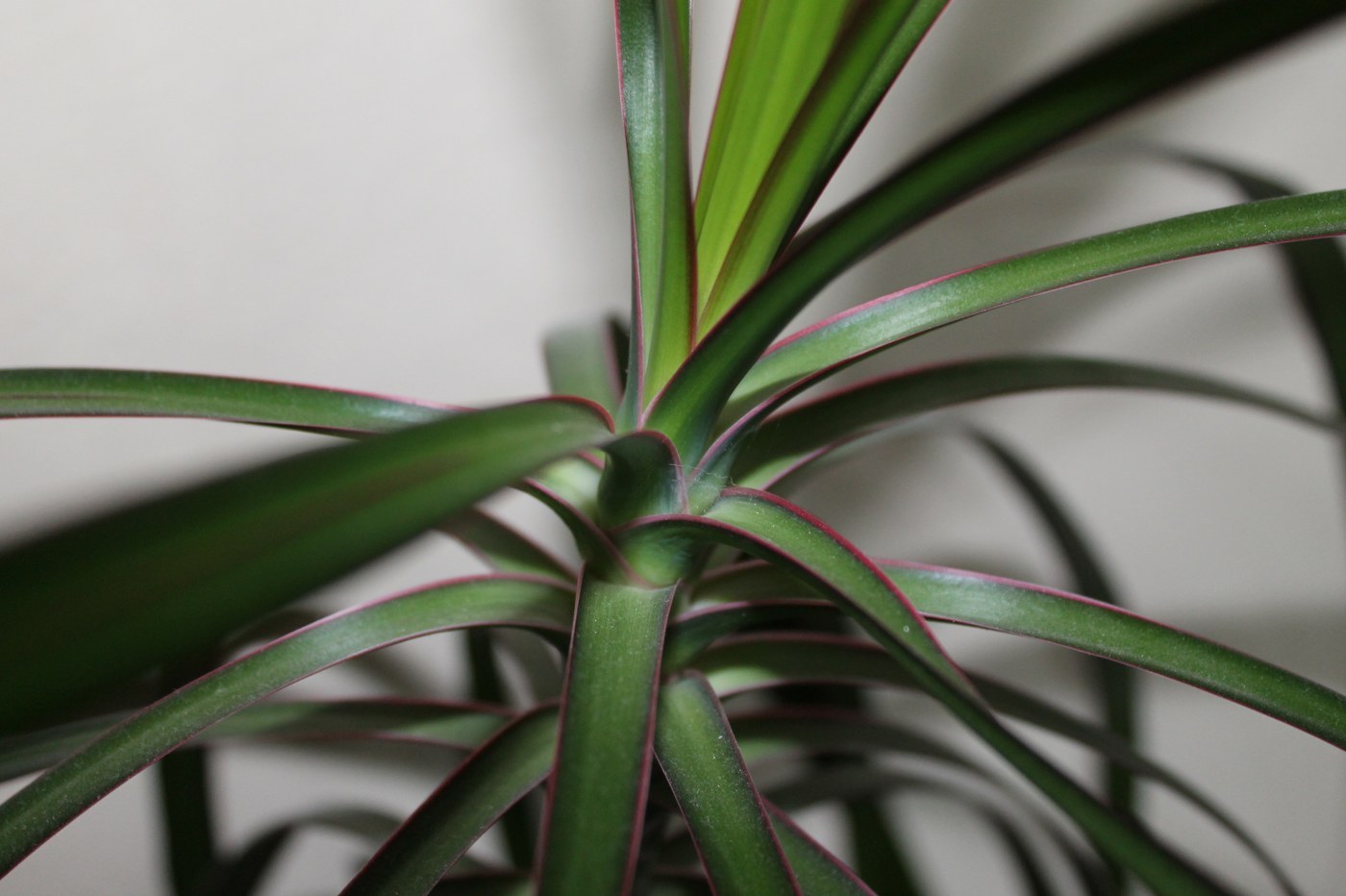
Key Identifying Features
The Dragon Tree (Dracaena marginata, the Madagascar dragon tree) is a popular indoor tree recognized by its thin, snaking woody stems crowned with a starburst of narrow, arching leaves. Each sword-like leaf is edged in red or purplish-red, giving the plant its signature look.
- Slim, gray-brown woody canes that often curve and twist
- Leaves clustered in fountain-like rosettes at the stem tips
- Narrow leaves with thin red or magenta margins
Leaves & Stems
The leaf-and-cane structure is highly distinctive:
- Leaves are long, thin, and strap- or sword-shaped, 30-60 cm long but only ~1-1.5 cm wide
- Color is glossy green with fine red, pink, or cream stripes along the edges (cultivars like 'Tricolor' and 'Colorama' show more pink/cream)
- Leaves arch outward then droop, forming a spiky pom-pom or palm-like tuft at each cane tip
- Stems are thin, woody, ringed with old leaf scars, and often grown several to a pot at curving angles
- As the plant grows, lower leaves drop, leaving a bare cane with a leafy crown
Flowers & Fruit
Flowering is rare indoors:
- Mature plants may produce sprays of small, fragrant white to pinkish flowers
- Followed occasionally by small yellow-orange berries
- Most houseplant specimens never bloom
How to Tell It Apart from Look-Alikes
- Corn plant (Dracaena fragrans): a relative but with much wider, cornstalk-like green leaves and thicker canes — no thin red margins.
- Ponytail palm (Beaucarnea): has a swollen bulb-like base and longer, finer cascading leaves without red edges.
- D. marginata's giveaway is the pencil-thin leaves with red edges erupting from slim curving canes.
Where You'll Find It
A staple office and home houseplant valued for tolerating low light and neglect, the Dragon Tree is sold as single canes or multi-stem 'character' trees. Native to Madagascar and nearby islands, it grows as a wild shrub or small tree in warm, dry scrubland.
Quick ID Checklist
- Thin woody canes, often curving or multi-stemmed
- Narrow sword-shaped leaves in a tuft at the tips
- Leaves edged in red, pink, or magenta
- Bare lower canes with leaf-scar rings
- Palm-like or fountain silhouette
Thin red-edged leaves spraying from slender canes confirm a Dracaena marginata Dragon Tree.
Frequently asked questions
Is the Dragon Tree a palm?
No. Although its tufted leaves give it a palm-like silhouette, Dracaena marginata is not a palm. It is a Dracaena, identifiable by thin woody canes topped with narrow red-edged sword-shaped leaves.
How do I tell a Dragon Tree from a Corn Plant?
Both are Dracaenas, but the Dragon Tree (D. marginata) has very thin canes and narrow pencil-width leaves edged in red, while the Corn Plant (D. fragrans) has thick canes and broad cornstalk-like green leaves.
Why does my Dragon Tree have a bare stem with leaves only on top?
This is normal growth. Dracaena marginata naturally sheds its lower leaves as it grows taller, leaving a bare, scarred cane topped by a fountain of foliage, which is part of its characteristic look.
What do the red edges on the leaves mean?
The thin red or magenta margins are a natural feature of the species and its cultivars, not a sign of stress. These colored edges are one of the quickest ways to identify the Dragon Tree.
Dragon Tree identified by the community
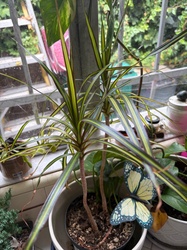
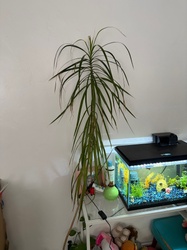
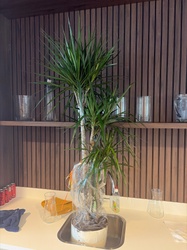
Recent Dragon Tree specimens identified with Plant Identifier.