
Dusty Miller Identification Guide
Identify Dusty Miller by its striking silver-white, felted, deeply lobed leaves grown for foliage rather than its small yellow flowers.
Read the full Dusty Miller encyclopedia entry →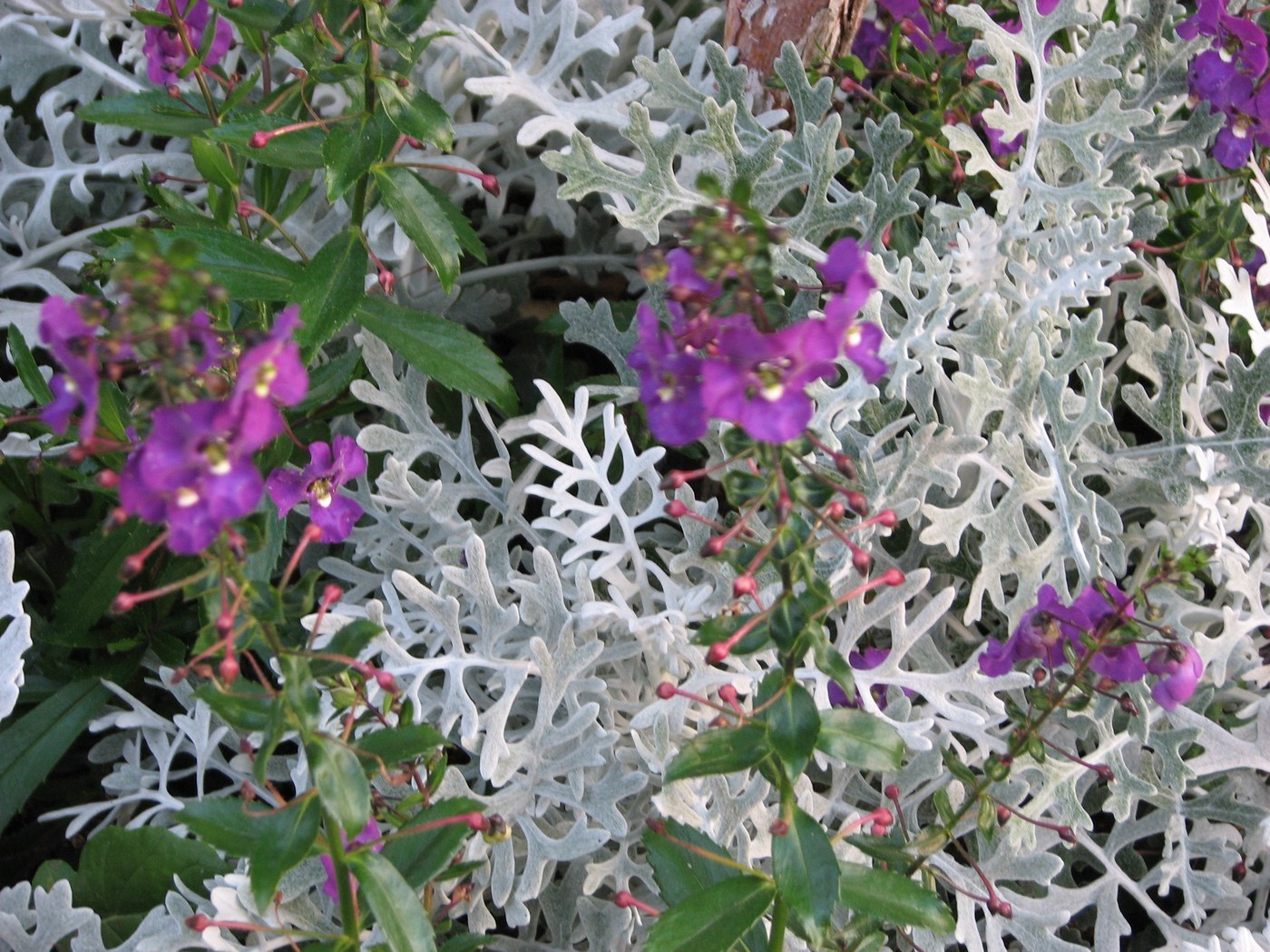
Key Identifying Features
Dusty Miller (Jacobaea maritima, formerly Senecio cineraria) is a mounding tender perennial grown almost entirely for its silvery-white, woolly foliage. It is one of the easiest bedding plants to recognize because of that frosted, felted appearance.
- Compact mound, typically 8-15 in (20-38 cm) tall
- Leaves coated in dense white-gray hairs (tomentum) that feel soft and felt-like
- Deeply lobed, fern- or oak-leaf-like leaf shape
- Color reads as silver to nearly white, brightest in full sun
- Grown for foliage; flowers are secondary
Leaves & Stems
The leaves are the whole story: alternate, deeply pinnately lobed or divided into rounded segments, giving a lacy, ornate outline. Both surfaces are densely covered in matted white woolly hairs, which is what creates the dusty silver look and helps the plant resist drought and reflect heat. Stems are also white-felted and somewhat woody at the base in older plants.
Flowers & Fruit
In its second year or in mild climates, dusty miller sends up clusters of small, daisy-like yellow flowers in flat-topped heads — a giveaway that it belongs to the aster/daisy family (Asteraceae). Many gardeners remove these to keep the focus on foliage. Seeds are small with a tuft of fine bristles (a pappus), typical of the family.
How to Tell It Apart from Look-Alikes
- Lamb's ear (Stachys byzantina): also silvery and fuzzy, but leaves are soft, undivided, thick, and tongue-shaped — not lobed like dusty miller's.
- Artemisia / 'Silver Mound': silvery too but with very fine, thread-like or feathery foliage and an aromatic scent; dusty miller leaves are broader and felted, not finely threaded.
- Other silver dusty millers: a few different species (Centaurea cineraria, Silene) are also sold as "dusty miller," but all share the felted silver look; the deeply lobed felted leaf points to Jacobaea maritima.
Where You'll Find It
Dusty miller is a staple edging and container plant, used to contrast and brighten beds of darker or brightly colored flowers. It thrives in full sun and well-drained soil, tolerates heat, drought, and coastal salt, and often overwinters in mild climates where it can become semi-woody.
Quick ID Checklist
- Silver-white, frosted overall appearance
- Soft, felted (woolly) leaf and stem surface
- Deeply lobed, fern/oak-leaf-shaped leaves
- Compact mounding habit under ~15 in
- Small yellow daisy flowers if allowed to bloom
- Thrives in hot, dry, sunny spots
Frequently asked questions
Why is dusty miller silver?
Its leaves are coated in dense white woolly hairs (tomentum) that reflect sunlight and reduce water loss. This felting gives the plant its signature dusty silver color and is the main ID feature.
Does dusty miller flower?
Yes, usually in its second year, producing clusters of small yellow daisy-like flowers that reveal its membership in the aster family. Many gardeners pinch them off to emphasize the foliage.
How is it different from lamb's ear?
Both are silver and fuzzy, but lamb's ear has thick, soft, undivided tongue-shaped leaves, while dusty miller has deeply lobed, lacy, fern-like leaves.
Is dusty miller a perennial or annual?
It is a tender perennial often grown as an annual. In mild climates it survives winter, becoming somewhat woody at the base and blooming the following year.