
Dutchman's Breeches Identification Guide
Recognize Dutchman's Breeches by its dangling white pantaloon-shaped flowers, finely divided fern-like leaves, and early-spring woodland habit, and tell it from its sister Squirrel Corn.
Read the full Dutchman's Breeches encyclopedia entry →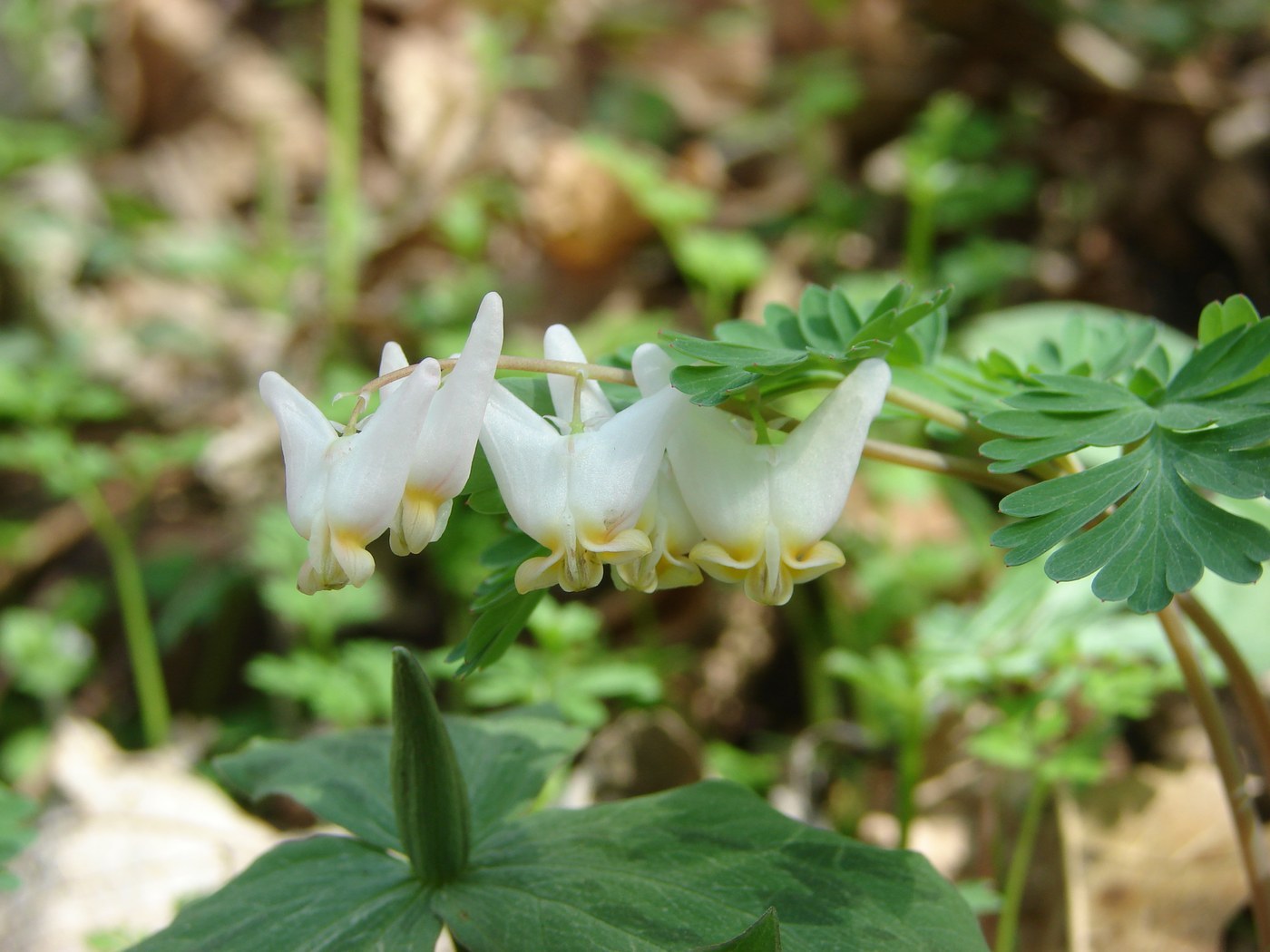
Key Identifying Features
Dutchman's Breeches (Dicentra cucullaria) is a beloved spring ephemeral of eastern North American woodlands, named for flowers that look like tiny upside-down pantaloons hung on a line. Look for:
- White, two-spurred flowers shaped like upside-down breeches, with yellow at the "waistband"
- Flowers dangling in a row along an arching stalk
- Finely dissected, fern-like gray-green leaves in a basal clump
- A low plant, 6-12 inches tall, blooming very early in spring
Leaves & Stems
All leaves are basal, rising directly from the ground on slender stalks. Each leaf is highly divided into many narrow, lacy segments, giving a soft, fern-like or parsley-like appearance, and is a distinctive pale blue-green. There is no leafy flowering stem; instead a leafless arching scape rises just above the foliage and carries the flowers in a one-sided nodding row. The plant grows from a cluster of small pink-white teardrop-shaped bulblets/tubers underground. As a spring ephemeral, the whole plant dies back by early summer.
Flowers & Fruit
Each flower is white (sometimes faintly pink-tinged), about 3/4 inch long, with two inflated upward-pointing spurs forming the "legs" and a yellow tip at the bottom forming the "waistband" of the breeches. They hang upside-down, several to a stalk. Bloom time is early to mid spring (April-May), often before trees leaf out. The flowers are pollinated mainly by early bumblebee queens with tongues long enough to reach the nectar in the spurs. The fruit is a small pointed green capsule; seeds bear an oil-rich appendage (elaiosome) that ants carry off, dispersing them.
How to Tell It Apart from Look-Alikes
- Squirrel Corn (Dicentra canadensis): nearly identical lacy foliage, but flowers are more heart-shaped with short rounded spurs (not pointed "legs") and are fragrant; its underground tubers look like little yellow corn kernels.
- Bleeding Heart (Dicentra/Lamprocapnos): larger pink heart-shaped flowers.
- Corydalis: similar divided leaves but tubular yellow or pink flowers.
The upside-down white pantaloon shape with two pointed spurs distinguishes Dutchman's Breeches from Squirrel Corn's rounded hearts.
Where You'll Find It
It grows in rich, moist deciduous woods, rocky wooded slopes, and shaded floodplains with leaf-litter soil, across the eastern U.S. and southeastern Canada (with a disjunct population in the Pacific Northwest). Look in early spring before the canopy closes, often in colonies.
Quick ID Checklist
- White flowers shaped like upside-down breeches with two pointed spurs
- Yellow "waistband" at the flower tip
- Lacy, fern-like blue-green basal leaves
- Leafless arching flower stalk
- Early-spring woodland ephemeral, 6-12 in tall
- Spurs pointed (not the rounded hearts of Squirrel Corn)
Frequently asked questions
How do I tell Dutchman's Breeches from Squirrel Corn?
Both have the same lacy foliage, but Dutchman's Breeches has white flowers shaped like upside-down pantaloons with two pointed spurs, while Squirrel Corn has rounded, fragrant heart-shaped flowers. Their underground tubers also differ, with Squirrel Corn's resembling yellow corn kernels.
Why does the plant disappear by summer?
It is a spring ephemeral. It emerges, flowers, and sets seed early while sunlight reaches the forest floor, then the foliage dies back and the plant goes dormant underground through summer and fall.
What pollinates the breeches-shaped flowers?
Mostly early-emerging bumblebee queens, whose long tongues can reach nectar in the flower's twin spurs. The flowers bloom early in spring when few other nectar sources are available.