
Eastern Hemlock Identification Guide
Recognize eastern hemlock by its short flat two-ranked needles with white underside bands, tiny cones, and drooping leader.
Read the full Eastern Hemlock encyclopedia entry →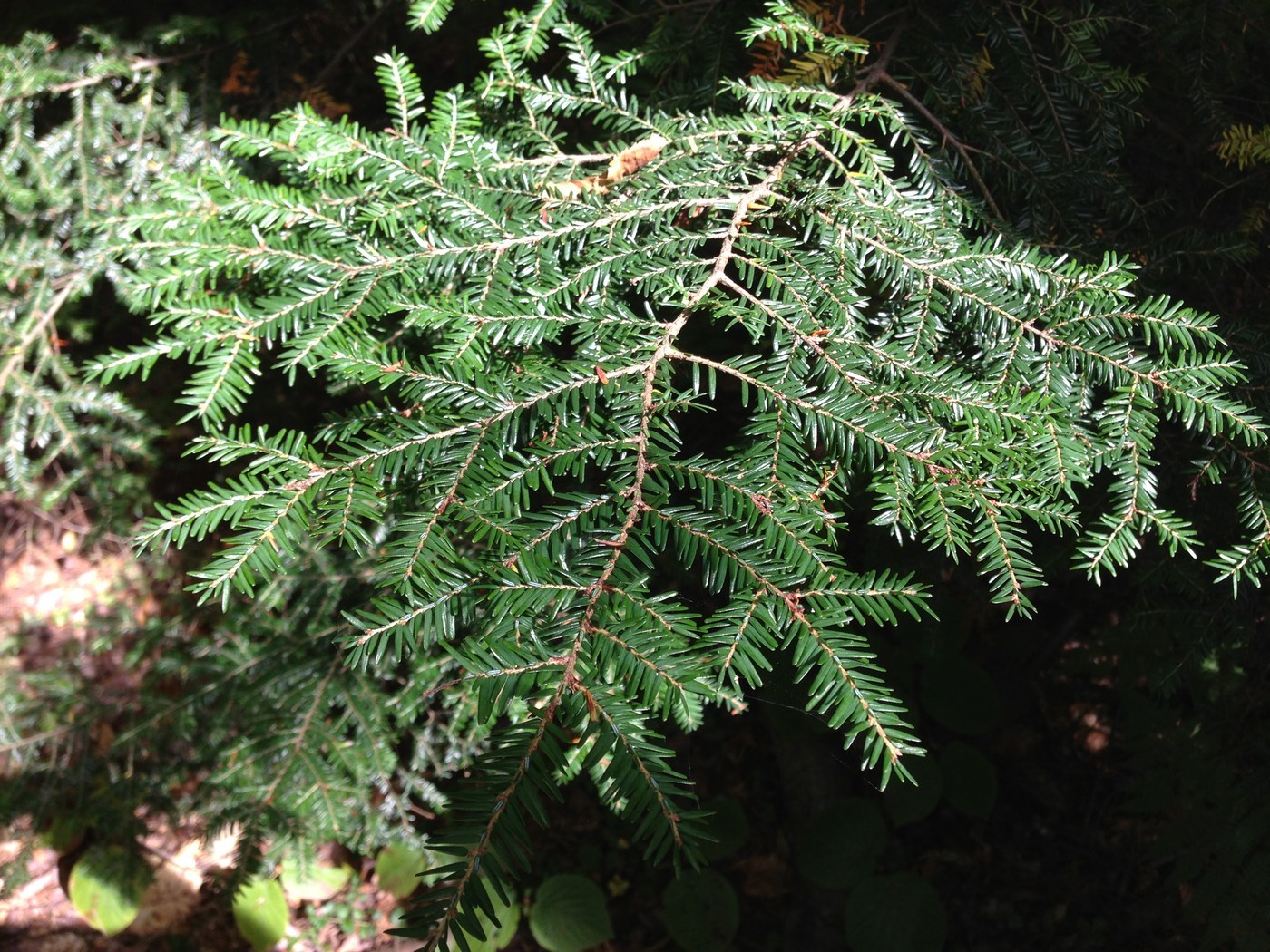
Key Identifying Features
Eastern hemlock (Tsuga canadensis) is a graceful, shade-tolerant evergreen conifer of cool, moist eastern North American forests, easily known by its delicate flat needles and tiny cones.
- Short, flat needles (about 1-1.5 cm) in two flat rows, plus tiny ones lying along the top of the twig
- Two whitish bands of stomata on the needle underside
- Small, oval, pendant cones under 2 cm
- A soft, feathery crown with a drooping leading shoot (leader)
Leaves & Stems
Needles are flat, soft, blunt-tipped, 1-1.5 cm long, dark green above with two distinct white lines beneath, attached by tiny stalks to small woody pegs. They spread in two flat rows (two-ranked) along the twig, but a close look reveals a row of shorter needles lying flat along the top of the twig pointing forward with their undersides showing, a feature unique to hemlocks. The needle margins are very finely toothed.
Twigs are slender, yellow-brown, and finely hairy. The overall form is pyramidal with gracefully drooping branchlets, and the topmost shoot (leader) characteristically droops or nods rather than standing erect. Bark is reddish-brown to gray, becoming thick and deeply furrowed with age.
Flowers & Fruit
Hemlock produces tiny pollen cones and inconspicuous female cones in spring. The seed cones are small (1.5-2.5 cm), oval, light brown, and hang down from the twig tips on short stalks, with thin rounded scales. They mature in one season and may persist after releasing their tiny winged seeds.
How to Tell It Apart from Look-Alikes
- Balsam fir: Needles longer, cones upright and disintegrating; no shorter top-of-twig needles.
- Yew (Taxus): Needles larger and darker with pointed tips, and bears red fleshy arils, not cones.
- Spruce: Stiff, sharp, four-sided needles all around the twig; cones much larger.
Tiny pendant cones plus short two-ranked needles with white bands and the row of inverted top-of-twig needles confirm hemlock.
Where You'll Find It
Native to cool, humid forests of the northeastern U.S. and southeastern Canada, often in ravines, north-facing slopes, and along streams where it forms dense shade. Severely threatened across its range by the invasive hemlock woolly adelgid.
Quick ID Checklist
- Short, flat, blunt needles in two rows with white underside bands
- Row of shorter needles lying along the top of the twig
- Tiny oval pendant cones under 2.5 cm
- Drooping leader shoot at the treetop
- Cool moist forest habitat
Frequently asked questions
What separates hemlock from a fir or spruce?
Hemlock has small soft flat needles in two rows with two white bands beneath, tiny hanging cones, and a drooping top shoot, while firs have upright cones and spruces have stiff sharp four-sided needles.
What is the unusual needle feature on the twig?
Besides the two flat rows, hemlock has a row of shorter needles lying flat along the top of the twig with their white undersides facing up, which is distinctive.
Why does the top of the tree droop?
The leading shoot of eastern hemlock naturally nods or droops rather than standing straight, giving the tree a soft, graceful silhouette.
What threatens eastern hemlock?
The hemlock woolly adelgid, an invasive sap-feeding insect, has caused widespread decline and death of hemlocks across the eastern United States.