
English Daisy Identification Guide
A guide to recognizing English daisy (Bellis perennis), a low lawn perennial with basal spoon-shaped leaves and small white, pink-tipped ray flowers on leafless stalks. Covers how to separate it from lawn look-alikes.
Read the full English Daisy encyclopedia entry →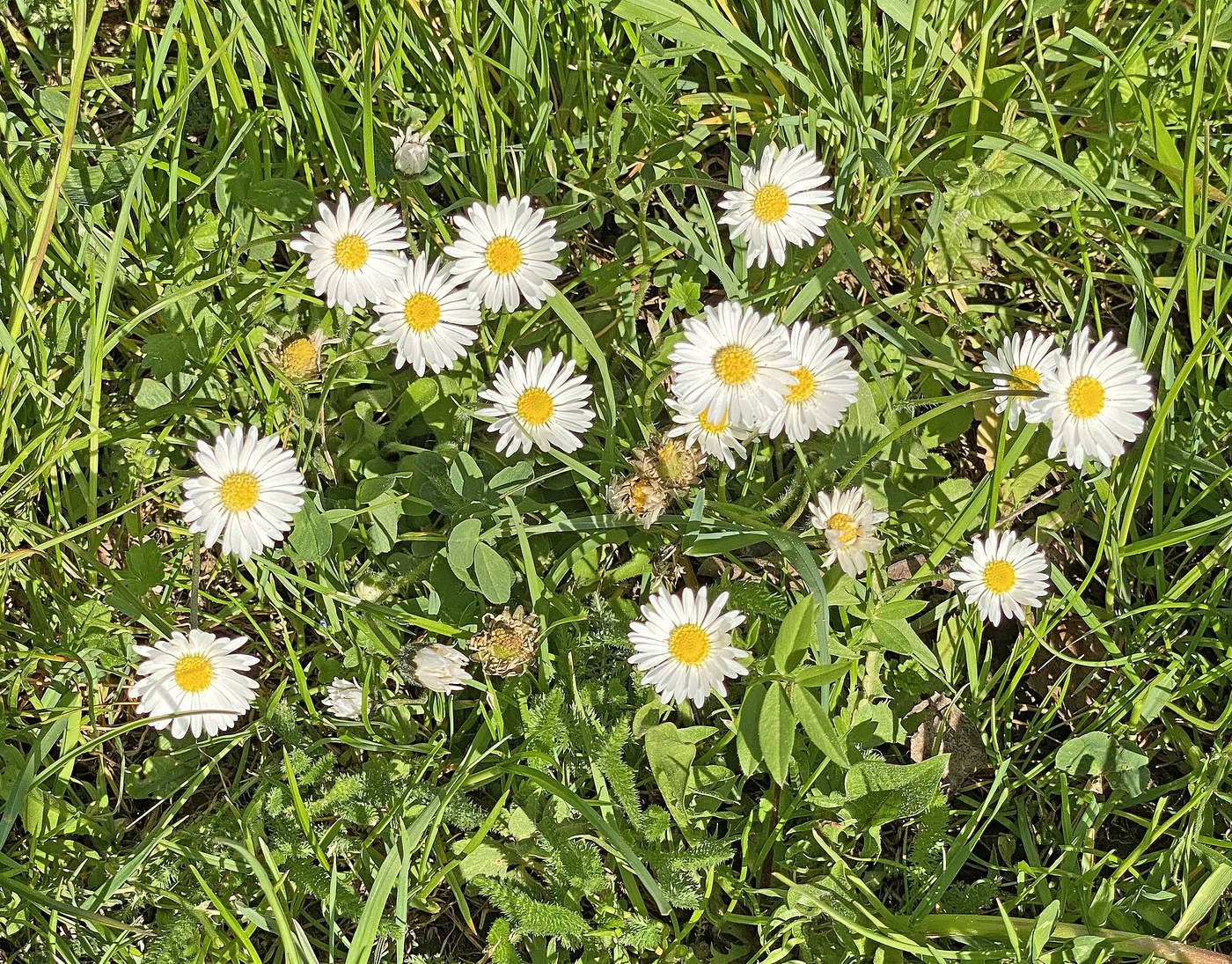
Key Identifying Features
English daisy (Bellis perennis) is a small, low-growing perennial that hugs the ground in lawns and meadows. Its signature is a single small flower head on a leafless stalk rising from a flat rosette of spoon-shaped leaves. The flower has white (often pink- or red-tipped) ray petals around a bright yellow center, and it closes at night and in cloudy weather.
- Basal rosette of small spoon-shaped leaves flat to the ground
- Leafless flower stalks (scapes), each bearing one head
- White rays, often tinged pink/red on the underside or tips, yellow disk
- Plants only 2 to 6 inches tall
- Spreads to form patches in turf
Leaves & Stems
Leaves are all basal, forming a tight rosette pressed against the soil. Each leaf is spoon-shaped (spatulate) to oval, 1 to 2 inches long, with a rounded tip, a tapering base, and slightly scalloped or shallowly toothed margins. Both surfaces and the margins carry fine hairs. There are no leaves on the flowering stems, an important distinction: each slender, sometimes hairy scape rises leafless straight from the rosette and holds a single flower head.
Flowers & Fruit
The flower heads are small, about 0.5 to 1 inch across, with numerous narrow white ray florets surrounding a flat yellow disk of tiny tubular florets. The ray tips and undersides are frequently flushed pink to crimson. Heads open in sunshine and close at dusk or in rain. English daisy blooms heavily in spring, often continuing through summer into fall in cool climates. The fruits are tiny, flattened, hairy achenes without a feathery pappus.
How to Tell It Apart from Look-Alikes
- Common (oxeye) daisy (Leucanthemum vulgare): Much taller (1 to 3 ft) with leafy stems and larger heads; English daisy is tiny with leafless stalks.
- Lawn daisy weeds / fleabanes: Have branched, leafy stems rather than a basal rosette with single-flower scapes.
- Dandelion: Has lobed leaves and a hollow stalk exuding milky sap with all-yellow heads, not white rays.
The combination of a flat rosette of spoon-shaped leaves plus solitary white-and-yellow heads on leafless stalks just inches tall is diagnostic.
Where You'll Find It
English daisy is a familiar plant of mowed lawns, turf, parks, meadows, and roadside grass, especially in cool, moist temperate regions. It tolerates regular mowing because its leaves and growing point stay near the ground. Native to Europe, it is widely naturalized in North America, particularly the Pacific Northwest and other mild, damp areas, and is also grown as a bedding ornamental.
Quick ID Checklist
- Tiny perennial, 2 to 6 in tall
- Flat basal rosette of spoon-shaped, slightly toothed leaves
- Leafless flower stalk, one head each
- White rays often pink-tipped, yellow center
- Heads close at night and in rain
- Common in lawns and short turf
Frequently asked questions
How do I tell English daisy from the big oxeye daisy?
Size and stems. English daisy is only a few inches tall with leafless flower stalks rising from a ground-hugging rosette, while oxeye daisy is 1 to 3 feet tall with leafy stems and much larger heads.
Why do the daisies in my lawn close up in the evening?
English daisy flower heads naturally open in sunshine and close at dusk and during rain, which is a normal and helpful identifying behavior.
Are the pink tips a different species?
No. Many English daisies normally have white rays flushed pink or red, especially on the undersides and tips. The coloring varies and is part of the species' typical appearance.
Why does it survive mowing so well?
Its leaves form a flat rosette and its growing point sits right at the soil surface, so mowers pass over it without harming the plant.