English Daisy
Bellis perennis
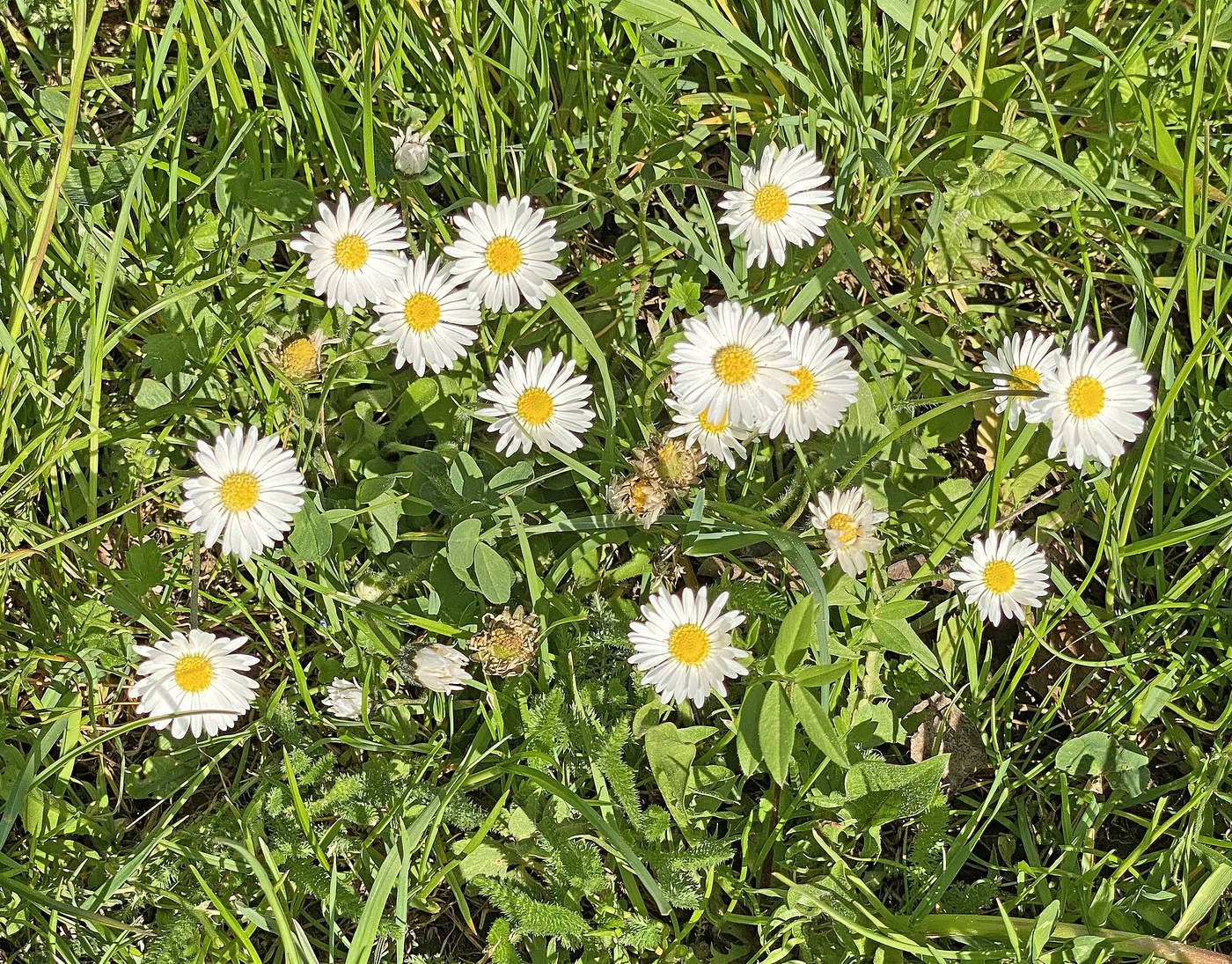
The English daisy is a low, cheerful perennial with white-to-pink petaled flowers around a yellow center, beloved in cottage gardens and famous as the daisy of lawns and daisy-chains.
- Light
- Full sun to part shade
- Water
- Regular; keep evenly moist
- Difficulty
- Easy
Got a plant like this?
Identify any plant from a photo, free.
Overview
The English daisy (Bellis perennis) is a small, mat-forming perennial native to Europe, traditionally seen dotting lawns and meadows. Its name Bellis means "pretty" and perennis "perennial," while "daisy" derives from "day's eye" because the flowers open at dawn and close at dusk.
Wild forms have simple single white blooms, but cultivated varieties offer fuller, pompon-like flowers in white, pink and red. It is widely grown as a spring bedding plant and is one of the most recognizable little flowers in the world.
How to identify it
A low rosette plant rarely exceeding 10–20 cm in flower.
- Leaves: spoon-shaped, slightly toothed, forming a flat basal rosette
- Flowers: solitary heads on leafless stalks, with a ring of white (often pink-tipped) ray petals around a golden-yellow center; cultivars may be double
- Behavior: flowers close at night and in dull weather
- Habit: spreads to form low mats, blooming mainly in spring and again in cool autumn weather
Care & growing
An easy, cool-season favorite for borders and containers.
- Light: full sun in cool climates, part shade where summers are hot
- Water: keep soil evenly moist; dislikes drought
- Soil: moist, well-drained, fertile soil
- Temperature: thrives in cool weather; may struggle or go dormant in summer heat
- Feeding: a light balanced feed supports continued bloom
- Propagation: by seed or by dividing clumps; deadheading prolongs flowering and limits self-seeding
Habitat & origin
Native to western, central and northern Europe, the English daisy has naturalized in temperate regions worldwide, including much of North America, where it can become a lawn weed.
It grows naturally in short grassland, meadows, lawns and other regularly grazed or mown open ground.
Frequently asked questions
Is the English daisy the same as the oxeye daisy?
No. The English daisy (Bellis perennis) is a small, low-growing plant, while the larger roadside oxeye daisy is Leucanthemum vulgare.
Will English daisies take over my lawn?
They can naturalize and spread in lawns, which some gardeners welcome and others manage by mowing or removing seedheads.
Why do the flowers close up?
The blooms open at dawn and close at dusk and in cloudy weather — the origin of the name 'day's eye.'
How do I propagate English daisies?
Grow them from seed or divide established clumps; deadheading prolongs flowering and limits self-seeding.
English Daisy guides
In-depth guides for identifying, growing, and caring for English Daisy.
How to Care for English Daisy
Grow charming English Daisy (Bellis perennis): low rosettes topped with button flowers for cool-season borders, edging, and containers.
English Daisy Identification Guide
A guide to recognizing English daisy (Bellis perennis), a low lawn perennial with basal spoon-shaped leaves and small white, pink-tipped ray flowers on leafless stalks. Covers how to separate it from lawn look-alikes.