
English Yew Identification Guide
Identify the English Yew (Taxus baccata) by its flat dark-green needles, red fleshy berry-like arils, and dense shade-tolerant evergreen form.
Read the full English Yew encyclopedia entry →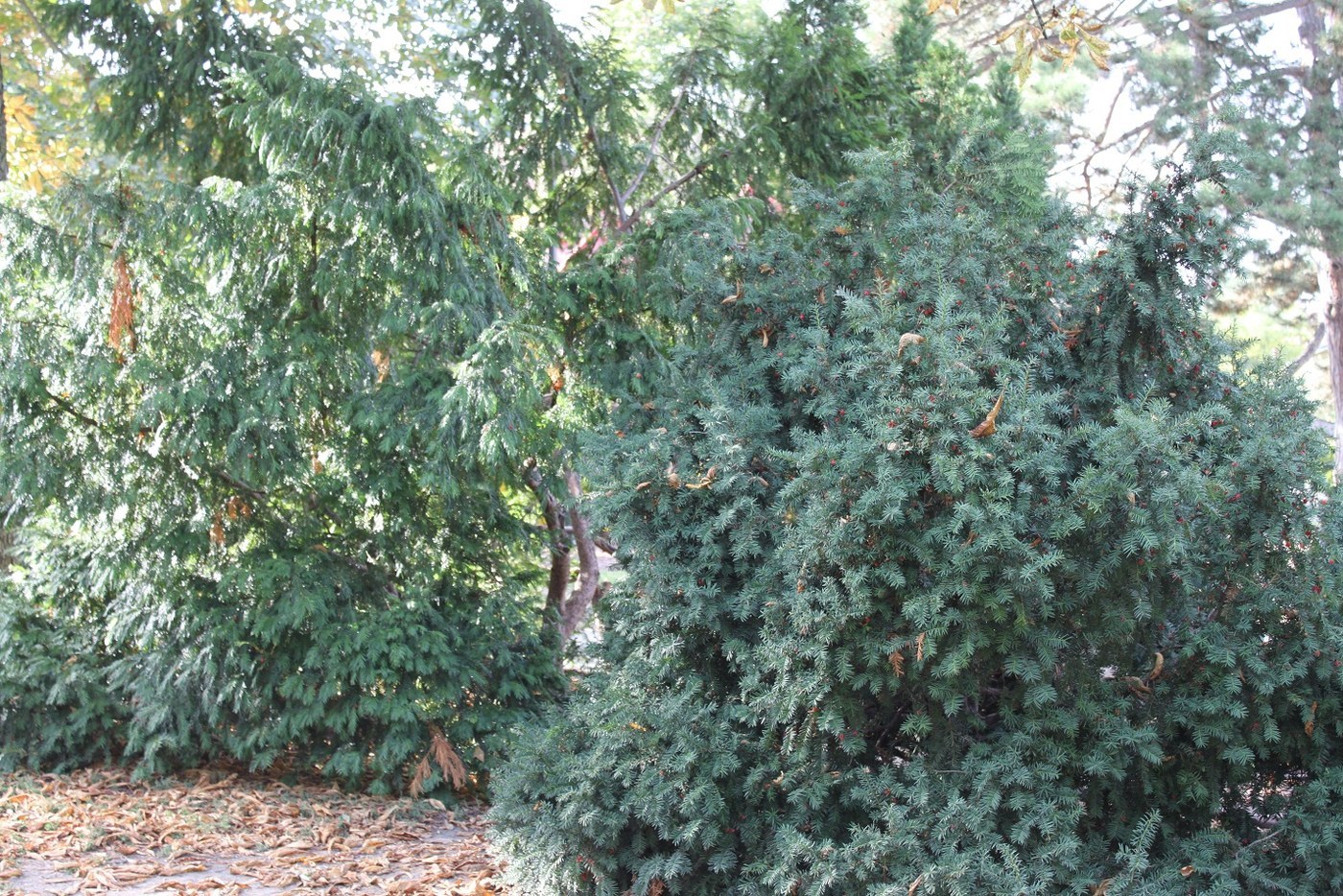
Key Identifying Features
English Yew (Taxus baccata), also called common yew, is a dense, slow-growing evergreen conifer, ranging from a 15-40 ft tree to a clipped hedge or topiary. It has flat, soft, dark green needles and, on female plants, unmistakable single red fleshy berry-like "arils." It is a true conifer but, unlike pines and spruces, does not bear woody cones.
- Form: dense, dark, often broad and rounded; tolerates heavy shade and shearing
- Needles: flat, soft, dark green, two-ranked
- Fruit: soft red cup-shaped aril (female plants)
Leaves & Stems
Needles are flat, linear, soft, 1/2 to 1 1/4 inch long, and dark glossy green above with a paler, dull green (not silvery) underside. They are arranged spreading in two rows (two-ranked) along the twig, giving a flattened, fern-like spray. Unlike fir, the needle tips are soft-pointed but not stiff or prickly, and the underside has two pale, indistinct bands rather than bright white. Bark is thin, reddish-brown, and flakes to reveal purplish patches; old trunks are often fluted and massive.
Flowers & Fruit
Yew is dioecious. Female plants produce a single seed partly surrounded by a soft, bright red, fleshy, cup-shaped aril (about 1/4-1/2 inch) - it looks like an open-ended red berry with a hole at the tip. Male plants release pale yellow pollen from small globular cones in late winter to spring.
How to Tell It Apart from Look-Alikes
- Firs (Abies): also flat needles, but tips are blunt or notched, undersides have two bright white bands, and they bear upright woody cones - not red arils.
- Hemlock (Tsuga): flat needles with white-banded undersides and small hanging woody cones.
- Other yews (Japanese yew, T. cuspidata; hybrid T. x media): very similar; English yew tends to have slightly longer, more pointed needles arranged more in a flat plane. All yews share the red aril.
The flat soft dark-green two-ranked needles + red fleshy single-seeded arils + reddish flaky bark + absence of woody cones confirm yew.
Where You'll Find It
Native to Europe, North Africa and western Asia, English yew is a classic plant of hedges, topiary, churchyards and formal gardens, thriving in shade and tolerating heavy pruning. Ancient specimens in European churchyards can be over 1,000 years old.
Quick ID Checklist
- Flat, soft, dark green needles in two spreading rows
- Needle underside dull pale green (not bright white-banded)
- Bright red, fleshy, cup-shaped single-seed arils (female plants)
- No woody cones; reddish, flaky bark
- Dense, shade-tolerant; often sheared into hedges/topiary
Frequently asked questions
How do I tell yew from a fir?
Flip a needle over: yew undersides are dull pale green, while firs have two bright white bands. Yew also bears red fleshy arils instead of woody cones.
What is the red 'berry'?
It is an aril - a soft, bright red, open-ended cup of flesh surrounding a single seed, produced only by female plants. It is the yew's seed-dispersal structure, not a true berry.
Why is it common in churchyards?
English yew is extremely long-lived (sometimes over 1,000 years) and was traditionally planted in European churchyards; its dense evergreen form also makes it ideal for hedging and topiary.