
Fire Pink Identification Guide
Identify Fire Pink by its brilliant scarlet five-petaled flowers with notched petal tips, sticky stems, and opposite lance-shaped leaves.
Read the full Fire Pink encyclopedia entry →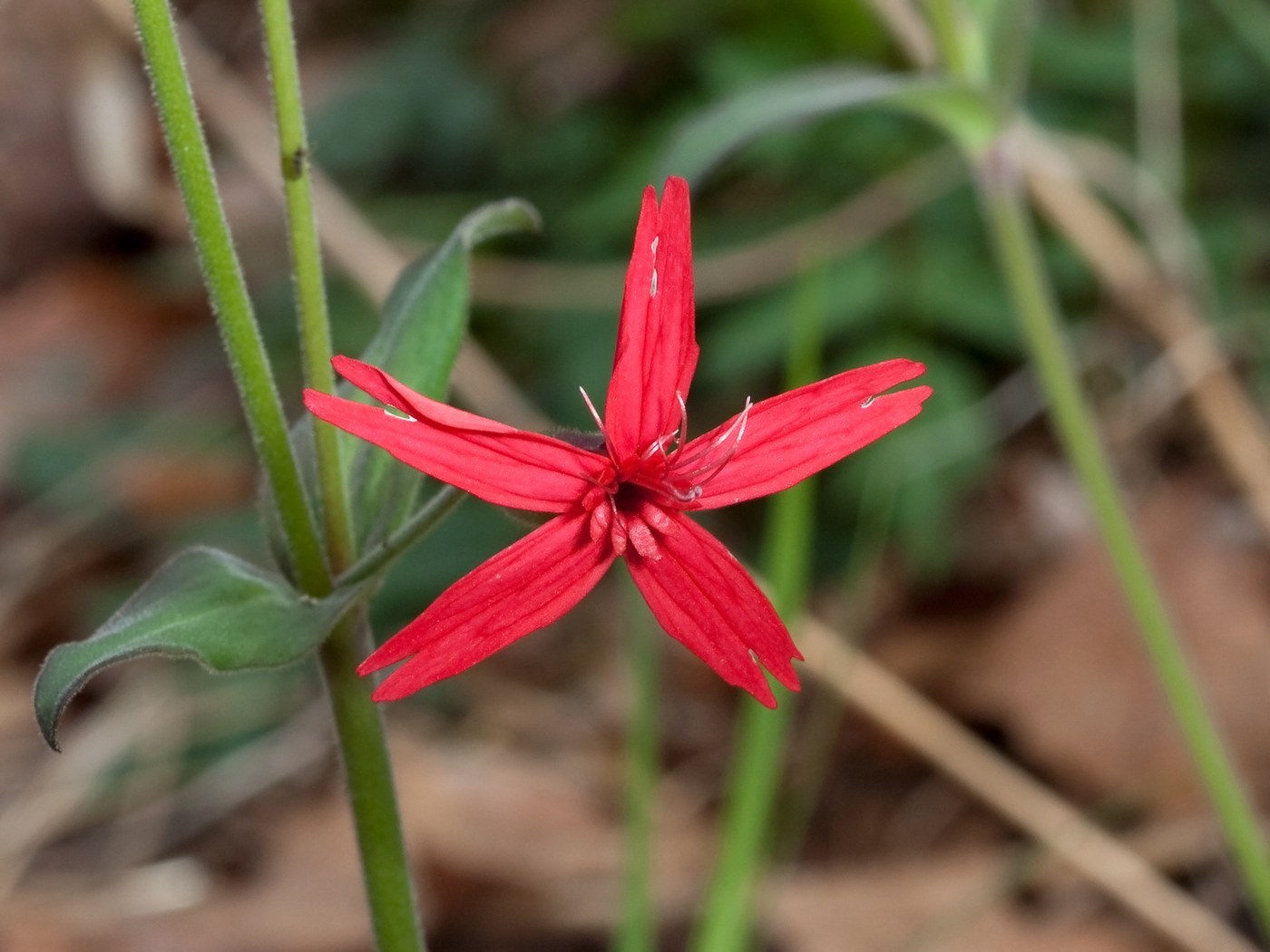
Key Identifying Features
Fire Pink (Silene virginica) is a striking scarlet-flowered woodland wildflower in the pink family (Caryophyllaceae). Despite 'pink' in its name, its flowers are vivid red. Key signs:
- Brilliant crimson-to-scarlet flowers with five narrow petals, each notched (split) at the tip.
- A tubular calyx (sticky green tube) holding the petals.
- Sticky-hairy stems that trap small insects.
- A loose, sprawling plant 20–60 cm (8–24 in) tall.
Leaves & Stems
Stems are slender, weak, and covered in sticky glandular hairs ('catchfly' stickiness), which can ensnare crawling insects. Leaves are opposite and lance-shaped to spoon-shaped, the lower ones broader, all with smooth edges, growing in a basal rosette plus a few opposite stem pairs. The plant often leans or sprawls on rocky slopes.
Flowers & Fruit
Flowering peaks in late spring to early summer (April–June). The 2.5–4 cm scarlet flowers are borne in a loose, branched cluster. Each petal is deeply notched at its tip (sometimes appearing 2-lobed or slightly toothed), flaring from a slender, sticky tubular calyx. The bright red color and tubular shape are adapted to hummingbird pollination. The fruit is a small capsule holding many seeds.
How to Tell It Apart from Look-Alikes
- Royal Catchfly (Silene regia) is also red but taller (up to 1.2 m), with un-notched or only slightly toothed petals, and grows in prairies.
- Indian Pink (Spigelia marilandica) has red tubular flowers with yellow throats and flares into five points, but its flowers are fused trumpets, not five separate notched petals.
- Cardinal Flower (Lobelia cardinalis) has two-lipped tubular red flowers and grows in wet ground.
The combination of scarlet, deeply notched five-petaled flowers + sticky stems + opposite leaves identifies Fire Pink.
Where You'll Find It
Fire Pink grows in dry to rocky open woods, wooded slopes, clearings, bluffs, and roadside banks in the eastern and central United States. It prefers part shade to sun and well-drained, often rocky or sandy soil. Look for its glowing red flowers lighting up wooded hillsides in late spring.
Quick ID Checklist
- Scarlet five-petaled flowers, petals notched at the tip
- Flowers on a sticky tubular calyx
- Sticky-hairy ('catchfly') stems
- Opposite, smooth, lance-shaped leaves + basal rosette
- Sprawling plant, 20–60 cm tall
- Dry, rocky open woods and slopes, late spring
Frequently asked questions
Why is it called Fire Pink if the flowers are red?
'Pink' refers to its plant family (the pinks, Caryophyllaceae) and to the notched, 'pinked' petal edges — not the color. The flowers are actually a brilliant fiery scarlet.
Why are the stems sticky?
Fire Pink is a 'catchfly' — its glandular hairs secrete a sticky substance that can trap small crawling insects, possibly deterring nectar thieves that don't pollinate it.
What pollinates Fire Pink?
Its tubular scarlet flowers are adapted for hummingbirds, which are drawn to the bright red color and can reach the nectar at the base of the long calyx tube.
How do I tell it from Royal Catchfly?
Fire Pink is shorter with deeply notched petals and grows in dry rocky woods, while Royal Catchfly is taller, has nearly un-notched petals, and grows in open prairies.