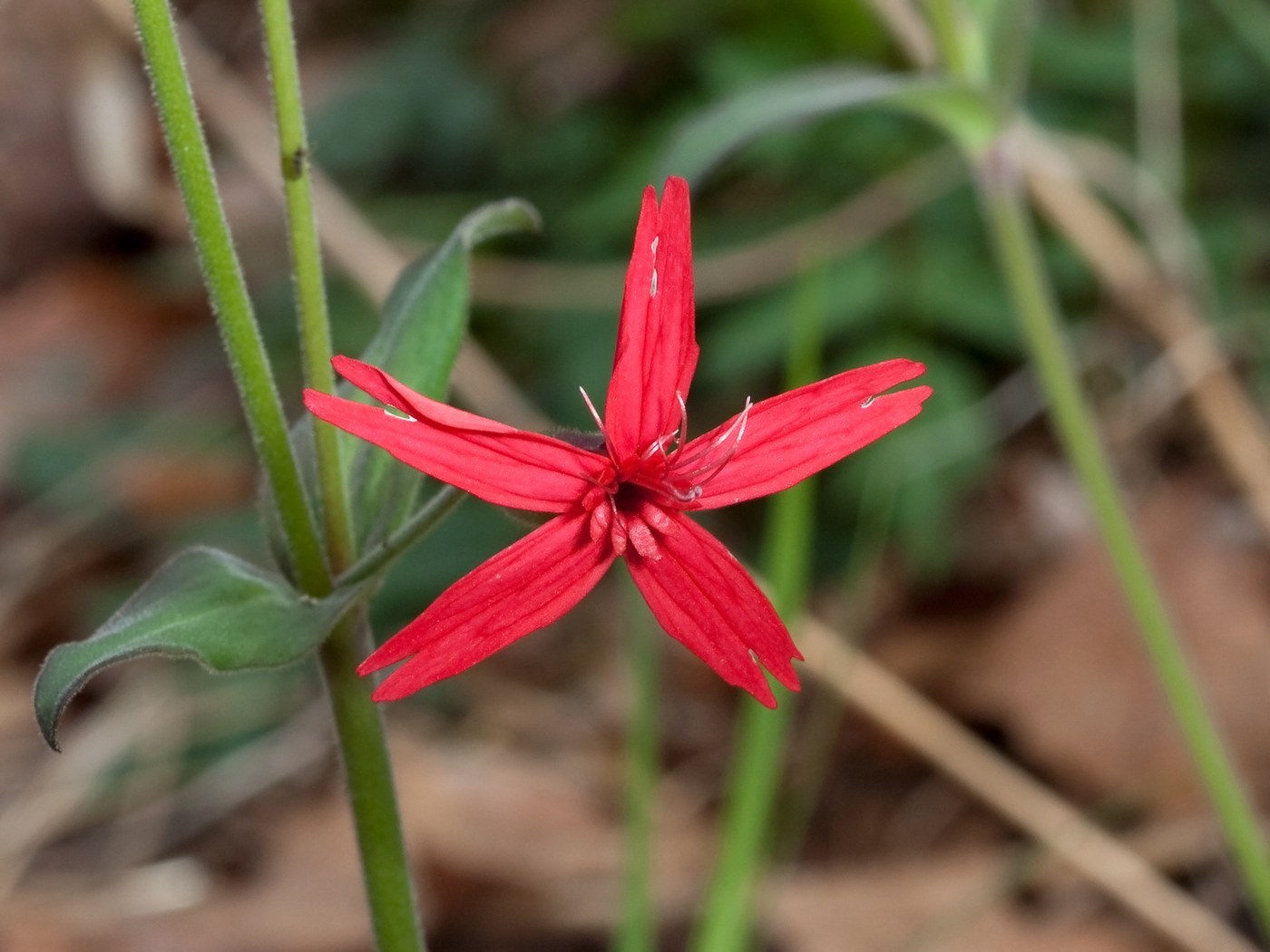
Fire Pink
Silene virginica
A short-lived native wildflower of eastern North American woodlands, prized for its brilliant scarlet, star-shaped flowers that lure hummingbirds in spring.
- Light
- Partial shade to dappled sun
- Water
- Moderate; well-drained soil
- Difficulty
- Moderate
Got a plant like this?
Identify any plant from a photo, free.
Overview
Fire pink is a clump-forming perennial in the carnation family, named not for its color but for the notched, "pinked" tips of its vivid scarlet-red petals. From late spring into summer it sends up slender stalks topped with five-petaled, star-shaped crimson flowers that are irresistible to ruby-throated hummingbirds.
Native to rocky woodlands and slopes of eastern North America, it is somewhat short-lived but self-seeds to persist. Its sticky, glandular stems trap small insects — the source of its alternate name, catchfly — though it is not carnivorous.
How to identify it
- Flowers: Brilliant scarlet-red, star-shaped, with five petals that are notched at the tips; about 3-4 cm across.
- Leaves: Lance-shaped, opposite, in a basal rosette and along the stem.
- Stems: Slender, sticky and glandular-hairy (catching small insects).
- Height: Typically 20-50 cm.
- Habit: Short-lived clumping perennial that self-seeds.
Care & growing
Light: Partial shade to dappled sun, as in its woodland-edge habitat.
Water: Moderate; needs sharp drainage and dislikes wet feet, especially in winter.
Soil: Well-drained, rocky or sandy, lean soils.
Temperature: Hardy in temperate climates.
Feeding: Little needed; avoid overly rich soil.
Propagation: Sow seed (it self-sows readily) or take cuttings; allowing it to set seed helps maintain it since individual plants are short-lived.
Habitat & origin
Native to the eastern and central United States, fire pink grows in open woods, rocky slopes, bluffs, and woodland clearings with good drainage. It favors lean, rocky ground rather than rich, moist soil.
It is grown in native plant, rock, and woodland-edge gardens for its dazzling flowers, though it can be a little finicky and short-lived in cultivation.
Frequently asked questions
Why is it called fire pink if the flower is red?
"Pink" refers to the notched, pinked petal edges (as in pinking shears), not the color. "Fire" describes its brilliant scarlet hue.
What pollinates fire pink?
Its bright red, nectar-rich flowers are especially adapted to attract ruby-throated hummingbirds, along with some butterflies.
Is it carnivorous?
No. Its sticky, glandular stems trap small insects, earning the name catchfly, but the plant does not digest them or rely on them.
Why doesn't my fire pink come back?
It is naturally short-lived. Allowing it to self-seed and giving it lean, well-drained soil helps a colony persist over time.
Fire Pink guides
In-depth guides for identifying, growing, and caring for Fire Pink.
How to Care for Fire Pink
A short-lived native woodland wildflower with brilliant scarlet star-shaped blooms that thrives in dappled shade and lean, sharply drained soil.
Fire Pink Identification Guide
Identify Fire Pink by its brilliant scarlet five-petaled flowers with notched petal tips, sticky stems, and opposite lance-shaped leaves.