
Flapjack Plant Identification Guide
How to recognize the Flapjack Plant (Kalanchoe luciae/thyrsiflora) by its stacked, paddle-shaped leaves and dramatic red margins.
Read the full Flapjack Plant encyclopedia entry →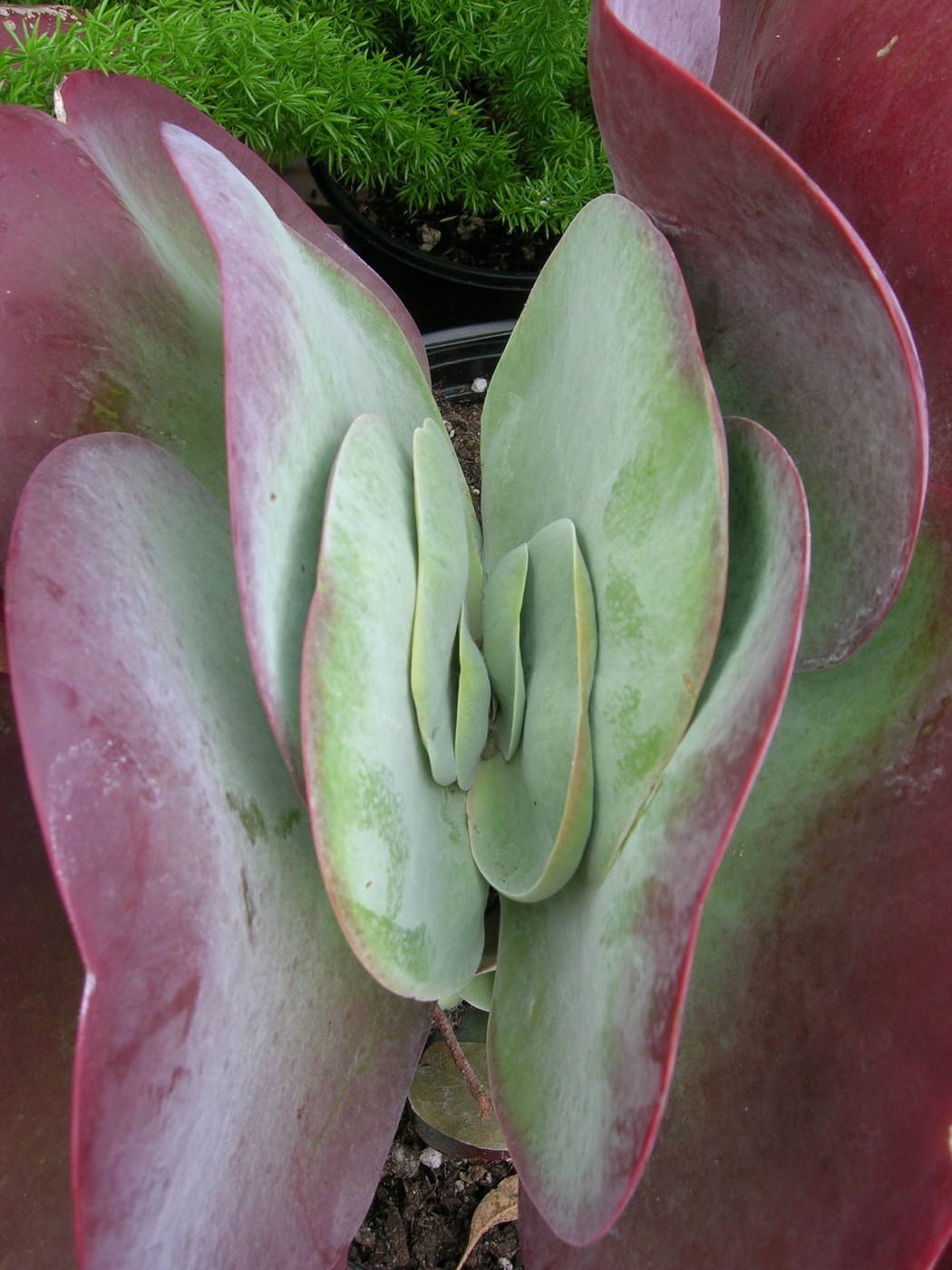
Key Identifying Features
The Flapjack Plant (Kalanchoe luciae, often sold as K. thyrsiflora) is instantly recognizable by its large, flat, rounded leaves stacked in clam-shell pairs that resemble a stack of pancakes. It is a clump-forming succulent that typically reaches 12–24 inches tall, with rosettes growing from a short central stem.
- Paddle-shaped leaves held nearly upright, overlapping like a deck of cards
- Blue-green to pale gray-green leaf surface with a powdery, waxy coating (farina)
- Vivid red, pink, or coppery margins that intensify in bright sun, cold, or drought stress
- Low-growing rosette habit that produces offsets at the base
Leaves & Stems
Leaves are fleshy, smooth, and spatula- to disc-shaped, usually 4–6 inches across, broadest near the rounded tip and tapering to the base. They are arranged in opposite pairs, each pair set at right angles to the one below. The surface carries a chalky glaucous bloom that rubs off if handled, leaving a fingerprint. The short, stout stem is largely hidden by the dense leaf rosette until the plant matures or stretches in low light.
Flowers & Fruit
Flowering is monocarpic — a rosette dies after blooming, but offsets carry on. A tall (up to 2–3 ft) flower spike rises from the center, bearing clusters of small, fragrant, tubular yellow flowers coated in white powder. K. luciae has nearly scentless flowers with rounded petals; the true K. thyrsiflora has strongly fragrant, longer tubular yellow blooms — a key distinction between the two.
How to Tell It Apart from Look-Alikes
- Kalanchoe thyrsiflora (true): Almost identical leaves, but flowers are sweetly fragrant with longer petal tubes; K. luciae (the common nursery plant) has scentless, urn-shaped flowers.
- Paddle Plant confusion: Both share the "paddle" nickname; rely on flowers and the redder margins of K. luciae in sun.
- Kalanchoe tetraphylla / other Kalanchoe: Smaller, narrower, or spotted leaves rather than the broad round paddles.
Where You'll Find It
Native to South Africa, Botswana, and surrounding southern Africa, it grows on rocky, well-drained slopes. As an ornamental it is widely grown in USDA zones 9–11 outdoors and as a houseplant elsewhere. It thrives in full sun to bright light, gritty soil, and tolerates drought; the red margins are most vivid when grown hard in strong light with cool nights.
Quick ID Checklist
- Stacked, flat, round paddle leaves in opposite clam-shell pairs
- Blue-green leaves with chalky bloom and red/pink margins
- Rosette form producing basal offsets
- Tall spike of powdery yellow flowers; rosette dies after blooming
- Succulent, smooth, hairless foliage
Frequently asked questions
Why are the leaf edges turning red?
Red margins are a normal stress response to bright sun, cold, or drought. More light equals redder edges; in shade the leaves stay mostly blue-green.
Is it Kalanchoe luciae or thyrsiflora?
Most plants sold as 'Flapjack' are actually K. luciae. The surest difference is the flowers: K. luciae blooms are scentless and urn-shaped, while true K. thyrsiflora has fragrant, longer tubular yellow flowers.
Will my plant die after it flowers?
Yes, the individual flowering rosette is monocarpic and dies after blooming, but it leaves behind basal offsets that continue the plant.
Why does the powdery coating rub off?
That chalky white layer is natural farina (epicuticular wax). It protects against sun and water loss and won't grow back where rubbed, so handle leaves by the edges.