
Flapjack Succulent Identification Guide
How to identify the Flapjack or Paddle Plant (Kalanchoe luciae / thyrsiflora) by its stacked, round, red-edged paddle leaves and rosette form.
Read the full Flapjack Succulent encyclopedia entry →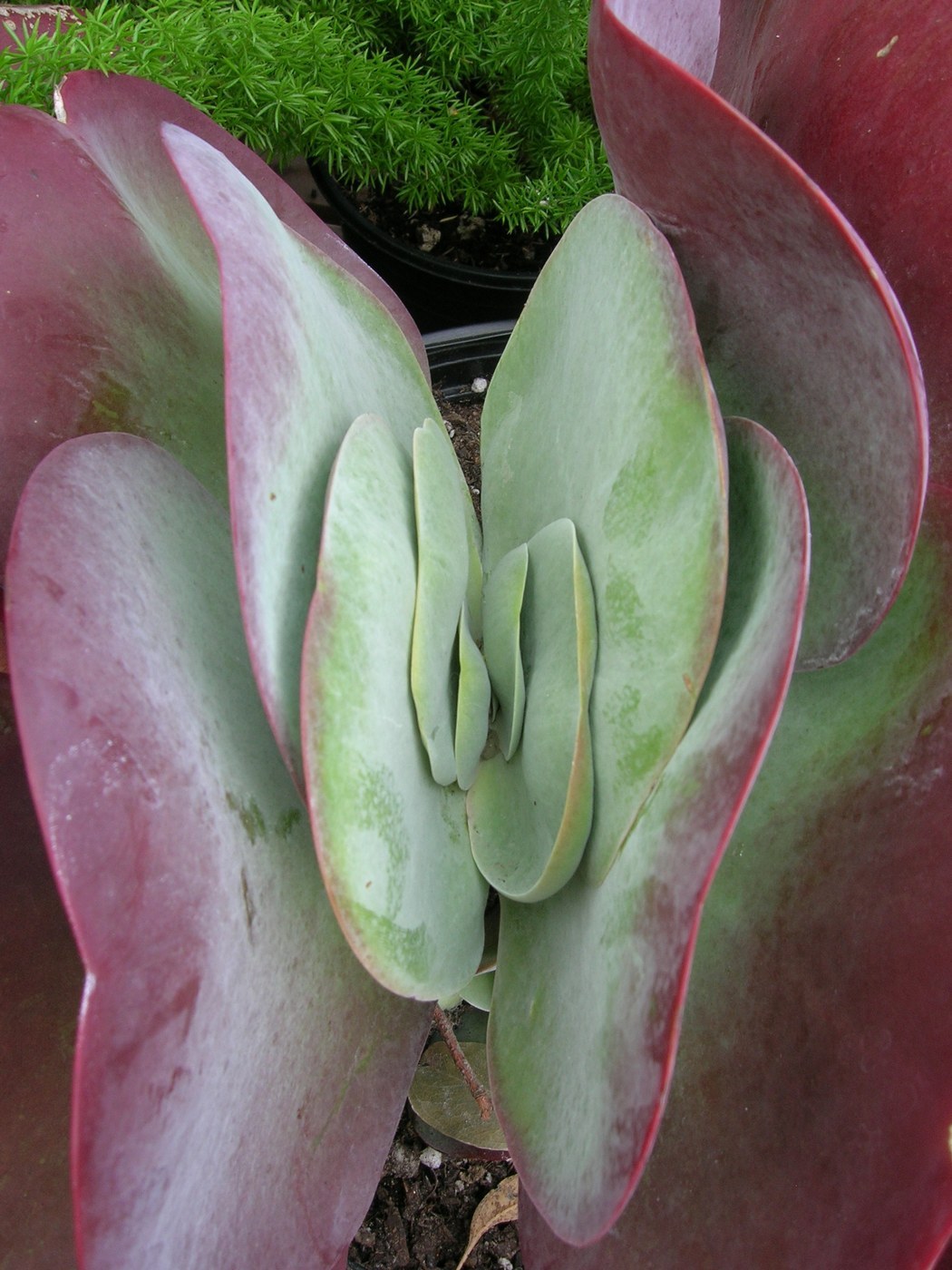
Key Identifying Features
The Flapjack succulent, also called Paddle Plant or Desert Cabbage, is usually Kalanchoe luciae (often sold as Kalanchoe thyrsiflora). Its standout traits:
- Large, flat, rounded paddle-shaped leaves stacked like a deck of pancakes
- Leaves arranged in an opposite, overlapping rosette
- Vivid red to crimson margins when grown in bright sun, with a gray-green to chalky white center
- A powdery farina (waxy bloom) coating that gives a frosted look
Leaves & Stems
Leaves are the defining feature: broad, spatula or clamshell shaped, thick and fleshy, growing up to 15 cm (6 in) wide. They sit in tight opposite pairs that rotate, forming a flattened rosette resembling stacked flapjacks. In strong light the edges and upper surfaces flush bright red or pink; in shade they stay mostly blue-green. The whole plant is dusted with a removable chalky white wax that protects against sun.
The stem is short and stout at first, but with age the plant elongates upward into a thick trunk-like stalk before flowering.
Flowers & Fruit
Flowering takes a few years and is dramatic. The plant sends up a tall flower spike up to 1 m (3 ft) topped with clusters of small, tubular, yellow to greenish flowers that are fragrant and coated in white powder. Importantly, Kalanchoe luciae is monocarpic for that rosette: after blooming the main rosette dies, but it leaves offsets (pups) at the base that carry on.
The true K. thyrsiflora has more strongly scented, brighter yellow blooms and is more powdery, but the two are commonly confused in the trade.
How to Tell It Apart from Look-Alikes
- Kalanchoe thyrsiflora: nearly identical, but leaves are typically more upright, heavily white-powdered, with less red and yellower fragrant flowers. K. luciae shows far more red coloring and is the more common houseplant.
- Echeveria rosettes: form rosettes too but with many smaller, pointed leaves, not a few large flat paddles.
- Kalanchoe tomentosa (Panda Plant): fuzzy, brown-tipped leaves, not smooth red-edged paddles.
The combination of few large flat round leaves + red edges + chalky bloom is unique to the Flapjack group.
Where You'll Find It
Native to South Africa (Eastern Cape and surrounds), it is grown worldwide as an ornamental succulent in containers, rock gardens, and dry borders. It is hardy outdoors in USDA zones 9-11 and elsewhere is a popular sunny windowsill or patio plant. Best color develops in full sun with sparse watering.
Quick ID Checklist
- Large, flat, rounded paddle leaves stacked in a rosette
- Red to crimson margins (intensifies in sun)
- Chalky white waxy coating you can rub off
- Opposite, overlapping leaf arrangement
- Tall yellow flower spike on mature plants, then rosette dies leaving pups
Frequently asked questions
Why are the leaf edges red on my Flapjack?
The red margins are a sun response. In bright direct light the plant produces protective pigments that turn the edges and tips red or crimson; in low light it stays mostly gray-green. More sun equals more red.
Is it Kalanchoe luciae or thyrsiflora?
Most red-edged 'Flapjacks' sold as houseplants are Kalanchoe luciae. True K. thyrsiflora is heavily white-powdered with more upright leaves and strongly scented bright yellow flowers and is less common in the trade.
My Flapjack grew tall and bloomed, then started dying. Is that normal?
Yes. Each rosette is monocarpic, meaning it flowers once and then that rosette dies. It almost always leaves offset pups at the base, so the plant continues through its babies.
What is the white powder on the leaves?
It is farina, a natural waxy bloom that protects the plant from sun and water loss. Avoid rubbing it off, since it does not grow back on that leaf and helps prevent sunburn.