
Flowering Dogwood Identification Guide
Identify flowering dogwood (Cornus florida) by its four large notched bracts, oval veined leaves with arcing veins, clustered red berries, and onion-shaped flower buds.
Read the full Flowering Dogwood encyclopedia entry →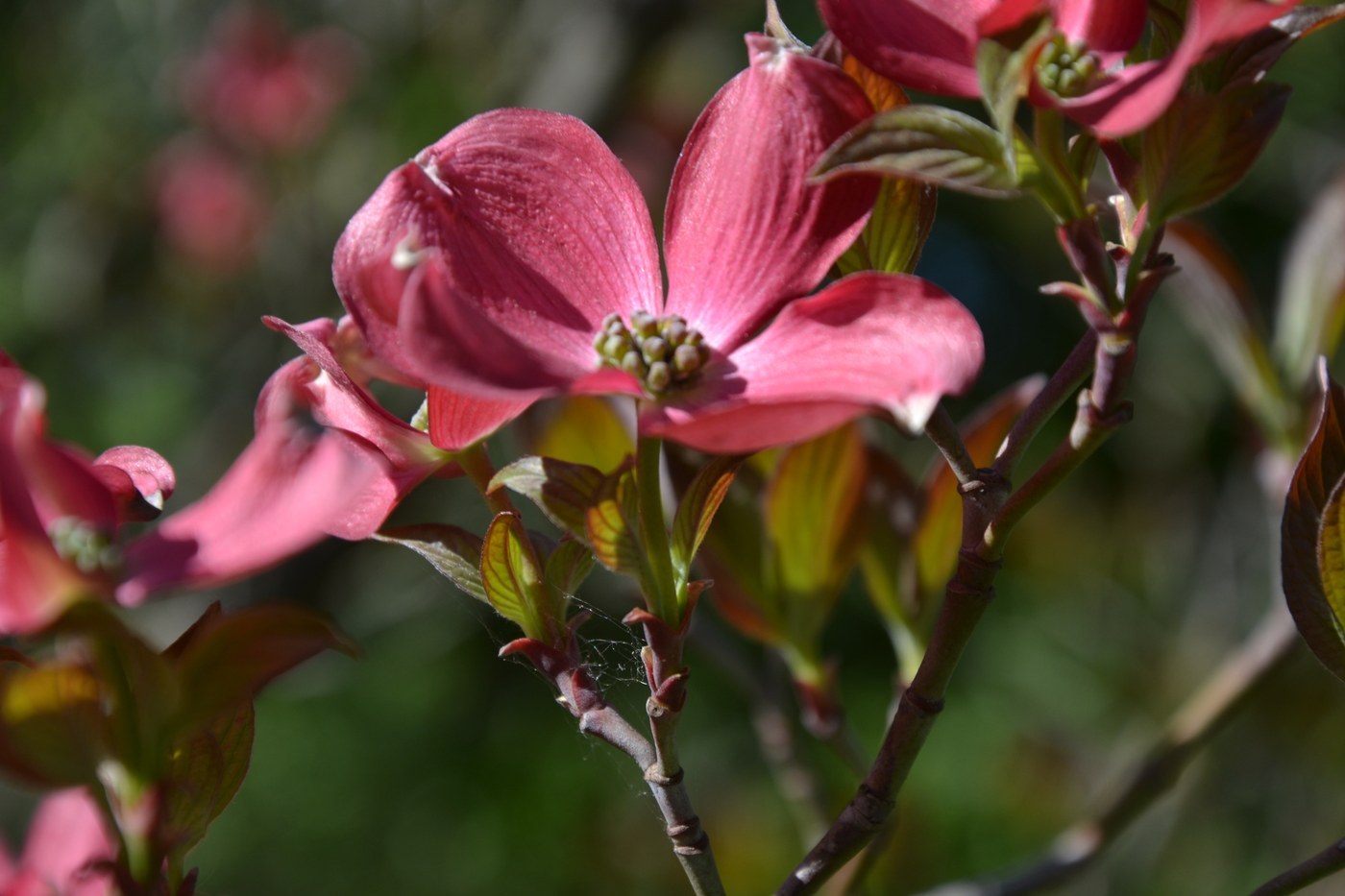
Key Identifying Features
Flowering dogwood (Cornus florida) is a small understory tree famous for its spring display of large white (or pink) four-'petaled' blooms - actually showy bracts surrounding a tiny central flower cluster. With its layered horizontal branches and oval leaves with distinctive curving veins, it is one of the easier ornamental trees to identify.
- Small tree, 15-30 ft (5-9 m) tall, with a flat-topped, layered crown
- Showy 4-bract 'flowers' in spring
- Bark broken into small blocky 'alligator' plates
Leaves & Stems
Leaves are opposite, oval, 3-5 in long, with smooth or slightly wavy margins and a pointed tip. The most reliable leaf clue is the arcuate venation: the lateral veins curve forward and run parallel to the leaf margin toward the tip. Gently tear a leaf and the veins stretch fine, stringy latex threads - a dogwood family trait. Leaves are dark green above, paler below, turning rich red to purple in fall. Twigs are slender; flower buds are distinctive onion- or turban-shaped at branch tips.
Flowers & Fruit
In spring before or as leaves expand, each 'flower' is really four large, rounded, notched bracts (each with a brown-stained notch at the tip) about 1.5-2 in across, white or pink, surrounding a small central cluster of tiny true greenish-yellow flowers. In fall, these mature into tight clusters of glossy, bright red, oval berries (drupes), each about 1/2 in long, often in groups of several - a key autumn identifier and a favorite of birds.
How to Tell It Apart from Look-Alikes
- Kousa dogwood (Cornus kousa): Has pointed (not notched) bracts, blooms later with the leaves, and bears a single round raspberry-like red fruit.
- Redbud (Cercis): Has heart-shaped alternate leaves and pea-like flowers, no bracts.
- Other Cornus shrubs: Have flat clusters of small white flowers, not four big bracts.
- The decisive cues: four notched bracts, opposite oval leaves with arcing veins, onion-shaped buds, and clustered red drupes.
Where You'll Find It
Flowering dogwood is a native understory tree of eastern North American woodlands, thriving at forest edges and in the dappled shade of larger trees in moist, well-drained, acidic soils. It is also one of the most popular ornamental landscape trees in lawns and gardens.
Quick ID Checklist
- Spring 'flowers' of 4 large notched white/pink bracts
- Opposite, oval leaves with veins that curve parallel to the margin
- Torn leaves show stringy latex threads
- Onion-shaped flower buds at twig tips
- Clusters of glossy red berries in fall
- Small layered tree of woodland edges; blocky 'alligator' bark
Frequently asked questions
Are the white parts of a dogwood flower really petals?
No. The four large white or pink 'petals' are actually modified leaves called bracts; the true flowers are the tiny greenish-yellow cluster in the center.
How can I confirm flowering dogwood from the leaves alone?
Look for opposite oval leaves whose side veins curve forward and run parallel to the leaf margin, and gently tear one - dogwood leaves stretch fine, stringy latex threads.
How is flowering dogwood different from kousa dogwood?
Flowering dogwood has four notched bracts and clusters of separate red berries, while kousa dogwood has pointed bracts, blooms later, and produces a single round raspberry-like fruit.
What do flowering dogwood fruits look like?
Tight clusters of glossy, bright red, oval berries (drupes) about half an inch long, ripening in fall and eaten by birds.