
Forsythia Identification Guide
Identify Forsythia by its arching canes covered in bright yellow four-petaled flowers in very early spring, blooming before the leaves emerge.
Read the full Forsythia encyclopedia entry →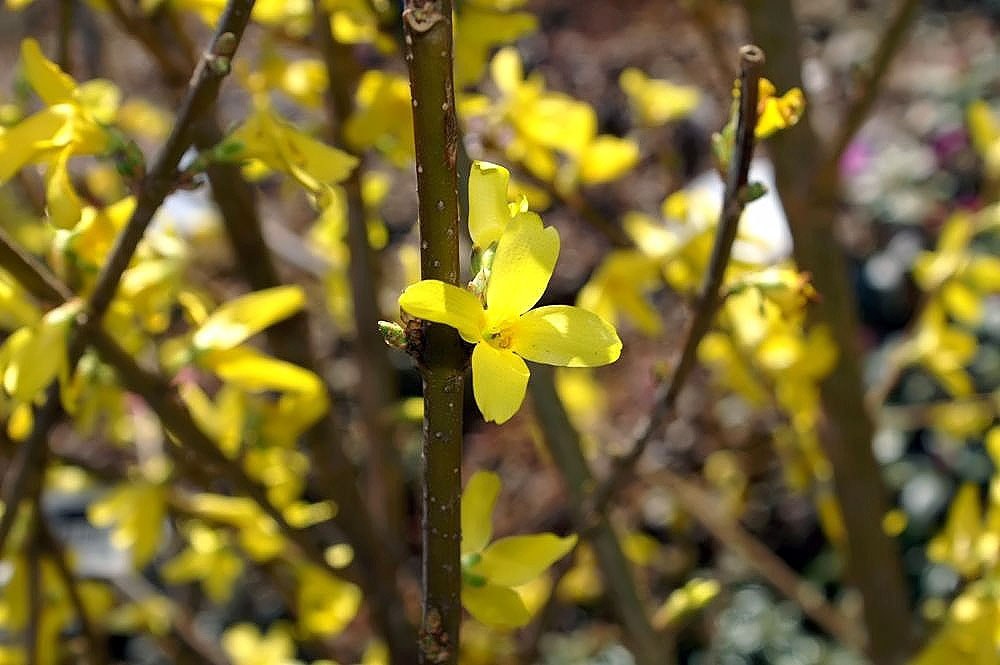
Key Identifying Features
Forsythia (genus Forsythia) is one of the earliest and brightest spring-flowering shrubs, instantly recognized by masses of yellow flowers on bare arching stems before the leaves appear. It forms a large, fountain-shaped, deciduous shrub.
- Bright yellow, four-petaled flowers lining the stems
- Blooms very early spring, before leaves emerge
- Long, arching to cascading canes
- Opposite, simple, toothed leaves appearing after bloom
Leaves & Stems
Stems are slender, arching, and often tip-rooting where they touch the ground, forming dense thickets. Young stems are green to tan, with chambered or hollow pith (visible if you snap a twig — a useful clue). Leaves are opposite, simple, 2–5 inches, oval to lance-shaped, with toothed margins mostly toward the tip; some are occasionally three-lobed. They are medium green, emerging after the flowers fade, and turn yellowish to purplish in fall.
Flowers & Fruit
The flowers are the defining feature: bright golden-yellow, with four narrow petals fused at the base into a short tube, borne in clusters along the previous year's bare stems in early spring. The whole shrub can look like a yellow fountain. Fruit is an inconspicuous brown woody capsule; many cultivars set little fruit. There is no fragrance to speak of.
How to Tell It Apart from Look-Alikes
- Winter jasmine (Jasminum nudiflorum) also has early yellow flowers on green stems but has six petals and blooms in winter; forsythia has four petals.
- Cornelian cherry dogwood (Cornus mas) blooms yellow early too but has tiny clustered flowers and alternate leaves, not large four-petaled blooms.
- Spicebush flowers are smaller and on a more upright shrub.
- The combination of bright 4-petaled yellow flowers on bare arching opposite-budded canes in earliest spring confirms Forsythia.
Where You'll Find It
Forsythia is a hugely popular ornamental shrub in temperate gardens worldwide, used in borders, hedges, and mass plantings, and grown for early cut branches that force indoors. Most cultivated forms derive from East Asian species; it tolerates a wide range of soils in full sun to part shade.
Quick ID Checklist
- Bright yellow 4-petaled flowers on bare stems
- Blooms in earliest spring, before leaves
- Arching, fountain-like canes; tip-rooting
- Opposite toothed leaves after flowering
- Twigs with chambered/hollow pith
Frequently asked questions
What is the easiest way to identify forsythia?
A fountain-shaped shrub covered in bright yellow, four-petaled flowers on leafless arching stems in very early spring is almost certainly forsythia.
How do I tell forsythia from winter jasmine?
Count the petals: forsythia flowers have four petals and bloom in early spring, while winter jasmine has six petals and blooms in mid-winter.
Do the flowers come before or after the leaves?
Before. Forsythia blooms on bare stems in early spring, and the opposite, toothed leaves emerge only after the flowers have faded.
Can I confirm forsythia by its stems?
Yes — snapping a young twig often reveals a chambered or hollow pith, and the arching canes frequently root where their tips touch soil, both helpful supporting clues.