
Franklin Tree Identification Guide
Identify Franklinia alatamaha, the extinct-in-the-wild Franklin tree, by its fragrant white camellia-like late-summer flowers, glossy oblong leaves, and fiery red fall color.
Read the full Franklin Tree encyclopedia entry →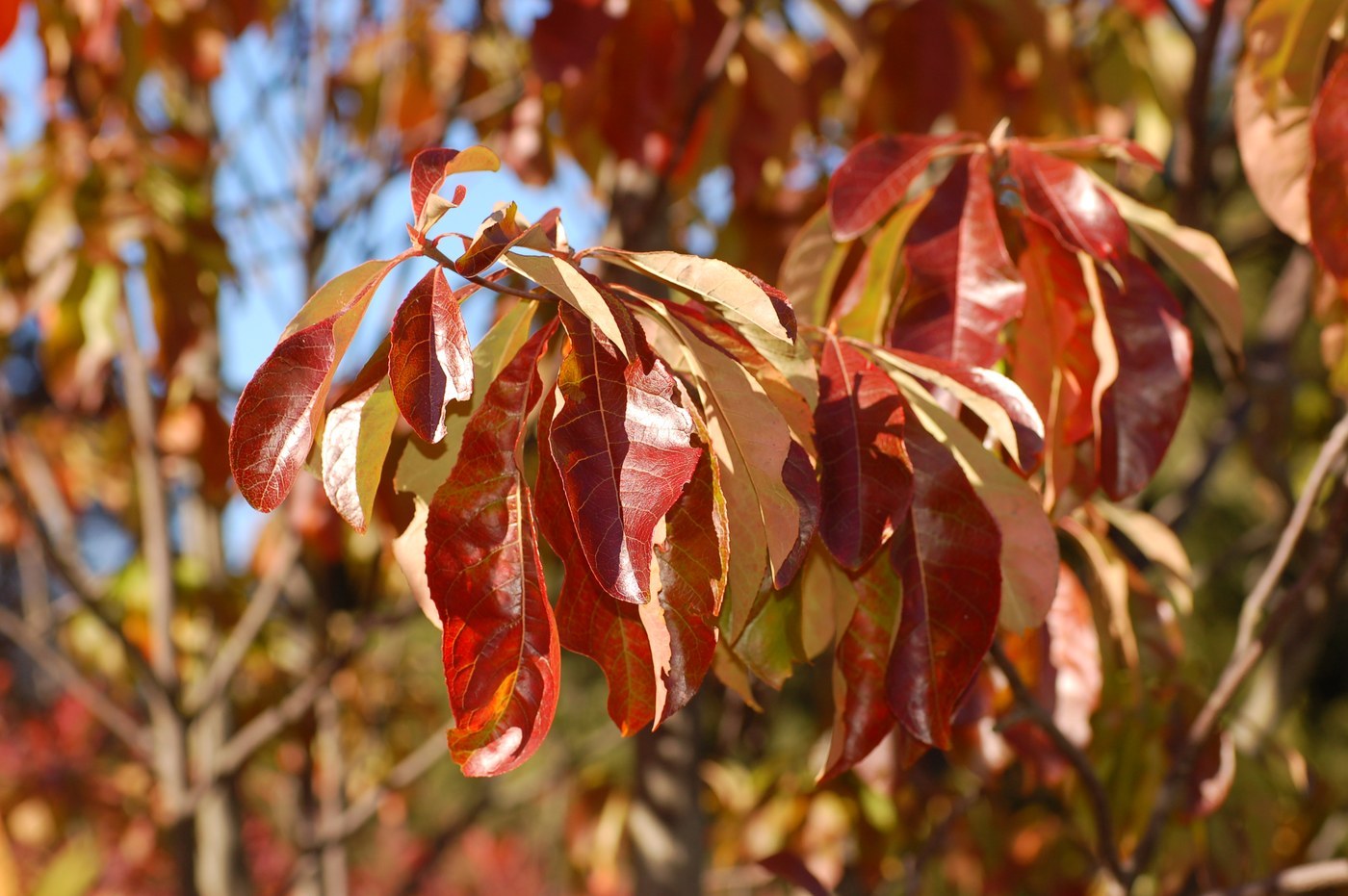
Key Identifying Features
The Franklin tree (Franklinia alatamaha) is a rare member of the tea/camellia family, extinct in the wild and surviving only in cultivation. Identify it by:
- Large, fragrant, white camellia-like flowers with a boss of golden-orange stamens, blooming unusually late, from late summer into fall
- Glossy, oblong, dark green leaves that turn brilliant red, orange, and purple in autumn
- A small, upright, often multi-stemmed tree or large shrub, 10-20 ft
- The striking habit of flowering and showing fall color at the same time
Leaves & Stems
Leaves are alternate, simple, oblong to obovate, 4-6 inches long, with shallowly toothed margins toward the tip, a glossy dark green upper surface, and a tapering base. The foliage is clustered toward the branch ends. In fall it becomes a vivid blaze of crimson, scarlet, orange, and burgundy, frequently while the last white flowers are still open — a memorable diagnostic.
Stems are slender; the bark is gray-brown with subtle vertical fissures and lighter striations. The plant often grows multi-stemmed, with an upright, somewhat open and rounded crown.
Flowers & Fruit
Flowers are the prize: 3 inches wide, with five rounded, slightly cupped pure-white petals surrounding a dense central tuft of bright golden-yellow stamens, and a sweet, honeysuckle-like fragrance. They resemble a single white camellia or a large Stewartia bloom. Unusually, they open from August into October, opening a few at a time over weeks.
The fruit is a distinctive woody, round, five-parted capsule that splits along both top and bottom, persisting on the tree.
How to Tell It Apart from Look-Alikes
- Stewartia (S. pseudocamellia): very similar white camellia-like flowers but blooms in early/mid summer, has flaky mottled bark, and its capsule differs. Franklinia blooms later and lacks the dramatic mottled bark.
- Camellia: evergreen, glossy leaves year-round; Franklinia is deciduous with brilliant fall color.
- Loblolly bay (Gordonia): a close relative with similar flowers but evergreen leaves and a southern wetland range.
The late-summer-into-fall white camellia flowers + simultaneous fiery fall color + deciduous toothed glossy leaves identify Franklinia.
Where You'll Find It
Originally found only along the Altamaha River in Georgia and last seen in the wild around 1803, every Franklin tree alive today descends from seed collected by the Bartrams in the 18th century. It exists solely as a planted specimen in arboreta, botanical gardens, and collectors' yards in USDA zones 5-8. It demands moist, acidic, well-drained soil and is famously finicky. Seeing one is always seeing a deliberately cultivated, conservation-significant plant.
Quick ID Checklist
- Small upright, often multi-stemmed deciduous tree, 10-20 ft
- White five-petaled camellia-like flowers with orange-gold stamen center
- Blooms late summer into fall, often alongside fall color
- Glossy oblong toothed leaves turning red/orange/purple
- Round woody five-parted seed capsules
- Found only in cultivation (extinct in the wild)
A finicky small tree opening fragrant white camellia flowers in autumn while its glossy leaves turn fiery red is the Franklin tree.
Frequently asked questions
Why is the Franklin tree considered extinct in the wild?
It was found only along Georgia's Altamaha River and last documented there around 1803. All living specimens descend from seed the Bartram family collected in the 1700s, so the species survives only in cultivation.
How do I tell Franklinia from Stewartia?
Both have white camellia-like flowers, but Franklinia blooms later, from late summer into fall, often while its leaves are coloring, and lacks Stewartia's flaky, mottled bark. Stewartia blooms in early summer.
When does the Franklin tree bloom?
Unusually late, from about August into October, opening a few flowers at a time. This overlap of fragrant white blooms with the tree's brilliant red and orange fall foliage is one of its most distinctive traits.
Is the Franklin tree related to the camellia?
Yes. It belongs to the tea family (Theaceae), alongside camellias, stewartias, and gordonias, which is why its flowers look so much like a single white camellia bloom.