
Fraser Fir Identification Guide
Identify Fraser fir by its flat silvery-backed needles, resin-blistered bark, and upright cones with protruding bent-back bracts. Covers needles, cones, look-alikes, and high-mountain habitat.
Read the full Fraser Fir encyclopedia entry →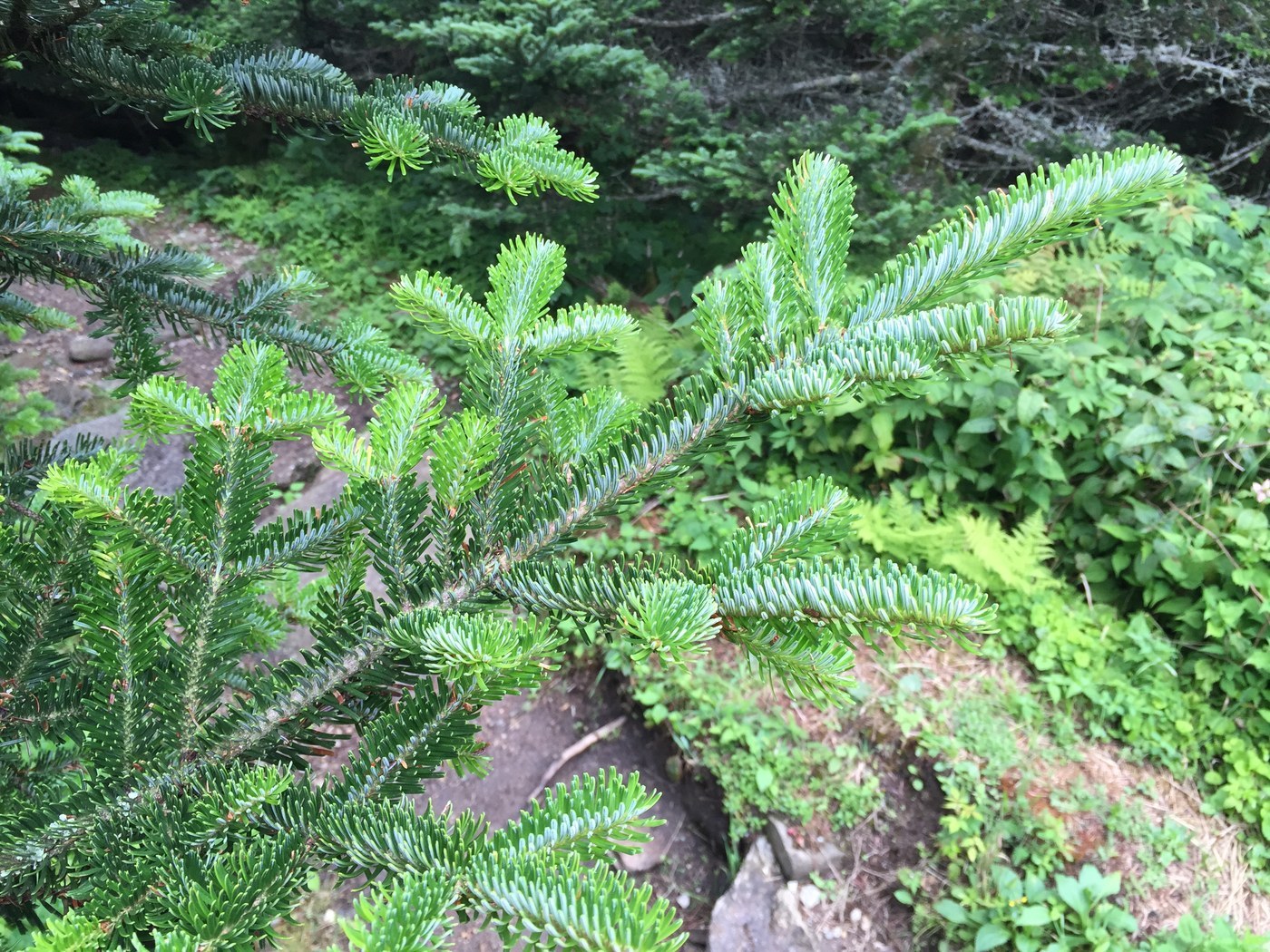
Key Identifying Features
Fraser fir (Abies fraseri) is a true fir endemic to the high peaks of the southern Appalachians, where it forms fragrant, spire-topped 'fir-spruce' forests. It is America's most popular Christmas tree, valued for soft needles that hold well. Identify it by flat, silvery-backed needles, resin-blistered gray bark, and upright cones whose papery bracts stick out and curve back.
Needles & Twigs
- Needles are flat, soft, and blunt or slightly notched at the tip, about a half to one inch long.
- They are dark green and glossy above with two bright silvery-white bands underneath, giving the crown a frosted look.
- Needles attach by a flat, disc-like base and pull off leaving a smooth round scar (the universal true-fir trait).
- They tend to curve upward, exposing the silvery undersides.
- Crushing releases a clean, resinous fir fragrance.
Bark & Cones
- Young bark is smooth, gray-brown, with raised resin blisters; older bark becomes scaly and reddish.
- Seed cones are upright, cylindrical, 1.5-2.5 inches long, dark purple when young.
- The diagnostic feature: each cone scale is backed by a protruding, yellowish-green papery bract that bends sharply downward (reflexed) over the scale, giving the cone a shingled, frilly look. Cones disintegrate on the tree.
How to Tell It Apart from Look-Alikes
- Balsam fir (Abies balsamea), its closest relative, has cone bracts that are short and mostly hidden inside the cone; Fraser fir bracts stick out and reflex. Their ranges barely overlap.
- Red spruce (Picea rubens), which grows alongside it, has sharp, four-sided needles on woody pegs and hanging cones — Fraser fir needles are flat and soft with upright cones.
- Hemlock has much smaller flat needles and small drooping cones.
Where You'll Find It
Fraser fir is restricted to cool, moist, high-elevation summits above about 5,500 feet in the southern Appalachians of North Carolina, Tennessee, and Virginia, including the Great Smokies and Mount Mitchell. Below those peaks it is grown extensively on Christmas tree farms in the same region.
Quick ID Checklist
- Flat soft needles with two bright silvery bands beneath, curving upward
- Needle bases leave smooth round scars (true fir)
- Smooth gray bark with resin blisters
- Upright cones with protruding, bent-back papery bracts
- High southern Appalachian summits or a tree farm
Flat silvery needles plus upright cones with reflexed bracts on a southern mountaintop confirm Fraser fir.
Frequently asked questions
How do I distinguish Fraser fir from balsam fir?
Look at the cone bracts: Fraser fir's bracts protrude and bend back over the scales, while balsam fir's are short and hidden inside; their natural ranges also barely overlap.
Where does Fraser fir grow naturally?
Only on cool, moist high-elevation summits above roughly 5,500 feet in the southern Appalachians of North Carolina, Tennessee, and Virginia.
Why is Fraser fir such a popular Christmas tree?
Its soft, fragrant, silvery-backed needles have excellent retention and its naturally narrow conical form needs little shaping, so it ships and lasts well.
How can I tell Fraser fir from the red spruce it grows with?
Fraser fir needles are flat, soft, and blunt with silvery undersides and leave smooth round scars, while red spruce needles are sharp, four-sided, and sit on woody pegs.